WA had the highest rates of Indigenous child removal in the country. At last, the state is finally facing up to it
- Written by: Jenna Woods, Dean, School of Indigenous Knowledges, Murdoch University
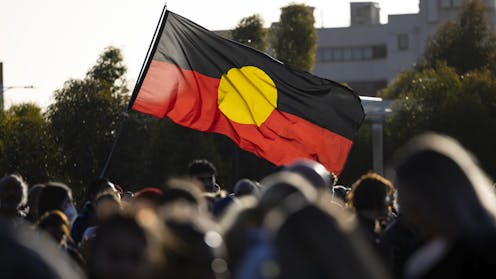
First Nations people please be advised this article speaks of racially discriminating moments in history, including the distress and death of First Nations people.
In 1997, Australia was confronted with the landmark Bringing Them Home report[1]. It chronicled the country’s long, dark history of the forced removal of First Nations children.
The report also made recommendations on what to do next. Compensation was key among them. Every state and territory heeded that call in the years that followed, except Western Australia.
In the decades since, many have called for the recognition of, and compensation for, First Nations people in WA forcibly removed from their families, culture and Country. In May, Premier Roger Cook answered that call, announcing a redress scheme[2] for living survivors of the Stolen Generations.
But the Stolen Generations aren’t just historical; they’re ongoing. Many still feel the reverberations of decades of trauma. WA will finally seek to redress some of it.
Generations forced apart
WA had the highest rates of forcible removal of Aboriginal children in this country. Today, more than 50%[3] of Aboriginal people in WA are either Stolen Generations survivors or their direct descendants.
Historian Margaret Jacobs wrote[4] that through the 1905 Aborigines Protection Act, “Indigeneity itself became inextricably associated with neglect”.
Aboriginal families, due solely to their Aboriginality, were regarded as inferior and their children were removed en masse to missions[5] where traditional cultural practices were prohibited. Stolen Generations child removals continued until the 1970s.
In the missions where Aboriginal children were placed after removal, psychological, physical and sexual abuse was widespread[6]. The children, often removed as infants, were institutionalised and raised by religious missionaries.
Speaking in traditional languages or engaging in cultural practices were prohibited, with the goal being to strip them of their Aboriginality so they could be fully assimilated into Western society. To minimise barriers to this, parents and families were prohibited from communicating or visiting their children.
The human consequences of these inhumane practices have been monumental.
The financial impact
Attachment theory[7] attests to the importance of early childhood experiences of love, care and safety on an individual’s future life outcomes. The theory suggests infants develop one of four main attachment styles in response to the care they receive from their parents or other carers during infancy.
The significance of this in the context of generations of children being forcibly removed from their caregivers cannot be understated.
In addition, the majority of Stolen Generations children survived various forms of abuse within these institutions and live with the resulting trauma of that.
Under the 1905 act, any property or personal items owned by Aboriginal people could be confiscated[8] at any time and money owing to Aboriginal peoples, including wages, was to be paid to the Chief Protector of Aborigines.
This prevented Aboriginal families from securing financial stability and establishing intergenerational wealth, despite their significant labour contributions to WA’s economic development.
A good indicator of intergenerational wealth consolidation can be found in rates of home ownership.
Currently, 45.8%[9] of Aboriginal people in the greater Perth area own their home, compared with 70.4%[10] of their non-Aboriginal counterparts.
Of those, 10.8% of Aboriginal households own their home outright, compared with 28.5% for non-Aboriginal owners.
This makes redress not just a symbolic move, but a deeply practical one too.
Compounding disadvantage
Overall, these circumstances have created a “gap within the Gap”.
This refers to the first gap, being that Aboriginal people have poorer life outcomes than their non-Aboriginal counterparts.
The gap within that gap is that Stolen Generations survivors and their descendants have poorer life outcomes than the general Aboriginal population.
Stolen Generations peoples and their descendants are more likely[11] to have mental health disorders, to experience family violence, homelessness or criminal justice involvement, and to have an addiction, including substances and gambling, while also being less likely to have a support network.
This state scheme[12] will make individual payments to living survivors of the Stolen Generations who were forcibly removed before July 1 1972.
It will deliver a one-off payment of $85,000 to survivors in recognition of the trauma and pain they suffered through their removal.
Registrations[13] for Stolen Generations members who are eligible for this scheme will open in the latter half of 2025 and payments will commence by the end of the year.
It won’t fix everything, but it’s a welcome sign of progress.
13YARN is a free and confidential 24/7 national crisis support line for Aboriginal and Torres Strait Islander people who are feeling overwhelmed or having difficulty coping. Call 13 92 76.
References
- ^ Bringing Them Home report (bth.humanrights.gov.au)
- ^ redress scheme (www.wa.gov.au)
- ^ more than 50% (www.aihw.gov.au)
- ^ wrote (catalogue.nla.gov.au)
- ^ to missions (humanrights.gov.au)
- ^ widespread (humanrights.gov.au)
- ^ Attachment theory (theconversation.com)
- ^ could be confiscated (www.legislation.wa.gov.au)
- ^ 45.8% (abs.gov.au)
- ^ 70.4% (www.abs.gov.au)
- ^ more likely (www.indigenousmhspc.gov.au)
- ^ state scheme (www.wa.gov.au)
- ^ Registrations (www.wa.gov.au)
Authors: Jenna Woods, Dean, School of Indigenous Knowledges, Murdoch University