NZ is prepared to take ‘further action’ over the Gaza crisis – here are 5 options
- Written by: Treasa Dunworth, Professor of Law, University of Auckland, Waipapa Taumata Rau
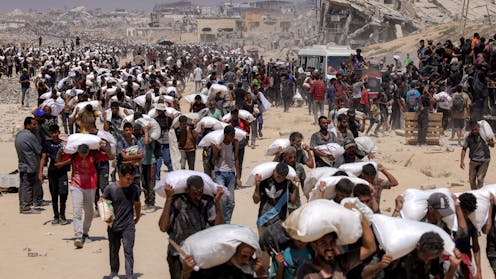
Is the tide turning over the crisis in Gaza? International pressure and condemnation of Israel’s actions has been increasing[1], with news and images of malnourished and starving Palestinians now hard to avoid.
This week, US President Donald Trump has acknowledged[2] there is “real starvation” happening, and instructed Israel to allow “every ounce of food” into Gaza.
And last week, the foreign ministers of 28 states – including New Zealand – issued a strongly worded Joint Statement on Humanitarian Situation in Gaza and the Occupied Palestinian Territories[3], calling for an “immediate, unconditional and permanent ceasefire” and condemning Israel’s denial of essential humanitarian assistance.
The statement marked an important shift in the international community’s response. Countries in the Global South have been challenging Israel’s actions since the start of the conflict, notably South Africa’s genocide case[4] before the International Court of Justice.
But this is the first time a grouping of western and other liberal democracies has issued such a strongly worded condemnation of Israel’s actions. (France, another signatory, has also now said it will recognise a Palestinian state[5] at the United Nations.)
Most importantly, the signatories conclude the statement by saying they “are prepared to take further action to support an immediate ceasefire and a political pathway to security and peace for Israelis, Palestinians and the entire region”.
5 options for further action
So far, however, Israeli prime minister Benjamin Netanyahu has shown little interest in halting[6] his devastating military campaign. If the situation continues to worsen, the question becomes: what would “further action” look like for New Zealand? Five options stand out.
1. Stop trade with Israel
Despite the joint declaration’s strong language, every signatory continues to trade[7] with Israel. Companies profiting from activities in the occupied Palestinian territories have been specifically criticised[8] by the United Nations Special Rapporteur.
The requisite legislation could be put in place by parliament agreeing to support Greens co-leader Chlöe Swarbrick’s private members bill[9] to “sanction unlawful occupation of Palestine”. That bill draws on the existing Russia Sanctions Act[10] passed in 2022 over the Ukraine war.
2. Change immigration rules
New Zealand has already created a special visa[11] category for Ukrainians and their families. The same could be done for Palestinians on the basis of family reunification.
3. Order an intelligence inquiry
The Inspector-General of Intelligence and Security can exercise his powers under the Intelligence and Security Act 2017 to open an inquiry into direct or indirect intelligence sharing with Israel, specifically through the Five Eyes network.
Four of the five members of Five Eyes are signatories to the joint statement, but there is currently no way of knowing whether New Zealand’s contribution is aiding Israel’s military actions. Last year, a group of lawyers (of which I was one) called for such an inquiry[12] to shed light on the situation, but the request was denied.
4. Withdraw from Operation Prosperity Guardian
The government could withdraw from the US-led multinational coalition[13] formed to counter Houthi attacks on maritime transport in the Red Sea.
While the Yemeni rebel attacks on commercial shipping are illegal, they are also linked to the continuing international failure[14] to stop the Gaza conflict. In this broader context, membership of the coalition can be seen as implicit support of Israel’s actions.
5. Refer Netanyahu to the International Criminal Court
Using starvation as a method of warfare is recognised as a war crime. Referring the Israeli prime minister to the International Criminal Court for prosecution would almost certainly attract the wrath of Israel and the US, which imposed sanctions on the court[15] earlier this year.
However, all signatories to the joint statement are members of the court, so a collective referral may provide some diplomatic cover. But there is no legal reason why New Zealand cannot refer the case on its own.
A rules-based order
All of these five possible actions are within New Zealand’s sovereign rights to undertake, and fit within the country’s support for a rules-based international order.
The common belief that New Zealand is too small and relatively powerless to influence global events such as the disaster in Gaza is arguably self-fulfilling and an excuse for inaction.
But New Zealand’s nuclear-free policy[16] stands as an example of how small nations can create change, with the political will to do so.
Signing the joint statement on Gaza and the Occupied Palestinian Territories opened the door to “further action”. If and when such action is triggered, New Zealand’s options are not insignificant.
References
- ^ has been increasing (www.aljazeera.com)
- ^ Donald Trump has acknowledged (www.theguardian.com)
- ^ Joint Statement on Humanitarian Situation in Gaza and the Occupied Palestinian Territories (www.mfat.govt.nz)
- ^ South Africa’s genocide case (www.icj-cij.org)
- ^ recognise a Palestinian state (www.reuters.com)
- ^ little interest in halting (www.nytimes.com)
- ^ every signatory continues to trade (www.aljazeera.com)
- ^ specifically criticised (www.un.org)
- ^ Chlöe Swarbrick’s private members bill (www.greens.org.nz)
- ^ Russia Sanctions Act (www.legislation.govt.nz)
- ^ special visa (www.immigration.govt.nz)
- ^ called for such an inquiry (www.rnz.co.nz)
- ^ US-led multinational coalition (www.defense.gov)
- ^ linked to the continuing international failure (www.crisisgroup.org)
- ^ imposed sanctions on the court (www.whitehouse.gov)
- ^ New Zealand’s nuclear-free policy (www.mfat.govt.nz)
Authors: Treasa Dunworth, Professor of Law, University of Auckland, Waipapa Taumata Rau