how the Hobson’s Pledge campaign relies on a ‘historical fiction’
- Written by: Richard Shaw, Professor of Politics, Te Kunenga ki Pūrehuroa – Massey University
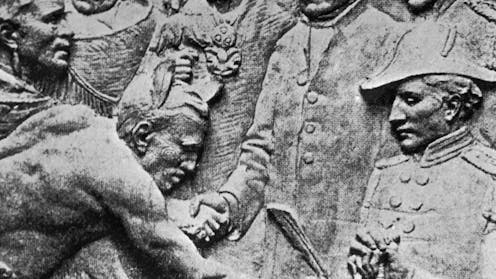
The phrase “We are now one people” has resurfaced lately, largely due to a campaign by the Hobson’s Pledge[1] lobby group against the retention of Māori wards at referendums being held as part of the upcoming local body elections.
Māori wards and constituencies[2] are the local authority equivalent of the Māori seats in Parliament, enabling a level of representation Māori have historically struggled to access[3]. Anyone – Māori or non-Māori – can stand for election in a Māori ward or constituency.
The campaign against these arrangements has been somewhat overshadowed by the misuse of a Māori woman’s photograph[4] on Hobson’s Pledge billboards next to the lines “My mana doesn’t need a mandate – vote no to Māori wards”.
But behind the immediate controversy lie deeper questions about the historical basis of claims made by Hobson’s Pledge and their justification for opposing city and district Māori wards.
At the core of those claims is the idea that the phrase “We are now one people” – more correctly, “He iwi tahi tātou” in te reo Māori, which is what Lieutenant-Governor William Hobson is held to have said at the signing of the Treaty of Waitangi in 1840 – has both moral and constitutional status.
Effectively, the inference is that Hobson’s words amount to a political requirement to treat everyone in the same manner, irrespective of ethnicity. The Hobson’s Pledge website frames this[5] as Hobson’s “promise […] that all New Zealanders would be one people”.
Colenso’s remembered history
Since the formation of Hobson’s Pledge in 2016[6], this interpretation has assumed canonical status among those determined to counter a perceived misinterpretation of te Tiriti o Waitangi/Treaty of Waitangi that enshrines Māori “privilege” and promotes “race-based” policies[7].
However, the only evidence Hobson uttered the phrase “He iwi tahi tātou” comes from Church Missionary Society printer William Colenso’s account, The Authentic and Genuine History of the Signing of the Treaty of Waitangi[8], published as part of the colony’s jubilee celebrations in 1890, 40 years after the events it recounts.

In his 39-page booklet, Colenso stresses that his recollections are based on notes written “down on the spot while fresh in memory”, and says the manuscript on which his history was based was read and commented on by fellow missionary William Wade and James Busby, the outgoing British Resident, in late February 1840.
But research comparing Colenso’s manuscript and his later history has concluded[9] his account “should be treated with a degree of informed caution”, partly because “none of the footnotes attributed to Busby by Colenso in his 1890 history appear in his 1840 manuscript”.
Colenso is clear Hobson spoke in te reo Māori, uttering the phrase “He iwi tahi tātou” each time he shook hands with one of the 45 rangatira (chiefs) who signed the Treaty at Waitangi. But his English translation – “We are [now] one people” – appears in parentheses to clearly indicate it has been added after the fact.
In their promotional material, Hobson’s Pledge routinely remove those parentheses, suggesting Hobson also uttered Colenso’s English translation.
No other existing record[10] corroborates Colenso’s claim about what Hobson said. This includes the one compiled at the request of parliament by William Baker, a translator for the Native Department, in July 1865 – 25 years before Colenso’s recollections of events were published.
Neither Hobson nor Colenso make any reference to a “pledge”. In fact, Colenso gives just one line to Hobson’s interactions with rangatira[11] at the signing, and spends far longer on the lieutenant-governor’s concerns about the behaviour of the Queen’s British subjects.
He recounts at some length Hobson’s explanation to rangatira that because “the law of England gives no civil powers to Her Majesty out of her dominions”, she “asks you to sign this treaty, and so give her that power which shall enable her to restrain them [her subjects]”.
‘We are peoples together’
Rather than being a pledge or promise, it’s much likelier Hobson was simply being polite when he said “He iwi tahi tātou”.
Significantly, too, there is no record of what the Māori rangatira at the time had to say about being “one people”. The same goes for the 500 or so other Māori, including 13 wāhine[12], who would subsequently sign te Tiriti o Waitangi in other parts of the country.
Colenso’s account lays bare the concern among, and division between, rangatira about signing the Treaty. But their views on Hobson’s te reo Māori phrase have not survived. Perhaps they simply assumed “we” were all Māori, which would have made sense given the estimated Māori population[13] at the time was some 80,000, compared to around 2,000 Pākehā[14].
It is curious that one particular line – “He iwi tahi tātou” – has been picked from Colenso’s translation, when other lines have not – including his recollection that “Mr. Busby addressed the Natives to the effect that the Governor was not come to take away their land, but to secure them in the possession of what they had not sold”.
None of this is Colenso’s fault, of course. And Hobson’s Pledge is entitled to promote its broader political aims. But to assert Hobson made a “pledge” at Waitangi is a historical fiction, based on a Pākehā missionary’s translation of words spoken in te reo Māori that can’t be independently verified.
In fact, when translated by someone for whom Māori is their first language, “He iwi tahi tātou” might be better understood to mean[15] “We are peoples together”. Which is largely where contemporary debates about the Treaty’s meaning begin, not end.
References
- ^ Hobson’s Pledge (www.hobsonspledge.nz)
- ^ Māori wards and constituencies (www.votelocal.co.nz)
- ^ historically struggled to access (www.tandfonline.com)
- ^ misuse of a Māori woman’s photograph (www.1news.co.nz)
- ^ frames this (www.hobsonspledge.nz)
- ^ formation of Hobson’s Pledge in 2016 (www.rnz.co.nz)
- ^ Māori “privilege” and promotes “race-based” policies (e-tangata.co.nz)
- ^ The Authentic and Genuine History of the Signing of the Treaty of Waitangi (babel.hathitrust.org)
- ^ has concluded (mro.massey.ac.nz)
- ^ No other existing record (thespinoff.co.nz)
- ^ rangatira (maoridictionary.co.nz)
- ^ wāhine (maoridictionary.co.nz)
- ^ the estimated Māori population (teara.govt.nz)
- ^ Pākehā (maoridictionary.co.nz)
- ^ better understood to mean (e-tangata.co.nz)
Authors: Richard Shaw, Professor of Politics, Te Kunenga ki Pūrehuroa – Massey University