NZ is trailing its allies over Palestinian statehood – but there’s still time to show leadership
- Written by: Treasa Dunworth, Professor of Law, University of Auckland, Waipapa Taumata Rau
It’s now a week since Prime Minister Christopher Luxon announced his government had begun to formally consider New Zealand’s position[1] on the recognition of a Palestinian state.
That leaves three weeks until the United Nations General Assembly convenes on September 9, where it is expected several key allies will change position and recognise Palestinian statehood.
Already in a minority of UN member states which don’t recognise a Palestinian state, New Zealand risks becoming more of an outlier if and when Australia, Canada and the United Kingdom make good on their recent pledges.
Luxon has said the decision is “complex”, but opposition parties certainly don’t see it that way. Labour leader Chris Hipkins says it’s “the right thing to do”, and Greens co-leader Chloë Swarbrick has called on government MPs to “grow a spine” (for which she was controversially ejected from the debating chamber).
Former Labour prime minister Helen Clark has also criticised the government [2] for trailing behind its allies, and for appearing to put trade relations with the United States ahead of taking a moral stand over Israel’s actions in Gaza.
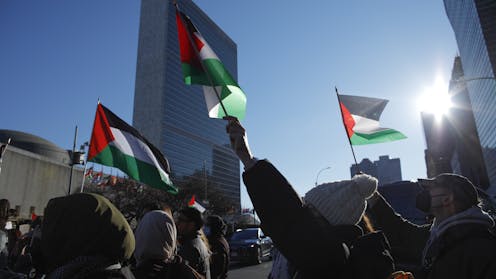
Certainly, those critics – including the many around the country who marched[3] during the weekend – are correct in implying New Zealand has missed several opportunities to show independent leadership on the issue.
The distraction factor
While it has been open to New Zealand to recognise it as a state since Palestine declared its independence in 1988[4], there was an opportunity available in May last year when the Irish, Spanish and Norwegian governments took the step.
That month, New Zealand also joined 142 other states calling on the Security Council to admit Palestine as a full member of the UN. But in a subsequent statement, New Zealand said its vote should not be implied as recognising Palestinian statehood, a position I called[5] “a kind of muddled, awkward fence-sitting”.
It is still not too late, however, for New Zealand to take a lead. In particular, the government could make a more straightforward statement on Palestinian statehood than its close allies.
The statements from Australia[6], Canada and the UK[7] are filled with caveats, conditions and contingencies. None are straightforward expressions of solidarity with the Palestinian right of self-determination under international law.
As such, they present political and legal problems New Zealand could avoid.
Politically, this late wave of recognition by other countries risks becoming a distraction from the immediate starvation crisis in Gaza. As the Israeli journalist Gideon Levy and UN Special Rapporteur Francesca Albanese[8] have noted, these considered and careful diplomatic responses distract from the brutal truth on the ground.
This was also Chloë Swarbrick’s point during the snap debate in parliament last week. Her private members bill[9], she noted, offers a more concrete alternative, by imposing sanctions and a trade embargo on Israel. (At present, it seems unlikely the government would support this.)
Beyond traditional allies
Legally, the proposed recognitions of statehood are far from ideal because they place conditions on that recognition, including how a Palestinian state should be governed.
The UK has made recognition conditional on Israel not agreeing to a ceasefire and continuing to block humanitarian aid into Gaza. That is extremely problematic[10], given recognition could presumably be withdrawn if Israel agreed to those demands.
Such statements are not exercises in genuine solidarity with Palestinian self-determination, which is defined in UN Resolution 1514[11] (1960) as the right of peoples “to freely determine their political status and freely pursue their economic, social and cultural development”.
Having taken more time to consider its position, New Zealand could now articulate a more genuine statement of recognition that fulfils the legal obligation to respect and promote self-determination under international law.
A starting point would be to look beyond the small group of “traditional allies” to countries such as Ireland that have already formally recognised[12] the State of Palestine. Importantly, Ireland acknowledged Palestinian “peaceful self-determination” (along with Israel’s), but did not express any other conditions or caveats.
New Zealand could also show leadership by joining with that wider group of allies to shape the coming General Assembly debate. The aim would be to shift the language from conditional recognition of Palestine toward a politically and legally more tenable position.
That would also sit comfortably with the country’s track record in other areas of international diplomacy – most notably the campaign to abolish nuclear weapons, where New Zealand has also taken a different approach to its traditional allies.
References
- ^ formally consider New Zealand’s position (www.nzherald.co.nz)
- ^ criticised the government (www.rnz.co.nz)
- ^ many around the country who marched (www.rnz.co.nz)
- ^ declared its independence in 1988 (www.un.org)
- ^ position I called (newsroom.co.nz)
- ^ Australia (www.theguardian.com)
- ^ Canada and the UK (theconversation.com)
- ^ UN Special Rapporteur Francesca Albanese (www.theguardian.com)
- ^ private members bill (bills.parliament.nz)
- ^ extremely problematic (theconversation.com)
- ^ UN Resolution 1514 (digitallibrary.un.org)
- ^ formally recognised (www.gov.ie)
Authors: Treasa Dunworth, Professor of Law, University of Auckland, Waipapa Taumata Rau