Bus seatbelts can save lives. How do we get more people to wear them?
- Written by: Milad Haghani, Associate Professor and Principal Fellow in Urban Risk and Resilience, The University of Melbourne
The recent Stonehaven school bus rollover[1] in Victoria, in which 12-year-old Milla Killeen was killed and many others were injured, reminds us that bus crashes, though uncommon, can have devastating consequences.
In 2023 alone, ten people were killed in the Hunter Valley wedding bus crash[2] in New South Wales. In a separate crash, 18 school children were hospitalised[3] after a truck collided with their bus near Melbourne.
When it comes to road safety, seatbelts are one of the most effective interventions[4] ever introduced. They have saved thousands of lives by reducing the severity of crashes for drivers and passengers. Compliance in cars in Australia is now nearly universal.
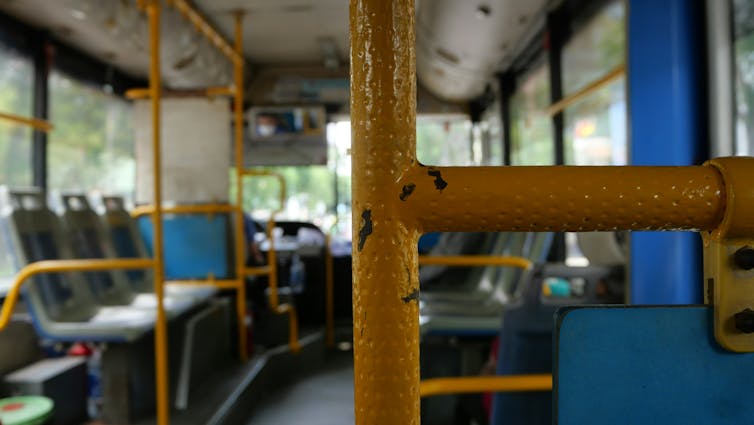
But this habit does not extend as strongly to buses, even when seatbelts are fitted. This is despite evidence showing[5] bus seatbelts are also highly effective.
So what are the laws around bus seatbelts in Australia? And how do we ensure people use them?
Bus versus car crashes
Buses account for a very small share of road fatalities in Australia[6].
Over the decade from 2014–2023, bus crashes made up approximately 1.6% of all fatal road crashes, averaging 17 fatal crashes per year, with only around four bus occupant deaths annually.
Bus occupants made up less than 1% of all fatalities or hospitalisations in road crashes.
Buses are generally safe because their size and mass offer greater protection in collisions. They are usually driven by professional and well-trained drivers, and many services operate on predictable, lower-risk routes.
However, when severe crashes do occur – such as rollovers or high-speed collisions – the consequences can be particularly serious.
Large numbers of passengers may be involved at once, many may not be restrained by seatbelts, and evacuation can be difficult, especially for children or older passengers.
Are bus seatbelts effective?
Seatbelts in cars are designed for smaller vehicles that decelerate and crash differently to large buses.
In cars, belts are critical because occupants are close to rigid structures[7] and are at high risk of being thrown forward, even in moderate collisions[8].
That is why wearing rates are near-universal and their effectiveness is beyond doubt[9].
Buses are heavier and sit higher off the ground. Most bus crashes are low-speed incidents where injuries are minor.
But in less common high-speed collisions and rollovers, the risks rise sharply.
In these situations, seatbelts on buses serve a similar function to those in cars. They reduce the chance of ejection, protect against secondary impacts inside the cabin and limit pileups of unrestrained passengers.
Crash simulation studies back this up. In one rollover test of a 13-metre coach[10], researchers compared unrestrained passengers with those using two-point and three-point belts.
Unbelted occupants faced a high risk of serious head and neck injury, while both belt types offered strong protection.
The study concluded that fitting at least two-point belts across all seats would markedly improve safety in rollover events.
The laws on bus seatbelts
National road rules say that if a bus has seatbelts, passengers must wear them[11].
Where states differ is in how far responsibility extends to the bus driver.
There are strict rules in New South Wales, where drivers are expected to instruct passengers to wear seatbelts. Bus companies can be fined if children are unrestrained.
Western Australia goes further by mandating lap-sash belts on all school buses.
In most other jurisdictions, the obligation rests almost entirely with passengers, and drivers are not expected to monitor or enforce use.
Tasmania is an outlier in still not requiring all school buses to be fitted with seatbelts.
From November 2026, new federal design rules[12] will require all new buses and coaches sold in Australia to be fitted with seatbelts and seatbelt reminder systems. Existing models built new must comply from November 2027.
Why don’t people wear them?
Seatbelts are only as effective as the extent to which passengers actually use them. The evidence is clear: installing belts on buses does not automatically translate into high compliance[13].
According to an older Australian trial[14], observed wearing rates can be as low as 14%, with averages closer to 45%.
This is largely backed up by international evidence[15] too.
Research has shown that, for young people, the perception of severity[16] is what motivates them to wear seatbelts. If they believe crashes can be serious, they are more likely to comply.
For adults, it is the perception of benefits that matters most: believing belts will actually help.
Across all groups, perceived barriers such as discomfort, inconvenience or fear of being trapped work against compliance.

Passengers are more likely to buckle up on long trips, but many remove the belt after a while to sleep or for comfort[19].
On short trips, the most common reason for not wearing one is the fear of not being able to get off in time.
Children raise particular challenges. While crash tests show bus seatbelts protect children in rollovers, concerns remain about whether younger children can always release the buckle in an emergency[20].
Studies suggest most can, but only just. Buckle-release forces are often near the limits of their strength.
This particularly highlights the need for child-friendly design standards to allow both restraint during impact as well as quick release during evacuation.
Operational and technical barriers also matter. Drivers cannot be expected to police dozens of passengers, particularly when their primary responsibility is safe driving.
How can we get people to strap in?
Trials show encouragement from teachers, parents or drivers has only limited effect[21] on people using bus seatbelts.
Instead, systematic measures are needed. These could include:
automated seatbelt reminders
clear signage and announcements
regular cleaning and maintenance of belts
and monitoring systems that alert operators when belts are not fastened.
The lesson from decades of research is clear: seatbelts can and do save lives, including on buses, but only if they are worn correctly.
Ensuring compliance remains the central challenge if new legal reforms are to translate into real safety gains.
References
- ^ Stonehaven school bus rollover (www.abc.net.au)
- ^ the Hunter Valley wedding bus crash (en.wikipedia.org)
- ^ 18 school children were hospitalised (www.bbc.com)
- ^ one of the most effective interventions (pmc.ncbi.nlm.nih.gov)
- ^ evidence showing (www-esv.nhtsa.dot.gov)
- ^ very small share of road fatalities in Australia (aueprod01ckanstg.blob.core.windows.net)
- ^ occupants are close to rigid structures (www.mdpi.com)
- ^ moderate collisions (wjes.biomedcentral.com)
- ^ their effectiveness is beyond doubt (onlinelibrary.wiley.com)
- ^ rollover test of a 13-metre coach (www-esv.nhtsa.dot.gov)
- ^ passengers must wear them (sgesco.com.au)
- ^ new federal design rules (www.infrastructure.gov.au)
- ^ does not automatically translate into high compliance (www.sciencedirect.com)
- ^ older Australian trial (www.academia.edu)
- ^ international evidence (www.sciencedirect.com)
- ^ the perception of severity (www.tandfonline.com)
- ^ Unsplash (unsplash.com)
- ^ CC BY (creativecommons.org)
- ^ to sleep or for comfort (www.sciencedirect.com)
- ^ release the buckle in an emergency (www.sciencedirect.com)
- ^ has only limited effect (www.academia.edu)
Authors: Milad Haghani, Associate Professor and Principal Fellow in Urban Risk and Resilience, The University of Melbourne