What is happening with the government’s contentious review of the Waitangi Tribunal?
- Written by Carwyn Jones, Honorary Adjunct Professor, Te Kawa a Māui - School of Māori Studies, Te Herenga Waka — Victoria University of Wellington
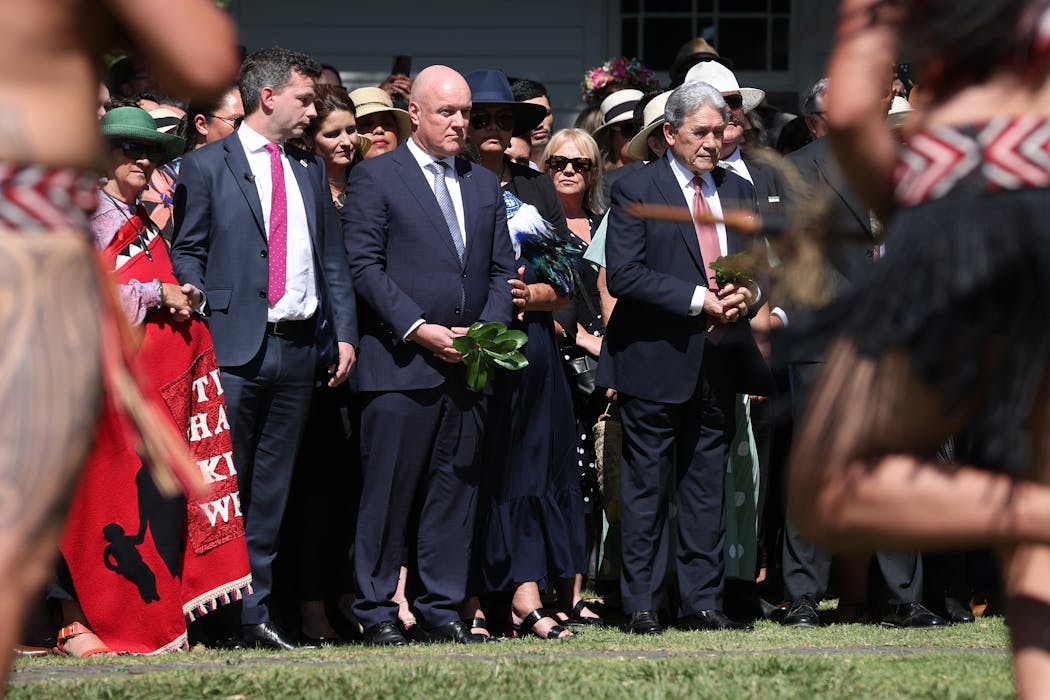
Resistance to the New Zealand government’s policies aimed at rolling back Māori rights and protections under te Tiriti o Waitangi/Treaty of Waitangi has now reached the United Nations.
The Committee on the Elimination of Racial Discrimination has now heard a complaint[1] made by Māori health advocate and lawyer Lady Tureiti Moxon.
Her complaint covers a range of legislative action the coalition government has taken since winning power in 2023, including the disestablishment of the Māori Health Authority, changes to Māori local body wards, and the removal of statutory obligations for Oranga Tamariki to work in partnership with Māori.
The complaint specifically raises concerns about the review of the Waitangi Tribunal’s governing legislation, the Treaty of Waitangi Act 1975[2], which was part of the coalition agreement[3] between the National Party and New Zealand First. The two parties committed to:
Amend the Waitangi Tribunal legislation to refocus the scope, purpose, and nature of its inquiries back to the original intent of that legislation.
A four-person Independent Technical Advisory Group was established in May this year to lead the review and report findings and recommendations to a group of ministers by September.
The government’s intention was to introduce legislative proposals before the end of the year[4], but neither the advisory group’s report nor any government decisions in response have been made public so far.
The role of the Waitangi Tribunal
Behind the review lie some questionable assumptions about the tribunal, including that it has overstepped its role as a forum for hearing historical Treaty claims by actively scrutinising contemporary government policy.
In May, ACT leader and Associate Justice Minister David Seymour released a statement[5] saying:
ACT supports the completion of full and final historic Treaty settlements as a pragmatic way to resolve past injustices, but the Waitangi Tribunal has gone well beyond its brief and has become increasingly activist.
It’s tried to become a source of authority in its own right and appears to regard itself as a parallel government that can intervene in the democratically elected Government’s policymaking process
Around the same time, New Zealand First MP and Minister for Resources Shane Jones was reported[6] as saying the tribunal
had become too litigious and intent on challenging the government’s right to implement its reform program, going well beyond the original remit envisaged when it was established 50 years ago.
In fact, the Waitangi Tribunal was not granted the jurisdiction to hear historical claims until 1985. The original intent of the 1975 Treaty of Waitangi Act was that the tribunal would specifically and exclusively assess contemporary law and policy[7] for consistency with the principles of the Treaty.
It was only ten years later, under the Labour government of David Lange, that the law was amended and the tribunal’s powers extended to cover historical grievances back to 1840, which paved the way for the introduction of the Treaty settlement process[8].
The Waitangi Tribunal and parliament
Public statements by current government ministers make it clear the review of the Treaty of Waitangi Act is about limiting the tribunal’s ability to inquire into contemporary government policy.
This is reflected in the advisory group’s terms of reference[9], which require the group to:
Assess whether the Tribunal’s investigatory powers […] remain appropriate and aligned with the principles of parliamentary privilege, separation of powers, and responsible government, particularly in relation to how these powers interact with the Crown’s policy-making functions.
That last clause raises a crucial question: does the tribunal’s scrutiny of contemporary policy inappropriately interfere with the policy-making functions of responsible government or the role of parliament?
We can find one answer in a Court of Appeal decision[10] last year. This touched on the relationship between the tribunal and parliament after the minister for children initially refused to comply with a request to provide evidence in a tribunal inquiry.
The court noted that it is not contrary to the constitutional principle of the separation of powers[11] for the tribunal to inquire into contemporary policy issues.
Unlike a court, the tribunal’s recommendations are not binding and so do not formally limit ministerial or parliamentary actions. At the same time, the participation of Māori Land Court judges in tribunal inquiries is important.
These judges bring highly relevant expertise, of course. But the fact they have security of tenure and constitutionally protected judicial independence is crucial to the tribunal fulfilling its purpose, and to holding the Crown to account for breaches of Māori rights.
Any moves to weaken that independence would fundamentally undermine the recognition of those rights – which is part of the reason Lady Tureiti Moxon’s complaint to the UN raises specific concerns about this review.
References
- ^ heard a complaint (www.rnz.co.nz)
- ^ Treaty of Waitangi Act 1975 (www.legislation.govt.nz)
- ^ coalition agreement (www.nzfirst.nz)
- ^ before the end of the year (www.beehive.govt.nz)
- ^ statement (www.scoop.co.nz)
- ^ was reported (lawnews.nz)
- ^ assess contemporary law and policy (www.waitangitribunal.govt.nz)
- ^ Treaty settlement process (teara.govt.nz)
- ^ terms of reference (share.google)
- ^ Court of Appeal decision (www.justice.govt.nz)
- ^ separation of powers (www.justice.govt.nz)
Authors: Carwyn Jones, Honorary Adjunct Professor, Te Kawa a Māui - School of Māori Studies, Te Herenga Waka — Victoria University of Wellington