Opposition to moving Australia Day from January 26 is hardening: new research
- Written by David Lowe, Chair in Contemporary History, Deakin University
Australians are deeply divided over whether January 26 is an appropriate day to celebrate Australia Day – and we are no longer debating it as much as doubling down in entrenched camps.
Over the past five years, we have tracked attitudes on whether Australia Day should continue to be celebrated on January 26 through the Deakin Contemporary History Survey.
The most striking result from our late 2025 wave is not a shift in overall opinion, but a hardening of opposition to changing the date. While the balance between those who support and those who oppose change has remained stable, fewer Australians are sitting in the middle. This means more are expressing strong disagreement with changing the date of Australia Day.
The statement “we should not celebrate Australia Day on 26 January” was included in the Deakin Contemporary History Survey in 2021, 2023, 2024 and late 2025.
Respondents were asked to indicate their level of agreement with this statement, from strongly agree to strongly disagree. The survey is a nationally representative online survey widely regarded as one of Australia’s most robust social surveys.
What did the survey find?
Across all four surveys, the overall distribution of opinion has remained strikingly stable. In 2021, around 38% of Australians agreed Australia Day should not be celebrated on January 26, while just over 60% disagreed. By late 2025, those figures are effectively unchanged, with 37% opposing the date and 62% supporting its retention.
However, while there was some softening in opposition in 2023 and 2024, the latest results suggest a return to the long-term average rather than a new shift in sentiment. In effect, the community is split 40/60 on the question of whether to change or retain.
What has changed is the strength of people’s feelings. Between 2021 and 2025, the proportion who strongly disagreed with changing the date increased markedly (from 30% to 38%), while the share who simply disagreed declined (from 31% to 26%). This is illustrated below.
In other words, many Australians who already supported keeping Australia Day on January 26 have moved from mild to strong opposition.
These changes are not because one age or gender group has shifted relative to others. Younger Australians remain more supportive of change than older Australians, and women remain more supportive than men.
What has changed is the strength of views within groups. Among 18-34 year olds, the proportion that strongly disagree with changing the date rose from 16% in 2021 to 23% in 2025.
A similar pattern is evident among older Australians: for those aged 55-74, strong disagreement increased from 40% to 47%, and among those aged 75 and over it rose from 47% to 53%. The same hardening is visible by gender, with strong disagreement among men rising from 36% in 2021 to 41% in 2025, and among women from 25% to 33%. The result is a broad hardening of attitudes across age and gender groups, rather than a change in who supports or opposes change.
What does this tell us?
These findings should be interpreted with appropriate caution. Although each survey wave uses large, weighted samples, some age and gender subgroups are smaller in the later waves, particularly in 2025.
Even so, the consistency of patterns across age and gender groups suggests this reflects a real shift in attitudes rather than chance fluctuation. On the supportive side, there is a modest shift from agree to strongly agree between 2021 and 2025, suggesting some consolidation of the pro-change view, though this change is modest and should be interpreted cautiously.
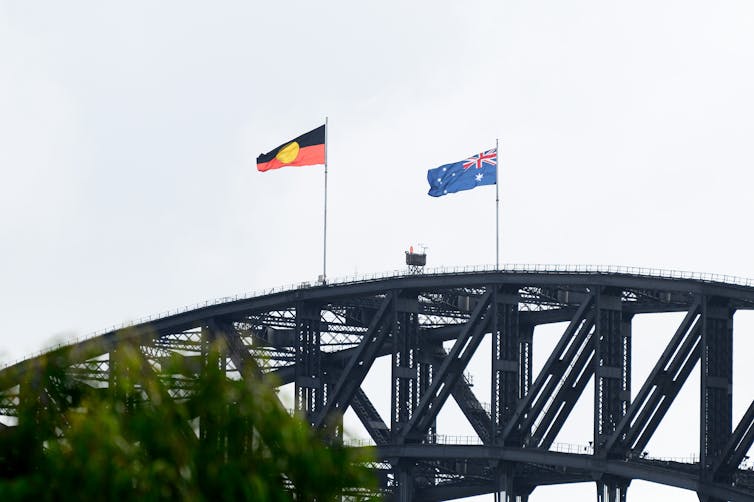
This hardening of conservative views is perhaps not surprising in the current context. The debate around Indigenous rights, including the failure of the Voice referendum in October 2023, shows that many Australians do not support official truth-telling and recognition processes.
This reluctance is also evident in our 2025 survey, where only 48% of respondents agreed it was appropriate to rename places and institutions to reflect Indigenous names and histories.
Following the referendum’s failure, most state and territory governments have largely abandoned the task of leading their constituencies through such processes. Studies[1] have shown a rise in explicit racism expressed towards Aboriginal and Torres Strait Islander people and communities during and since the referendum.
The rise in voting support[2] for One Nation, which mirrors the success of populist politicians in the United States and United Kingdom, provides further evidence of the rise of a more hardline, right-wing populism, which often celebrates rather than questions the history of European imperialism.
It will need strong leadership from politicians and civic and religious leaders if we are to find ways to bridge this deepening divide.
References
- ^ Studies (www.abc.net.au)
- ^ rise in voting support (theconversation.com)
Authors: David Lowe, Chair in Contemporary History, Deakin University