as humans return to the Moon, which of these 4 futures will we choose?
- Written by: Priyanka Dhopade, Senior Lecturer in Mechanical Engineering, University of Auckland, Waipapa Taumata Rau
The four Artemis II astronauts who looped around the Moon[1] this week are expected to splash down soon. NASA’s grand mission spells a return to human deep-space travel, with renewed interest in building a long-term Moon base[2].
The images captured by the crew[3] are spectacular, offering a view from the far side of the Moon with Earth hovering low on the horizon.
They are another reminder of technical achievement and human ambition. But in the background, decisions about what happens next and who benefits are already taking shape[4].
While there have always been legal tensions around ownership, access and control of space, in 2026 they no longer seem like abstract concepts.
The 1967 Outer Space Treaty[5] declares space “the province of all mankind”, barring countries from claiming ownership. Yet newer frameworks like the United States’ Artemis Accords[6] introduce concepts such as exclusive “safety zones” around lunar activities, which could include mining of water or helium-3[7].
Space law expert Cassandra Steer views this as an example of the US “trying to carve out a loophole[8]”. Legal scholar Michael Byers and space archaeologist Alice Gorman further note[9] that even well-intentioned mechanisms can become tools for asserting control[10] in a domain that is meant to remain shared.
This tension between cooperation and competition, shared benefit and private gain, is neither accidental nor new. It reflects fundamentally different ways of imagining the future of space.
So, is this new lunar era going to be one marked by countries’ collective stewardship[11] of what lies beyond Earth – or yet another space race?
4 futures for the final frontier
Our latest research[12] charts these competing visions for space across four different trajectories.
Some countries treat space as a frontier to be claimed and exploited, echoing earlier eras of terrestrial expansion. Others see it as a resource to fuel economic growth on Earth, prioritising rapid development over long-term sustainability.
A third vision imagines space as an escape hatch: a place to build new societies as Earth becomes less habitable. And finally, a smaller but emerging perspective views Earth and space as strongly interconnected, requiring stewardship across both domains.
These scenarios[13] are already playing out in current policy and practice.
Consider the growing commercial presence in orbit. Satellites now number in the tens of thousands[14], with around two-thirds of them[15] owned by SpaceX and hundreds of thousands more planned[16].
The result is orbital congestion and a creeping “tragedy of the commons[17]”, where individual actors maximise short-term gain at the expense of the environment. Orbital debris, including more than one million fragments larger than a centimetre[18], threatens long-term access to space itself.
At the same time, geopolitical competition is intensifying.
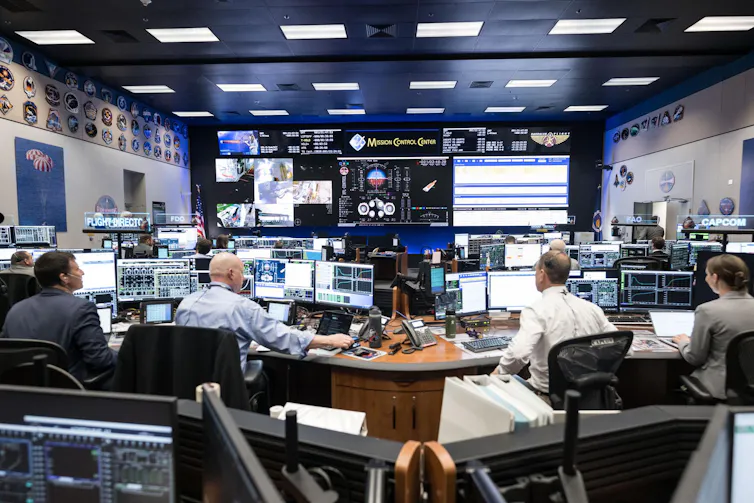
Artemis II might be framed as an international mission, but it also reflects strategic positioning – particularly as major powers like the US and China race towards their lunar ambitions.
A sense of possibility
Within this increasingly contested landscape, Indigenous worldviews offer a fundamentally different way of imagining space[20]: not as a frontier apart from Earth, but as part of a shared living system.
Our research, using a method known as “causal layered analysis[21]” developed by Pakistani-born Australian political scientist Sohail Inayatullah, shows these tensions reflect deeper competing assumptions about what space is for.
Depending on who is making the rules, it becomes either a marketplace, a lifeline, a refuge or an ecosystem.
Artemis II brings those differences into sharp relief. The decisions being made now about regulation, access and governance will shape the future of space activity for decades.
We argue for a shift towards an “Earth-space sustainability[22]” model, one that treats Earth and space as interconnected rather than separate domains.
That means setting shared sustainability goals and involving Indigenous peoples in co-governance, bringing values of reciprocity, shared responsibility and long-term stewardship into decision making.
These principles need to be embedded in institutions as well as rhetoric.
Co-governance frameworks[23] that bring together governments, industry and Indigenous communities – alongside enforceable standards and tools such as the Space Sustainability Rating[24] – offer one path towards more responsible stewardship.
This is not the easiest route for countries to take. It challenges powerful economic incentives and geopolitical rivalries. But the alternatives – unchecked competition and environmental degradation – are worse.
The return to the Moon offers a sense of possibility. It is natural to be captivated by the engineering, the scale and the ambition of it. But the more consequential story lies beneath.
As humans circle the Moon once again, the question is no longer whether we can go back, but how we choose to behave when we get there.
The author acknowledges the contribution of Ronda Geise who led this research as part of her masters degree in mechanical engineering at the University of Auckland.
References
- ^ looped around the Moon (www.nasa.gov)
- ^ building a long-term Moon base (www.nasa.gov)
- ^ images captured by the crew (www.nasa.gov)
- ^ are already taking shape (www.thespacereview.com)
- ^ 1967 Outer Space Treaty (www.unoosa.org)
- ^ Artemis Accords (www.nasa.gov)
- ^ helium-3 (www.esa.int)
- ^ trying to carve out a loophole (www.theverge.com)
- ^ further note (www.cambridge.org)
- ^ asserting control (www.rnz.co.nz)
- ^ collective stewardship (www.nature.com)
- ^ latest research (www.sciencedirect.com)
- ^ scenarios (thecommonsjournal.org)
- ^ now number in the tens of thousands (www.discovermagazine.com)
- ^ around two-thirds of them (www.independent.co.uk)
- ^ hundreds of thousands more planned (www.esa.int)
- ^ tragedy of the commons (earth.org)
- ^ including more than one million fragments larger than a centimetre (www.sdo.esoc.esa.int)
- ^ NASA (www.nasa.gov)
- ^ fundamentally different way of imagining space (theconversation.com)
- ^ causal layered analysis (www.sciencedirect.com)
- ^ Earth-space sustainability (www.earth-space.today)
- ^ Co-governance frameworks (www.academia.edu)
- ^ Space Sustainability Rating (spacesustainabilityrating.org)
Authors: Priyanka Dhopade, Senior Lecturer in Mechanical Engineering, University of Auckland, Waipapa Taumata Rau