Why is the government trying to make the cashless debit card permanent? Research shows it does not work
- Written by: Elise Klein, Senior Lecturer, Australian National University
Dystopic policy in Australia is often hidden in plain sight.
As Curtin University Professor Suvendrini Perera has written[1], systematic failures are not necessarily “spectacular acts” but the “decisions and indecisions of bureaucratic oversights and misplaced assumptions”. And these amount to a “slow violence” over time.
Read more: Australia has been stigmatising unemployed people for almost 100 years. COVID-19 is our big chance to change this[2]
One such failure is the Cashless Debit Card[3], which has been trialled in Australia since 2016.
Yet, among all the measures in last month’s budget was the news the Morrison government will make the trial scheme “ongoing[4]”.
What is the Cashless Debit Card?
The Cashless Debit Card scheme quarantines 80% of social security payments to a cashless card, which prevents spending on alcohol, illegal drugs and gambling products.
 The card is supposed to quarantine welfare payment for essentials such as food and groceries.
www.shutterstock.com
The card is supposed to quarantine welfare payment for essentials such as food and groceries.
www.shutterstock.com
It is currently being trialled in Ceduna in South Australia, the East Kimberley in Western Australia, the Goldfields in WA and Hervey Bay region in Queensland, with about 12,000 people[5] involved.
The card compulsorily includes a broad range of people[6] receiving support for many reasons, including payments for disability, parenting, caring, unemployment and youth allowance. The Australian Human Rights Commission[7] is among those who have pointed out the the card disproportionately impacts First Nations people.
Research shows it does not work
Peer-reviewed research has consistently shown the card, and income management[8] more broadly, do not meet policy objectives. A 2020 academic study[9] of multiple locations found compulsory income management “can do as much harm as good”.
Survey respondents reported not having enough cash for essential items, while the research found the card “can also stigmatise and infantilise users”.
My research examining the card in the East Kimberley shows it makes life more difficult[10] for people subjected to it, including making it harder to manage money. People also reported the card made it more difficult to buy basic goods[11] such as medicine and groceries.
Read more: 'I don't want anybody to see me using it': cashless welfare cards do more harm than good[12]
Other research from the Life Course Centre suggests compulsory income management has been linked to a reduction of birth weight[13] and school attendance[14]. The majority of these children are First Nations kids.
Bill before parliament
A bill[15] to make the card permanent was introduced to parliament just a day after the budget was handed down.
If passed, it will also transfer about 25,000 people in the Northern Territory and Cape York[16] who are on the Basics Card (an earlier version of income management) onto the Cashless Debit Card.
Introducing the bill to the House, Morrison government minister Trevor Evans said[17] the card was delivering “significant benefits” in the trial communities.
The program has the objective of reducing immediate hardship and deprivation, helping welfare recipients with their budgeting strategies and reducing the likelihood that they will remain on welfare and out of the workforce for extended periods.
The government also says[18] the card is used “just like an everyday bank card” and is seeing a reduction in drug and alcohol use and gambling.
Senate inquiry
But as highlighted above, the value of the scheme is heavily disputed by policy experts. People put on the card, community groups, lawyers and doctors also oppose[19] any expansion of the card.
The card’s expansion has been the subject of a brief Senate inquiry[20], which is due to report on November 17.
This is the sixth Senate inquiry into the Cashless Debit Card. Each one has seen submissions from across the community which overwhelmingly reject the card[21].
First Nations groups have led the charge[22], stating income management is not in the spirit of self-determination and the current bill would “directly contradict the recent National Agreement on Closing the Gap”.
Smoke and mirrors
Trials of public policy programs require, by definition, research to examine their performance and to justify any continuation. Yet, the government continues to rely on anecdotes[23] and the widely criticised 2017 evaluation by ORIMA Research[24] as “proof” for the roll out of the Cashless Debit Card.
In 2018, the Australian National Audit Office[25] found the ORIMA evaluation was methodologically flawed and unable to provide any credible conclusions regarding the real impact of the trial.
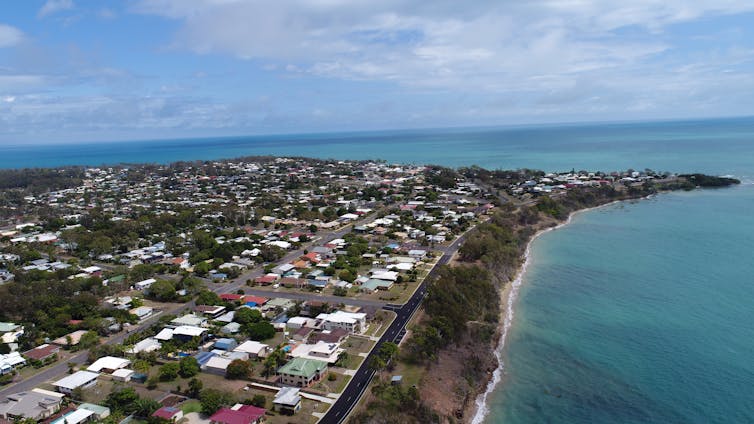 The card has been trialled in the Hervey Bay and Bundaberg region since 2019.
www.shutterstock.com
The card has been trialled in the Hervey Bay and Bundaberg region since 2019.
www.shutterstock.com
In the latest bill, the government also misrepresents the findings from a 2014 evaluation of compulsory income management into the Northern Territory, claiming the findings were supportive of income management[26]. Yet this evaluation[27],
[did] not find any consistent evidence of income management having a significant systematic positive impact.
Compelled by the Senate[28], the government has since commissioned the University of Adelaide[29] to evaluate the scheme. This research was due to be released by the end of 2019 but is yet to be made public.
When asked about the report in Senate estimates last month[30], Social Services Minister Anne Ruston said it was not about deciding whether the card would continue, but to give advice on “what what was working particularly well”.
Perversely, the current bill also removes any need to further evaluate the Cashless Debit Card, instead opting to rely on the department to undertake its own desk-based research[31].
Why is evidence being ignored?
The protracted life of the Cashless Debit Card in Australian public policy shows the ongoing disregard for evidence-based policy making.
It also shows the continued slow violence against thousands of Australians who deserve much better from elected officials and the structures set up to support them.
Whilst it is easy not to pay attention to the mundane details of policy, the Cashless Debit Card shows we must.
Read more: 'An insult' – politicians sing the praises of the cashless welfare card, but those forced to use it disagree[32]
References
- ^ has written (www.smh.com.au)
- ^ Australia has been stigmatising unemployed people for almost 100 years. COVID-19 is our big chance to change this (theconversation.com)
- ^ Cashless Debit Card (www.theguardian.com)
- ^ ongoing (www.abc.net.au)
- ^ 12,000 people (www.theguardian.com)
- ^ broad range of people (www.dss.gov.au)
- ^ Australian Human Rights Commission (humanrights.gov.au)
- ^ income management (onlinelibrary.wiley.com)
- ^ academic study (theconversation.com)
- ^ life more difficult (openresearch-repository.anu.edu.au)
- ^ buy basic goods (128f2a8c-7e2b-db29-c5ed-c863dde6f97c.filesusr.com)
- ^ 'I don't want anybody to see me using it': cashless welfare cards do more harm than good (theconversation.com)
- ^ birth weight (www.lifecoursecentre.org.au)
- ^ school attendance (www.lifecoursecentre.org.au)
- ^ bill (www.aph.gov.au)
- ^ Northern Territory and Cape York (www.dss.gov.au)
- ^ Trevor Evans said (parlinfo.aph.gov.au)
- ^ also says (parlinfo.aph.gov.au)
- ^ also oppose (www.aph.gov.au)
- ^ Senate inquiry (www.aph.gov.au)
- ^ overwhelmingly reject the card (www.theguardian.com)
- ^ led the charge (www.amsant.org.au)
- ^ anecdotes (www.anneruston.com.au)
- ^ evaluation by ORIMA Research (www.dss.gov.au)
- ^ Australian National Audit Office (www.anao.gov.au)
- ^ were supportive of income management (parlinfo.aph.gov.au)
- ^ this evaluation (caepr.cass.anu.edu.au)
- ^ by the Senate (www.theguardian.com)
- ^ University of Adelaide (www.abc.net.au)
- ^ Senate estimates last month (parlinfo.aph.gov.au)
- ^ desk-based research (parlinfo.aph.gov.au)
- ^ 'An insult' – politicians sing the praises of the cashless welfare card, but those forced to use it disagree (theconversation.com)
Authors: Elise Klein, Senior Lecturer, Australian National University