As China's trade war with Australia shows, New Zealand must be careful to balance its own economic priorities
- Written by: Hongzhi Gao, Associate professor, Te Herenga Waka — Victoria University of Wellington
New Zealand and China are being pushed toward[1] further regional economic integration as part of the Regional Comprehensive Economic Partnership (RCEP[2]) signed last month.
On the face of it, the RCEP is a positive step for cross-border investments. It further integrates trade between the two nations, along with Japan, South Korea, Australia and the ten countries in the Association of Southeast Asian Nations (ASEAN).
But perhaps we should stop to ask whether the haste with which this is happening will generate equitable and sustainable benefits.
One of the main criticisms of globalisation is that, in an aggressive and politically driven push for economic integration, the institutional (legal, political) differences between trading and investment partner countries have been overlooked.
The US-China trade war in the past three years, and now COVID-19, have highlighted the differences[3] in responses to trade, investment and the pandemic by countries with very different political and economic ideologies.
In particular, China is using its global power to expand its influence and reset the rules[4] of trade relationships. New Zealand must be cautious about its exposure to Chinese influence at this level.
Rebalancing the books
Our analysis of foreign direct investment (FDI) application data from the New Zealand Overseas Investment Office from the beginning of 2017 to the end of 2019 shows two conflicting trends.
In financial and insurance services, and the information, communications and technology sectors, application approvals favoured the US and Australia. But in manufacturing, even after the US–China trade war broke out, approvals favoured China.
Read more: An all-out trade war with China would cost Australia 6% of GDP[5]
This greater receptiveness to Chinese investments in manufacturing might reflect the push for more economic integration with China in recent years.
But this approach needs to be scrutinised in light of the current stand-off between China and Australia.
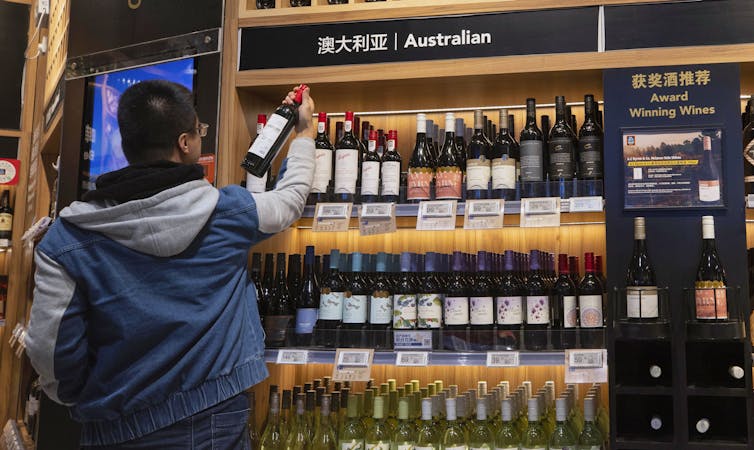 Wine war: Australian wine on sale in Shanghai was hit with new import duties after political tensions escalated.
AAP
Wine war: Australian wine on sale in Shanghai was hit with new import duties after political tensions escalated.
AAP
The downside of economic integration
The recent call by Australia[6] (supported by New Zealand, the EU and Canada) for an independent investigation into the origin of COVID-19 shows how much deeper institutional differences matter.
China imposed tariffs and other trade restrictions[7] on Australian beef, barley, minerals, wine and most recently coal[8] in response to that call and to Australian government criticism of Beijing’s suppression of political dissent in Hong Kong.
Read more: NZ remains unscathed by US-China trade war, but that's no reason for complacency[9]
In an ideal world, the free trade agreement between Australia and China and the much-hyped regional economic integration represented by the RCEP might have salvaged the relationship and allowed the parties to talk more openly about their disputes.
But the opposite has happened. The stronger economic relationship and mutual economic dependency have actually made China’s retaliation[10] even more painful for Australia. The less powerful party is always hurt more when a relationship goes wrong.
The lessons for New Zealand
New Zealand and Australia are not alone in being at something of a crossroads with China. Many countries are confronting the difficulty (impossibility, even) of balancing the pressure to be part of China’s economic orbit and their fundamental institutional differences.
In essence, it is the tension between greater political and economic freedoms, and state intervention and control. The implications for resolving trade disputes and other economic disagreements are profound.
Read more: Beyond travel, a trans-Tasman bubble is an opportunity for Australia and NZ to reduce dependence on China[11]
For that reason, New Zealand’s FDI policies and application approvals should reflect a preference for countries with similar institutional conventions. While balancing its trade interests is critical for New Zealand, it should not be driven purely by immediate economic benefits.
New Zealand’s FDI policies should reflect its own best long-term interests: continued regional economic integration with Australia, enhanced post-Brexit leverage[12] of the political, historical and cultural links with the UK, and closer economic ties with developing economies (especially Commonwealth countries such as India and Malaysia).
In doing so, New Zealand will reduce the political and economic risks of over-integration with China and avoid the kind of conflicts based on deep institutional differences we are now witnessing.
References
- ^ pushed toward (unctad.org)
- ^ RCEP (www.mfat.govt.nz)
- ^ highlighted the differences (www.scmp.com)
- ^ reset the rules (www.nytimes.com)
- ^ An all-out trade war with China would cost Australia 6% of GDP (theconversation.com)
- ^ call by Australia (www.scmp.com)
- ^ imposed tariffs and other trade restrictions (www.smh.com.au)
- ^ coal (www.theguardian.com)
- ^ NZ remains unscathed by US-China trade war, but that's no reason for complacency (theconversation.com)
- ^ China’s retaliation (www.bloomberg.com)
- ^ Beyond travel, a trans-Tasman bubble is an opportunity for Australia and NZ to reduce dependence on China (theconversation.com)
- ^ post-Brexit leverage (www.rnz.co.nz)
Authors: Hongzhi Gao, Associate professor, Te Herenga Waka — Victoria University of Wellington