Regardless of the rules, sport is fleeing free TV for pay, and it might be an avalanche
- Written by: Hunter Fujak, Lecturer in Sport Management, Deakin University
Netball Australia has signed a five-year deal it describes as “ground-breaking[1]”.
Every game of every round of each year’s Super Netball competition will be broadcast live and ad-free on Foxtel platforms including its sports streaming app Kayo Sports.
For viewers who don’t want to part with cash, two games each week will be available live and free on Kayo Freebies[2], although viewers will have to hand over their email and other details.
That several events will be free is good for Netball Australia — it gives it potential access to the mass audience it would have had on free-to-air TV – and also good for Foxtel because it will pioneer a way of getting around the anti-siphoning[3] rules that are meant to ensure major events can be watched by everyone.
Rugby Union is doing something similar.
From tonight every match will be shown live on Stan Sport[4], part of the movie streaming platform Stan owned by Nine, under a three-year deal worth a reported A$100 million[5].
Enough matches will be shown free on the Nine network to satisfy the anti-siphoning rules.
Read more: The TV networks holding back the future[6]
The Rugby deal replaces an earlier one with Foxtel, which used the Ten network to broadcast free matches.
Cricket is now broadcast on both Foxtel[7] and the Seven Network, a deal Seven is reportedly trying to get out of[8]. It means fans must now subscribe to watch domestic men’s One Day Internationals for the first time.
Anti-siphoning antiquated
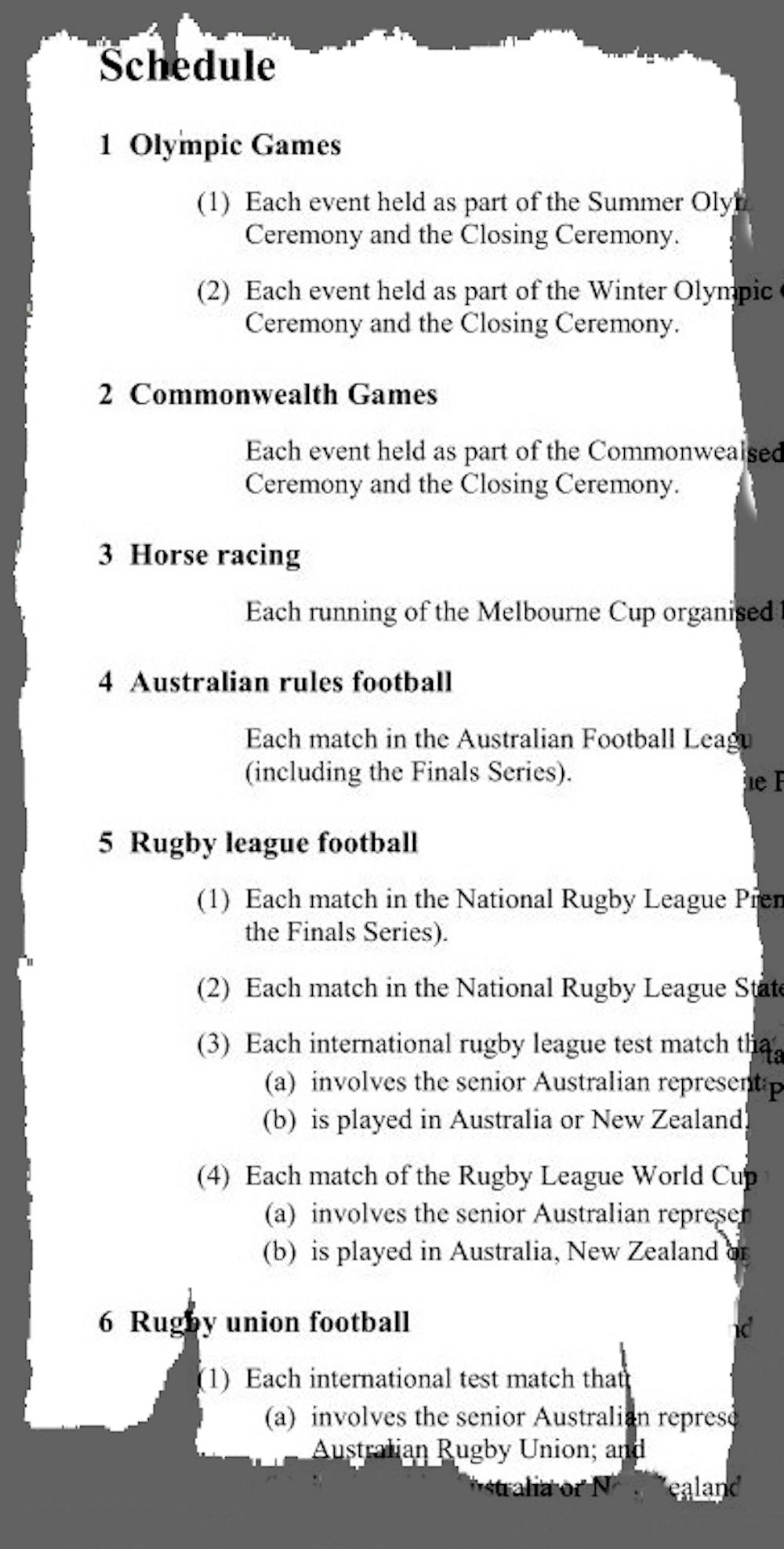 Broadcast Service Events Notice[9]
Australia’s anti-siphoning laws were enacted with the birth of pay TV[10] thirty years ago in order to ensure all Australians retained access to “culturally significant[11]” sports and events.
So-called “broadcast events notices[12]” specify events that, in the opinion of the minister, “should be available free to the general public”.
Among those currently on the list are every event at the Summer and Winter Olympic games, the Melbourne Cup, every match in the AFL and AFL premiership competitions, and each cricket test played in Australia or overseas by a representative team chosen by Cricket Australia.
The rules don’t compel free-to-air networks to broadcast these events, but they do require them to be given first dibs.
While broadly successful in securing sporting events for free-to-air television and the viewing public, the rules are becoming battle weary[13].
‘Freemium’ not tested
Netflix, Amazon, Twitter, Facebook, Stan, Kayo, Telstra and the smartphone didn’t exist when the rules were drawn up.
The rules as written appear to allow Kayo to pursue a Spotify and YouTube-style “freemium” strategy while fulfilling the requirements of the legislation.
Read more:
Fight over live-streamed sport to go on after final bell sounds[14]
As worded, the law refers to events “available free to the general public” rather than events available on free-to-air TV.
Kayo is opening the way for Fox Sports and others to meet the formal requirements of the anti-siphoning laws while raiding sports until now housed on free-to-air TV, the AFL and Rugby League among them.
Netball the canary in the coalmine
Broadcast Service Events Notice[9]
Australia’s anti-siphoning laws were enacted with the birth of pay TV[10] thirty years ago in order to ensure all Australians retained access to “culturally significant[11]” sports and events.
So-called “broadcast events notices[12]” specify events that, in the opinion of the minister, “should be available free to the general public”.
Among those currently on the list are every event at the Summer and Winter Olympic games, the Melbourne Cup, every match in the AFL and AFL premiership competitions, and each cricket test played in Australia or overseas by a representative team chosen by Cricket Australia.
The rules don’t compel free-to-air networks to broadcast these events, but they do require them to be given first dibs.
While broadly successful in securing sporting events for free-to-air television and the viewing public, the rules are becoming battle weary[13].
‘Freemium’ not tested
Netflix, Amazon, Twitter, Facebook, Stan, Kayo, Telstra and the smartphone didn’t exist when the rules were drawn up.
The rules as written appear to allow Kayo to pursue a Spotify and YouTube-style “freemium” strategy while fulfilling the requirements of the legislation.
Read more:
Fight over live-streamed sport to go on after final bell sounds[14]
As worded, the law refers to events “available free to the general public” rather than events available on free-to-air TV.
Kayo is opening the way for Fox Sports and others to meet the formal requirements of the anti-siphoning laws while raiding sports until now housed on free-to-air TV, the AFL and Rugby League among them.
Netball the canary in the coalmine
 Liz Watson of the Vixens and coach Simone McKinnis celebrate victory during the Super Netball Grand Final.
ALBERT PEREZ/AAP
A key question will be whether access via an app is really “free”. Surrendering email addresses and demographical information in return for watching isn’t quite the same as free. Facebook and Google have made it more than clear that such data is valuable[15].
The stakes are high for sport leagues, media outlets and fans.
It has been argued[16] that even in the hypothetical absence of an anti-siphoning list, most sports would be well served to choose a free-to-air broadcast partner to maximise their exposure and popularity.
Super Rugby[17]’s 25-year decline behind a Foxtel paywall is used as a cautionary tale.
Sport accounts for about only 10% of commercial television air time, yet rates consistently highly[18]. Sport, news and reality television account for all of free to air’s top twenty programs.
Free-to-air’s share of the advertising market is at present predicted to decline from 20% in 2018 to 14%[19] in 2023.
The loss of sport could send it into an even faster nosedive.
Liz Watson of the Vixens and coach Simone McKinnis celebrate victory during the Super Netball Grand Final.
ALBERT PEREZ/AAP
A key question will be whether access via an app is really “free”. Surrendering email addresses and demographical information in return for watching isn’t quite the same as free. Facebook and Google have made it more than clear that such data is valuable[15].
The stakes are high for sport leagues, media outlets and fans.
It has been argued[16] that even in the hypothetical absence of an anti-siphoning list, most sports would be well served to choose a free-to-air broadcast partner to maximise their exposure and popularity.
Super Rugby[17]’s 25-year decline behind a Foxtel paywall is used as a cautionary tale.
Sport accounts for about only 10% of commercial television air time, yet rates consistently highly[18]. Sport, news and reality television account for all of free to air’s top twenty programs.
Free-to-air’s share of the advertising market is at present predicted to decline from 20% in 2018 to 14%[19] in 2023.
The loss of sport could send it into an even faster nosedive.
References
- ^ ground-breaking (supernetball.com.au)
- ^ Kayo Freebies (help.kayosports.com.au)
- ^ anti-siphoning (www.legislation.gov.au)
- ^ Stan Sport (www.stan.com.au)
- ^ A$100 million (www.abc.net.au)
- ^ The TV networks holding back the future (theconversation.com)
- ^ Foxtel (www.foxtel.com.au)
- ^ trying to get out of (www.smh.com.au)
- ^ Broadcast Service Events Notice (www.legislation.gov.au)
- ^ birth of pay TV (www.aph.gov.au)
- ^ culturally significant (theconversation.com)
- ^ broadcast events notices (www.legislation.gov.au)
- ^ battle weary (www.smh.com.au)
- ^ Fight over live-streamed sport to go on after final bell sounds (theconversation.com)
- ^ valuable (thenewdaily.com.au)
- ^ argued (books.google.com.au)
- ^ Super Rugby (www.tandfonline.com)
- ^ consistently highly (www.freetv.com.au)
- ^ 14% (www.pwc.com.au)
Authors: Hunter Fujak, Lecturer in Sport Management, Deakin University