The government hands Facebook a free pass
- Written by: Joshua Gans, Professor of Strategic Management, University of Toronto
The Conversation[1] is a great news site. But, for the most part, people don’t read it like a newspaper. Instead, articles on specialised topics are shared[2] with other people. One way is via Facebook[3].
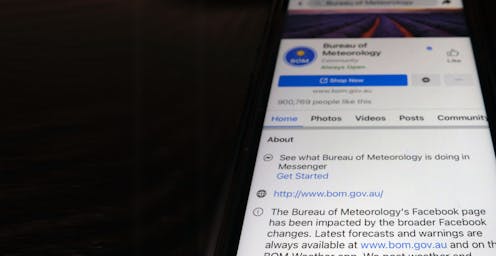
Yesterday, almost none of that was possible worldwide for the Conversation’s Australian content because Facebook opted to ban[4] all news (even seeming[5] news ) from Australian sources to avoid being designated for compulsory negotiations[6] under legislation before the Australian parliament.
The government’s new media bargaining code was a response to the Australian Competition and Consumer Commission’s digital platforms inquiry[7] that found it was hard for content providers, including but not limited to news organisations – to deal with platforms whose rules were always changing.
Parts of these grievances are legitimate, and relate to editorial and algorithmic issues. Others relate to the platform’s stranglehold on online advertising.
But rather than tackle these issues head on, Australia’s government sliced out a sliver of the sites affected – news sites – and attempted to fix things for it, saying it’s concerned about competition[8].
Competition policy without more competition
To any economist, the point of competition policy is to encourage competition. In this case, either more digital platform options for consumers, or more news content options.
But the government’s legislation[9] seems to be uniquely designed to deliver neither.
The code allows news organisations to negotiate with large digital platforms about things such as how their algorithms work to prioritise content, and money.
And money is what it is really all about. The news organisations want more of it, large digital platforms have it. It’s that simple.
The code empowers news organisations to get money from digital platforms by
-
making it unlawful for digital platforms that do not pay up to provide links to Australian news, giving big news outlets quasi-monopoly bargaining power
-
allowing deals to be made without the need for authorisation by a regulator concerned about the public interest
-
providing a regulatory stop-gap should that not happen, whose design is tilted in interest of one of the parties
This last step requires a little explanation.
It is not unknown, especially in Australia, for competition policy to work by first allowing parties to negotiate, and then imposing a regulated settlement only if they fail.
And its normally about empowering the little guy[10], in the belief that’s what leads to socially desirable outcomes.
Little guys locked out
But not in this case. It is only the large news organisations that would be allowed to negotiate over money.
It’s quite different to the system adopted in France, whose government is able to collect money from digital platforms via a tax, which can, should the government wish, be distributed to content providers on a criteria other than naked private interest. The French system isn’t clearly pro-competition either, but it at least provides a mechanism that could enable good outcomes to occur.
Read more: Banning news links just days before Australia's COVID vaccine rollout? Facebook, that’s just dangerous[11]
The Australian process fails to deliver competition in two ways.
First, it allows the treasurer, rather than a judge, to designate the platforms the process will apply to. He is unlikely to designate a platform that large media organisations have no problem working with, as that will entail work.
Second, the treasurer is unable to designate a platform that doesn’t carry any Australian news. So if a digital platform wants out, it can get out.
Both of these things have begun to come to pass in the last day — even before the code has been legislated.
Facebook gains a bargaining tool
Google has done deals with some large news outlets and thereby signalled it will do deals with others to ensure it is not designated. It means Google won’t have to deal with all of the other smaller voices that also have a problem with it.
Facebook has opted out of the news content business altogether, as the law allows it to. It decided Australian news wasn’t worth it, at least for now. Australians can still share news from around the world, which in some ways is more valuable to them than local news they are already aware of.
Facebook might be doing it to get a better deal when negotiations take place.
Read more: Why Google is now funnelling millions into media outlets, as Facebook pulls news for Australia[12]
Bizarrely, before the government’s proposed legislation, if Facebook had excluded content from suppliers in order to get a better deal, Australia’s Competition and Consumer Commission could have prosecuted it for exclusionary conduct[13].
The new code gives Facebook a licence to do what it has just done, and argue that it could not have been exercising market power because it was merely using the steps identified in the code as necessary for it to avoid compulsory arbitration.
Never mind that this really means Facebook
-
has been able to demonstrate to news outlets how much they need it
-
is now able to get news organisations to agree to better conditions than if it had not been given this licence.
In other words, the entire process has had the (I hope) unintended consequence of enhancing the very market power that it claimed to intend to contain.
No more platforms, no more competition
Those games aside: where will this end up? It will end up with the large digital platforms doing deals with the largest news outlets. Those deals will be multi-year lump-sum payments which enable everyone to go about their business. There will be no new digital platforms, no new content providers, no more competition.
The shareholders of the large digital platforms will be a few million dollars poorer and the shareholders of large Australian news outlets a few million dollars richer.
There will be no improvement in any competitive outcome whatsoever. As often happens in Australia, oligarchies will consolidate, and consumers will get nothing.
References
- ^ The Conversation (theconversation.com)
- ^ shared (www.wikihow.com)
- ^ Facebook (www.facebook.com)
- ^ ban (about.fb.com)
- ^ seeming (www.facebook.com)
- ^ compulsory negotiations (parlinfo.aph.gov.au)
- ^ digital platforms inquiry (www.accc.gov.au)
- ^ concerned about competition (joshfrydenberg.com.au)
- ^ legislation (parlinfo.aph.gov.au)
- ^ empowering the little guy (www.sciencedirect.com)
- ^ Banning news links just days before Australia's COVID vaccine rollout? Facebook, that’s just dangerous (theconversation.com)
- ^ Why Google is now funnelling millions into media outlets, as Facebook pulls news for Australia (theconversation.com)
- ^ exclusionary conduct (espace.library.uq.edu.au)
Authors: Joshua Gans, Professor of Strategic Management, University of Toronto