Budget 2021: the floppy-V-shaped recovery
- Written by: Richard Holden, Professor of Economics, UNSW
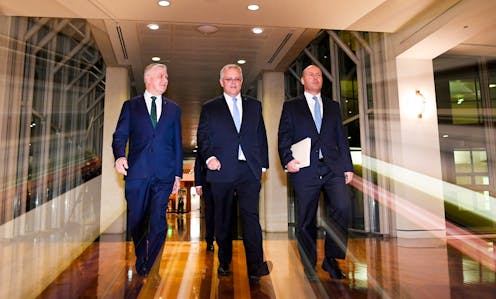
I don’t often feel sorry for politicians. But having to manage a process that produces forecasts about the next four years of an economy still clawing its way out of a pandemic, and then having to publicly defend those forecasts, is no easy task.
That said, our compassion for the plight of Treasurer Josh Frydenberg shouldn’t stop us judging his budget forecasts. And, like all forecasts, those rest heavily on the assumptions that underpin them.
Core budget assumptions
The core budget assumptions about unemployment and economic growth are relatively rosy. Unemployment is forecast to be down to 4.75% by 2023-23 and 4.5% the year after – both well below pre-pandemic levels.
Real GDP growth is expected to rebound to 4.25% in 2021-22 and then settle down to about 2.5% thereafter. Given we are unlikely to have the population growth of the pre-COVID era, that’s a pretty high rate.
Taking a look graphically at actual and forecast GDP makes it clear why folks are talking about a “V-shaped recovery”. But even the fairly bullish assumptions reveal a recovery where the V isn’t really sharp enough. Call it a “floppy-V-shaped recovery.”
That’s rather disappointing, especially given Frydenberg has fundamentally shifted Liberal party fiscal strategy away from “debt and deficits” and dalliances with austerity, to one that sees government spending at more than 26% of GDP in steady state.
But what is more disappointing is that this increased spending isn’t forecast to translate into stronger employment and wages growth.
Read more: Frydenberg spends the budget bounty to drive unemployment down to new lows[1]
The budget forecasts an unemployment rate of 4.5% in 2023-24 and 2024-25. That’s better than pre-pandemic levels, but not all that close to the 4%-or-lower number many economists (including RBA governor Philip Lowe) think might be required to get wages growing meaningfully for the first time since 2013.
The budget forecasts reflect this, with wages growth of 2.25% in 2022-23 and 2.5% in 2023-24 both equal to forecast inflation in those years. That is, real wages growth is not even forecast to begin again until 2024-25—and even then, only barely.
Non-mining business investment is forecast to grow by 1.5% in 2021-22 and then jump by a massive 12.5% in 2022-23. That might reflect a post-COVID investment boom driven by a widely mRNA-vaccinated nation and a raft of government incentives. Or it might just be wishful thinking.
Read more: View from The Hill: Frydenberg finds the money tree[2]
As to immigration, we can expect our borders to be largely shut for the foreseeable future. This is reflected in the budget’s forecast population growth of “around 0.1% in 2020-21, 0.2% in 2021-22 and 0.8% in 2022-23.”
Whether immigration does actually pick up significantly in 2022-23 depends crucially on our vaccination rollout.
If we can reverse the bungled execution to date, overcome vaccine hesitancy, and secure enough Pfizer and Moderna doses (including for boosters) immigration might grow strongly again.
Read more: Less hard hats, more soft hearts: budget pivots to women and care[3]
But there are a number of things that have to go right for that to happen. And the government has a poor track record to date on those things.
And then there’s one notable assumption that makes news in every budget: the iron-ore price. The budget papers themselves highlight the importance of it, noting:
“The recent strength in key commodity prices, particularly iron ore, has seen a significant resurgence in Australia’s terms of trade […] As a result, nominal GDP is expected to grow by 3¾% in 2020-21, by a further 3½% in 2021-22 and by 2% in 2022-23.”
The budget assumes the iron-ore price will decline from its current level of over US$200 a tonne, to US$55 a tonne by March 2022. This incredibly pessimistic assumption basically gives the government a buffer on the headline deficit figure. If the forecast of a $99.3 billion deficit in 2022-23 is beaten significantly, it will likely be due to iron ore prices staying high.
The biggest assumption of all
The core economic assumptions discussed above underpin the budget bottom line – a number that used to receive considerably more attention when there was a question of “when” the budget might be back in surplus.
Those days are gone.
Frydenberg has engineered a remarkable shift in Liberal party economic philosophy. While maintaining their brand as “the party of lower taxes, not higher taxes”, they have jettisoned budget-balance fetishism.
Read more: Cuts, spends, debt: what you need to know about the budget at a glance[4]
Good. It’s about time.
But the biggest assumption of all in the out years of the budget is that the government – should it be reelected – sticks to this new strategy. If they do it holds the promise of being transformative.
It would represent a modest but welcome transformation of the economy, and a dramatic transformation of the Liberal Party brand.
References
- ^ Frydenberg spends the budget bounty to drive unemployment down to new lows (theconversation.com)
- ^ View from The Hill: Frydenberg finds the money tree (theconversation.com)
- ^ Less hard hats, more soft hearts: budget pivots to women and care (theconversation.com)
- ^ Cuts, spends, debt: what you need to know about the budget at a glance (theconversation.com)
Authors: Richard Holden, Professor of Economics, UNSW
Read more https://theconversation.com/budget-2021-the-floppy-v-shaped-recovery-159230