Frydenberg finds the money tree
- Written by: Michelle Grattan, Professorial Fellow, University of Canberra
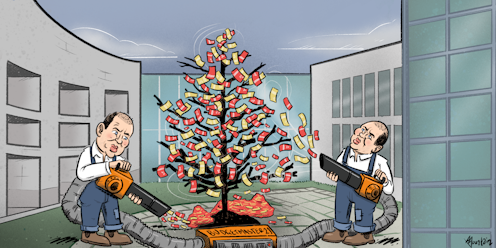
Josh Frydenberg’s third budget aims to give Australia a post-pandemic soft landing, using revenue windfalls for spending and tax cuts rather than for slashing the deficit.
Its philosophy is very much gain, not pain, for a population that has endured the stress of the pandemic, albeit not the devastation experienced by so many other countries.
There are plenty of winners, and minimal direct losers in a budget that lays the ground work for an election that is still expected next year rather than this.
Hard decisions have been eschewed. Prime Minister Scott Morrison is trying to avoid offending voters.
The political prism of this budget is very much in the moment. As such, it leaves Opposition Leader Anthony Albanese little room. Excessive criticism, and he risks sounding carping. Demands for too much more, and he might be accused of irresponsibility.
The $7.8 billion extension of the low and middle income tax offset is a carrot for Labor’s core constituency. Frydenberg told reporters the recipients were “the tradies and the truckies,” and “the teachers and the nurses”.
The budget dodges major reform, with the notable exception of aged care, which the royal commission’s scathing findings made unavoidable.
Read more: Budget splashes cash, with $17.7 billion for aged care and a pitch to women[1]
The deficit for the coming financial year is forecast to be $106.6 billion, only marginally below the December budget update forecast of about $108 billion.
Tens of billions of dollars in windfall revenue (from the faster-than-expected economic recovery, and high iron ore prices) have been distributed, rather than going to the bottom line.
At the end of the budget period, in 2024-25, the deficit will be an estimated $57 billion. Indeed, there is no surplus in sight in a decade.
Without a policy U-turn, Frydenberg as treasurer will likely never deliver that “back in black” budget. Indeed, by the time there is a surplus, he might have served as prime minister, been in opposition, and departed politics.
But of course, after the next election, at some point there will be a change of policy, towards fiscal consolidation.
Frydenberg presents an optimistic picture for the economy in the coming financial year, with the caveat that the pandemic lurks and therefore so does uncertainty.
The budget forecasts unemployment falling to 5% next year and dropping to 4.5% by June 2024. Growth peaks at 4.25% next financial year, but slows after that.
Critics will say that given the state of the economy, and the amount of revenue, budget repair is being delayed too long. That won’t, of course, be the judgement of the public.
We can apply many measuring sticks to the budget, beyond the spending-versus-repair one.
The most obvious is its response to the aged care royal commission. The government is putting some $17.7 billion into the system, and there will be 80,000 additional home care packages (the waiting list is 100,000).
The experts will argue over the money and probably conclude it is not enough. Equally, the test must be whether the initiatives adequately address improving regulation and achieving a larger, better trained and remunerated workforce. The government makes the right noises but the judgement can only come later. The workforce issues are particularly challenging.
Read more: Frydenberg spends the budget bounty to drive unemployment down to new lows[2]
The size of the task is enormous, with a planned new funding model to improve quality and a goal of cultural reform. Health Minister Greg Hunt on Tuesday described it as a “once in a generation” reform. The program will take five years.
As foreshadowed, there are many initiatives for women – on safety, health and economic security. Reforms to child care benefit families, but women especially will be making comparisons with the more generous, less targeted Labor scheme.
Many individuals and businesses will be scrutinising the budget for what it says about opening Australia back to the world.
The message is that it will be a slow path.
Migrants, temporary and permanent, will gradually start to come from mid next year.
Late this year, “small phased programs” of international students will start.
Inbound and outbound travellers will remain low for the next year.
But hey – it’s assumed “a population-wide vaccination program is likely to be in place by the end of 2021”. Let’s hope this is so – but it’s only an assumption.
By the end of next year, barring a fresh assault by the pandemic, we might – just might – be looking at more normality. And then we will be facing a more “normal” budget too, with its share of nasties.
References
- ^ Budget splashes cash, with $17.7 billion for aged care and a pitch to women (theconversation.com)
- ^ Frydenberg spends the budget bounty to drive unemployment down to new lows (theconversation.com)
Authors: Michelle Grattan, Professorial Fellow, University of Canberra
Read more https://theconversation.com/view-from-the-hill-frydenberg-finds-the-money-tree-159225