Remembering Geoffrey Giudice, the 'bosses man' who helped make Australia's Fair Work Commission fair
- Written by: Judy Hughes, PhD candidate in History, La Trobe University
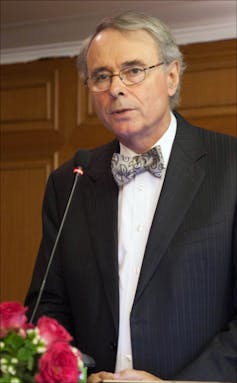
In the turbulent world of industrial relations, Geoff Giudice was an oasis of calm.
An employers’ barrister and earlier a union researcher, the 13th president of Australia’s national workplace tribunal, now called the Fair Work Commission, had a knack for putting people at ease.
“He brought to his professional life a mixture of humility, sophisticated intelligence, integrity, personal likeability, a preparedness to work, and a suppleness of thinking that enabled him to adjust to change,” said lawyer Michael Tehan at his funeral[1] in November.
And there was a lot of change. The newly-elected Howard Coalition Government appointed Giudice a judge and president of the Australian Industrial Relations Commission in 1997 within months of introducing its Workplace Relations Act.
The new law severely restricted the commission’s powers to resolve disputes and set wages and conditions and instead sought to encourage employers and employees to settle their differences at the workplace.
Further rounds of change followed - both by the Coalition Government in its unpopular WorkChoices legislation and the Rudd Labor Government which reconstituted the tribunal as Fair Work Australia.
Calls for more change continue today.
Independent and impartial
In an oral history interview I conducted with him for the Sir Richard Kirby Archives[2] in 2012 Giudice outlined his approach to leading the tribunal through contentious times. It was based on professionalism, integrity and setting an example.
“I didn’t want it ever to be said that while I was president of the commission there was any suggestion of corruption in the way decisions were made and that everybody would get a fair go based on the submissions they made,” he said.
Giudice regarded independence as not only being seen to be impartial by those who appeared before the commission, but also in dealings with government.
Read more: The enduring myth of the industrial relations club[3]
He strongly believed there was great danger for tribunal members in expressing views on government policy. To do so could “undermine confidence in the tribunal’s decisions” and lead to a perception of the tribunal pursuing an agenda rather than applying the law.
At the time of his appointment in 1997 some in the union movement were angry and suspicious given his earlier representation of high-profile business clients including Ansett and mining giant Rio Tinto.
When he retired in 2021, however, the Australian Council of Trade Unions praised his achievements, even describing him as a “good boss[4]”.
Sir Richard Kirby Archive Oral History Program, treasures of the archives.The commission was established as the Commonwealth Court of Conciliation and Arbitration in 1904 shortly after Federation and the great strikes of the 1890s.
Legislation aimed at abolishing it and returning its powers to the states in 1929 led to the defeat of the Bruce-Page Coalition government.
When the Howard government introduced WorkChoices in 2005 (which also contributed to its defeat), Giudice rolled out a series of briefings for unions and employers as well as some media in which, while not straying into discussion of government policy, he made it clear the commission had a continuing role.
Appointed by both sides
When the Rudd Labor government replaced the commission with Fair Work Australia in 2009, Rudd’s industrial relations minister Julia Gillard appointed Giudice inaugural president, saying he would deliver a “fair go”.
Born in Bendigo in 1947, Giudice accidentally fell into a career in industrial relations in 1970 by taking up a vacation job with the Hospital Employees’ Federation.
While he went on to represent mostly employers as a barrister, which is usual in labour law, he said the union experience gave him a “good idea of the difficulties faced by people who are on low incomes”.
Following his death on November 18 2021, friends and colleagues described him as intelligent, kind, thoughtful, humble, witty and even chivalrous.
Known for his signature bow tie and love of the Melbourne Football Club, it was revealed that in his final days he got to hold the premiership cup after Melbourne’s long-awaited win.
A staunch Catholic, his post-retirement positions included professorial fellow with The University of Melbourne, chair of Catholic Professional Standards Ltd and chair of the AFL Tribunal and AFL Appeal Tribunal.
Read more: We should simplify industrial relations, but not in the way business wants[5]
He was famously media-shy, refusing nearly all interview requests. But as the commission’s first media adviser – a role he created – I know he supported the work of journalists in communicating the work of the tribunal to the public.
For those who assume a previous professional background will predict the behaviour of an appointee to public office, his life is an invitation to think again.
References
- ^ funeral (tobinbrothers.com.au)
- ^ Sir Richard Kirby Archives (www.fwc.gov.au)
- ^ The enduring myth of the industrial relations club (theconversation.com)
- ^ good boss (www.fwc.gov.au)
- ^ We should simplify industrial relations, but not in the way business wants (theconversation.com)
Authors: Judy Hughes, PhD candidate in History, La Trobe University