Google AI

Weekend Times


The Times

Business News

More permanent skilled visas are a big deal. The government is heading in the right direction

  • Written by: Henry Sherrell, Deputy Program Director (Migration), Grattan Institute

More permanent skilled visas are a big deal. The government is heading in the right direction

Migration didn’t rate a mention[1] in Treasurer Josh Frydenberg’s budget speech. But the increase in Australia’s permanent skilled intake that Home Affairs Minister Alex Hawke announced on budget night[2] is a big deal, and one that will leave Australians better off.

The government is shifting the composition of Australia’s permanent skilled migrant intake for 2022-23, moving back towards visas with a track record of selecting younger, skilled migrants best placed to succeed in Australia. At the same time, the total number of skilled visas on offer will rise to 109,900 – about 30,000 more than 2021-22 planning levels.

As the Grattan Institute’s 2021 report Rethinking permanent skilled migration[3] showed, people who gain a permanent skilled visa to Australia typically live and work here for many decades. This means policy decisions affecting who gains a visa in the first place can have compounding effects over many years.

But there are still more changes needed to fix Australia’s migration program – including abolishing some visas programs that don’t make any economic sense, and simplifying the sponsorship process for businesses and migrants.
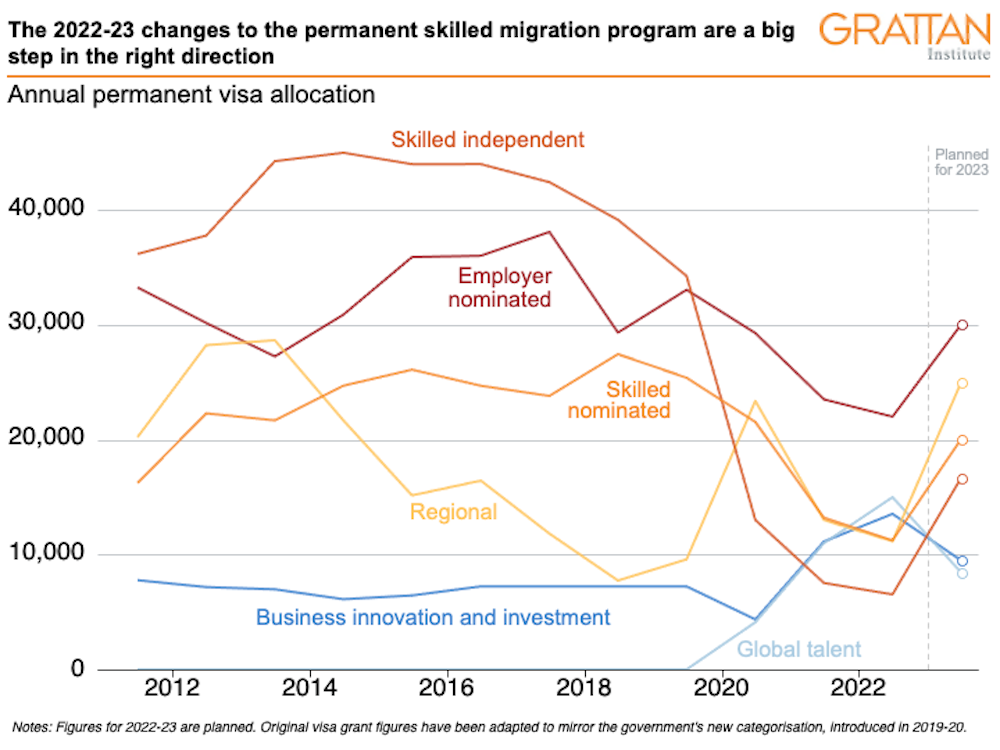
Australia migration intake by program, 2011 to 2023.
CC BY[4] There’s a big increase in skilled worker visas The number of skilled worker visas – allocated via employer sponsorship or the points test – rises to 91,652 in 2022-23, up from 50,900 this financial year. This comes from both the increase in the number of visas and the composition shift described above. Employer sponsorship will increase 8,000 to a total of 30,000 permanent skilled visas, and the points-tested Skilled Independent category has been tripled to 16,652 visas. Migrants selected through these programs are highly skilled, and typically earn higher incomes than Australians of similar ages. They also generate a much larger economic benefit to the Australian community. For instance, Treasury estimates[5] primary holders of permanent employer-sponsored visas pay $557,000 more in taxes than they receive in public services and benefits over their lifetimes. Primary holders of Skilled Independent visas pay $386,000 more in taxes than they can expect to receive in return. Business investment visas scaled back Australia’s “buy a visa” scheme, the poorly functioning Business Innovation and Investment Program (BIIP), has been cut from 13,500 visas to 9,500. It should be abolished. Few investors are financing projects that would not otherwise occur. Few are providing entrepreneurial acumen that will benefit the Australian community, because they are typically less skilled and speak little English. Grattan Institute research shows people who get this visa are older and earn significantly less than other skilled migrants. Treasury research[6] published in December 2021 showed each primary visa holder costs Australian taxpayers an average of $117,000 over their life in Australia, due to paying less in tax than their draw on government services and benefits. The government’s decision to shrink the Business Innovation and Investment Program and reallocate places elsewhere will eventually save taxpayers about $1 billion from this year’s intake alone. That’s a valuable gain for a government grappling with the long-term costs of the pandemic and an ageing population. Global talent program shrunk The Global Talent visa program for highly skilled professionals has also been scaled back, from 15,000 to 8,448 places. Attracting global talent is a worthy goal, but the mechanisms used to select migrants for the program remain unproven. There are few rules – applicants don’t require a sponsoring employer or a firm salary offer – and the rules that do exist are often arbitrary and hard to administer. We don’t know who is being selected or what their incomes are. Until a more robust evaluation is conducted, scaling back this visa is a good idea. What the government should do next The federal government has committed to reviewing the occupation lists that dictate what jobs are eligible for skilled migration visas. It should just scrap them. These occupation lists are cumbersome, vulnerable to lobbying and ineffective. Instead, employers should be subject to a wage threshold of $70,000 to sponsor workers on a temporary visa[7] and $80,000 to sponsor workers on a permanent visa[8]. Sponsored workers should be paid the equivalent of what Australian workers are paid, to prevent wages being undermined. Read more: It's time Australia dumped its bureaucratic list-based approach to temporary work visas[9] These changes would better target visas to people with the most valuable skills, and simplify the sponsorship process for firms and migrants. Points-tested visas[10], which assess prospective migrants based on their age, qualifications, skills and English proficiency, should be independently reviewed to ensure they give priority to younger, higher skilled workers. Points should be allocated only for characteristics that suggest an applicant will succeed in Australia. While state-nominated and regional visa holders do better than investors, they still earn substantially lower incomes than employer-sponsored or independent points-tested visa holders. Australia’s debates about migration policy tend to focus too much on the size of the intake, and not enough on who we choose. But even though it might not have made huge headlines on budget night, our skilled migration program has just taken a big turn for the better. References^ rate a mention (joshfrydenberg.com.au)^ announced on budget night (minister.homeaffairs.gov.au)^ Rethinking permanent skilled migration (grattan.edu.au)^ CC BY (creativecommons.org)^ Treasury estimates (treasury.gov.au)^ research (treasury.gov.au)^ sponsor workers on a temporary visa (grattan.edu.au)^ permanent visa (grattan.edu.au)^ It's time Australia dumped its bureaucratic list-based approach to temporary work visas (theconversation.com)^ Points-tested visas (immi.homeaffairs.gov.au)Authors: Henry Sherrell, Deputy Program Director (Migration), Grattan Institute

Read more https://theconversation.com/more-permanent-skilled-visas-are-a-big-deal-the-government-is-heading-in-the-right-direction-180324

The Weekend Times Magazine

Smart Lock: The Future of Home Security and Convenience

A smart lock has revolutionized the way people think about home security. Moving beyond traditional keys and mechanical locks, smart locks bring technology and convenience together, offering homeowners and businesses a new...

First Time Down Under: What to Do in Melbourne

Image Source Melbourne is often the first stop for travelers arriving in Australia, and it makes an excellent introduction to life Down Under. Known for its welcoming atmosphere, creative energy, and...

Australia’s top economists oppose the next increases in compulsory super: new poll

The five consecutive consecutive hikes in compulsory super contributions due to start next July should be deferred or abandoned in the view of the overwhelming majority of the leading Australian...

How Homeowners Can Prepare for Asbestos Removal in Melbourne

If you own an older home in Melbourne, there’s a chance asbestos-containing materials may be present somewhere on your property. That’s why professional asbestos removal Melbourne services are necessary, but as...

CHECK.CHECK.CHECK. The new ‘Slip, Slop, Slap,’ for a night out campaign

CHECK.CHECK.CHECK. The new ‘Slip, Slop, Slap,’ for a night out launched by the Night Time Industries Association A new campaign Check. Check. Check. encouraging punters to do their...

Building Designer in Melbourne: Crafting Innovative, Functional, and Sustainable Spaces

In a city celebrated for its architectural excellence and diverse urban character, the role of a building designer Melbourne has never been more important. Melbourne’s built environment is a dynamic blend...

Slow, Small and Switched Off: Why a Kimberley Coast Cruise Fits How We Want to Travel Now

Ask Australians how they want to holiday in 2026 and a clear theme comes back: slower. In Wotif's Unpack '26 travel report, half of Australians said they plan to swap...

The Best Tech Inventions to Cover the Next Decade

Online casino gaming is one piece of evidence to prove that the tech world is constantly evolving and becoming better. Thanks to the coming of technology you can get to...

The Most Popular Tattoo Placements (and Why)

Choosing where to place your tattoo is almost as important as choosing the artwork itself. Placement affects how a tattoo looks, how it heals, how visible it is in day-to-day...

hacklink jojobetjojobetjojobethacklink panelBetimtürkiye yasal bahis siteleri