Labour’s fourth ‘well-being budget' still comes up short on the well-being of women
- Written by: Jennifer Curtin, Professor of Politics and Policy, University of Auckland
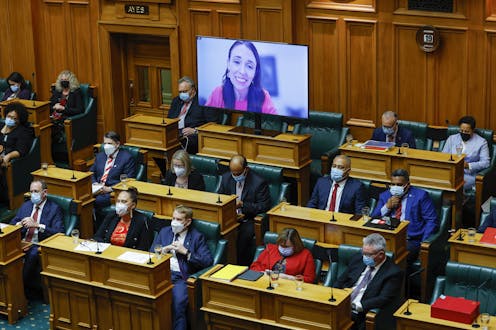
All budgets are about economics and politics, and 2022’s was no different. The Labour government continued its economic rebuild through commitments to infrastructure and industry, low- and middle-income earners’ living costs, and the successful implementation of signature reforms in health and climate.
Commentators judged it largely responsible, given the backdrop of international disruption, risks of continued inflation and stretched supply chains. The reaction to how New Zealand’s women fared, however, has been mixed[1].
Politically, Labour needed to reassure both core and softer voters with this budget. And since the 1990s, women have been an important source of soft votes for Labour. Under John Key, National closed the gender gap that had opened under Helen Clark’s previous administration.
But women voters began to return to Labour[2] in 2017 and overwhelmingly supported Labour in 2020. The NZ Election Study[3] shows 51% of women respondents voted Labour compared to 21% for National. These figures suggest support from women cannot be taken for granted.
Hits and misses
What did the 2022 budget offer New Zealand’s diverse communities of women and non-binary people? There was some good news: the NZ$580m package for Māori and Pacific initiatives and additional funding for the prevention of family and sexual violence were welcome.
So were increases for specialist mental health and addiction services, to health practitioners for care of intersex children and young people, and to ACC for injuries that birthing parents suffer. Sole parent beneficiaries will now receive child support payments as income. And because women continue to earn on average less than men, the additional $350 cost-of-living payment matters.
Read more: A budget for the ‘squeezed middle’ – but will it be the political circuit-breaker Labour wants?[4]
But it isn’t all good news. The equal employment opportunities commissioner has highlighted the cost-of-living payment excludes beneficiaries[5], and pay gaps affecting Māori, Pacific, ethnic communities and disabled whānau have been overlooked.
Such gaps could be addressed if government ministries were required to undertake intersectional[6] analysis of their budget proposals to ensure inequalities based on such things as race, gender, ethnicity, class or sexual orientation aren’t reinforcing one another.
For example, we know women were disproportionately affected by COVID-19 job losses[7], with wahine Māori and Pacific women[8] experiencing the highest rates of unemployment. We also know the underutilisation rate for women[9] is almost four percentage points higher than for men.
Women in work
The budget’s investment in construction, advanced manufacturing, digital tech and agricultural industries, along with the continuation of the Apprenticeship Boost[10] have been positively received.
But as with previous budgets[11], inclusive outcomes are complicated by the gender segregation within our labour market. To be fair, the government has funded initiatives to encourage women to move into these industries, and the number of women working in construction has increased by 12,600 since 2020[12].
Read more: The cost of living crisis means bolder budget decisions are needed to lift more NZ children out of poverty[13]
Proportionally, however, women are only 15% of the sector (a two point increase over two years). Likewise, there has been little increase in the representation of women employed in manufacturing.
Figures from the digital technology sector are harder to distil. According to industry group NZTech, only 27% of digital technology roles were held by women[14], while employment of Māori and Pacific Peoples was at 4% and 2.8% respectively.
The 2022 OECD Economic Survey[15] of New Zealand, and the NZTech and Digital Skills Forum, have both identified the need to develop digital apprenticeships, design inclusive education pathways, and actively support careers for women, Māori and Pacific people in this sector.
Genuine well-being
We also need to remember that continuing to invest in the care economy[16] and social sectors will benefit post-pandemic recovery.
Caring for future generations through climate change mitigation and emissions reductions was also a significant part of this budget. The $150 million investment in clean vehicles, and $109 million for active and public transport initiatives, are commendable.
But applying an equity and gender analysis[17] to these initiatives would reveal the complexities associated with assuming that all New Zealanders will be able to avail themselves of these “greener” options.
For example, New Zealand’s National Climate Change Risk Assessment[18] identified how the impacts of climate change can exacerbate existing inequities for those marginalised by ethnicity, gender, socioeconomic status, age, literacy or health.
Read more: Collapse of negotiations with care workers shows little has changed in how the government views the work of women[19]
While women are interested in electric vehicles[20], the extended (permanent for some) discounts on public transport fares are more likely to benefit them than a clean vehicle rebate; women are more likely than men[21] to use public transport, in part because of their lower income levels.
But cost is not the only barrier to using public transport. Safety is also important[22], meaning connection times between services, regular rural and regional services, street lighting and distances between stops and work or home matter to women.
The budget statement released in December 2021 included evidence that New Zealand women felt a lot less safe than men. The Treasury cites OECD figures[23] that reveal New Zealand’s gender gap on feeling safe is second highest, only slightly better than Australia.
So there is more work for the government to do to ensure inequities are systematically addressed through public policy and the budget process. Perhaps the best starting point would be a requirement that all state agencies include gender[24] in their calculations and analysis. That way New Zealand can truly be a leader on budgeting for “well-being”.
References
- ^ has been mixed (www.stuff.co.nz)
- ^ return to Labour (press-files.anu.edu.au)
- ^ NZ Election Study (www.nzes.net)
- ^ A budget for the ‘squeezed middle’ – but will it be the political circuit-breaker Labour wants? (theconversation.com)
- ^ excludes beneficiaries (www.hrc.co.nz)
- ^ intersectional (www.ted.com)
- ^ job losses (www.stats.govt.nz)
- ^ Māori and Pacific women (www.treasury.govt.nz)
- ^ underutilisation rate for women (www.stats.govt.nz)
- ^ Apprenticeship Boost (www.workandincome.govt.nz)
- ^ previous budgets (www.rnz.co.nz)
- ^ 12,600 since 2020 (www.stats.govt.nz)
- ^ The cost of living crisis means bolder budget decisions are needed to lift more NZ children out of poverty (theconversation.com)
- ^ held by women (nztech.org.nz)
- ^ OECD Economic Survey (www.oecd.org)
- ^ care economy (www.ilo.org)
- ^ equity and gender analysis (www.oecd-ilibrary.org)
- ^ National Climate Change Risk Assessment (environment.govt.nz)
- ^ Collapse of negotiations with care workers shows little has changed in how the government views the work of women (theconversation.com)
- ^ interested in electric vehicles (www.chargesmart.co.nz)
- ^ more likely than men (women.govt.nz)
- ^ also important (www.itf-oecd.org)
- ^ OECD figures (www.oecd.org)
- ^ include gender (women.govt.nz)
Authors: Jennifer Curtin, Professor of Politics and Policy, University of Auckland