HILDA finds working from home boosts women's job satisfaction more than men's, and that has a downside
- Written by: Mark Wooden, Professorial Fellow, The University of Melbourne
The shift to working from home is unlikely to reverse[1].
Data from the HILDA[2] (Household, Income and Labour Dynamics in Australia) Survey released on Monday show the proportion of Australians working “most hours” from home jumped from around 6% before the pandemic to 21% in 2020. Unpublished data available to researchers shows a further jump to 24% in 2021.
While the rise was most pronounced in Victoria (which was in lockdown when the 2020 survey was conducted) there were big increases in all states except Tasmania.
Working from home increased in every industry but agriculture. It increased the most in industries dominated by office jobs.
Easier to work at home, or harder?
The 2020 survey asked those who had increased their hours working at home whether their ability to do their jobs was “much better”, “a little better”, “about the same”, “a little worse”, or “much worse”.
There are arguments in each direction[3]. On one hand, working from home can give workers greater control of their time, making it easier to balance work and non-work activities. And at-home workers often report fewer meetings and interruptions, meaning work at home can be less stressful.
On the other hand, working from home can blur boundaries between work and non-work time, pushing work into unsocial hours. And it can mean workers spend more time isolated, without the opportunity to interact with colleagues.
Read more: About that spare room: employers requisitioned our homes and our time[4]
What the survey found was that the proportion of these workers who reported negative effects on their ability to do their job (42%) far outweighed the proportion who reported positive effects (24%).
Another way of looking at the result is to say that given that one-third of those working more at home reported little change in their ability to do the job, more than half found things no worse.
Although the number reporting negative effects outnumbering the number reporting positive effects might seem surprising, it is less surprising given that many of the people who suddenly had to work from home in 2020 lacked dedicated workspaces and had to share space with other household members working at home and children forced to learn remotely.
In non-pandemic times, when working from home is voluntary and home workspaces are better set up, assessments are likely to be more positive.
Women feel better off, men not much
The 2020 HILDA Survey found minimal effects of working from home on job satisfaction. But preliminary unpublished research we have undertaken on data from the 2021 survey paints a different picture – one divided on gender lines.

Focusing on people employed in both 2019 and 2021, and controlling for worker characteristics, we find a significant positive association between changes in the extent of working from home and changes in job satisfaction among women, but not men.
Furthermore, the improvement among women is concentrated on women with children.
The largest increase is found for those who work two days in the workplace and three days at home.
For mothers who shifted to the two-day/three-day arrangement, average job satisfaction increased by around 0.9 of a point on the scale of zero to ten, which amounted to a 12% improvement.
The findings suggest the main benefit for workers from working from home arises from the improved ability to combine work and family responsibilities – something that matters to women more than men as they continue to shoulder the bulk of home and care work.
Greater opportunities to work from home should thus lead to the greater involvement of mothers in paid work. This is a good thing. But there is at least one potential problem.
Working from home can be a trap
It is well-established that the workers visibly present in a workplace are more likely to be promoted[5] and get extra responsibilities[6] than the workers who are not.
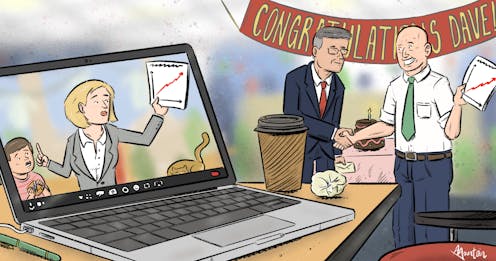
If women become less visibly present at a faster rate than men, their efforts are less likely to be recognised and they are more likely to be excluded from tasks and roles that enhance their promotion prospects.
Unless attitudes change, this downside of working from home is likely to become more apparent for women.
References
- ^ unlikely to reverse (www.nber.org)
- ^ HILDA (melbourneinstitute.unimelb.edu.au)
- ^ each direction (www.pc.gov.au)
- ^ About that spare room: employers requisitioned our homes and our time (theconversation.com)
- ^ promoted (www.gsb.stanford.edu)
- ^ extra responsibilities (pubsonline.informs.org)
Authors: Mark Wooden, Professorial Fellow, The University of Melbourne