When Your Perth Pool Needs More Than Maintenance: A Guide to Pool Renovation and Resurfacing
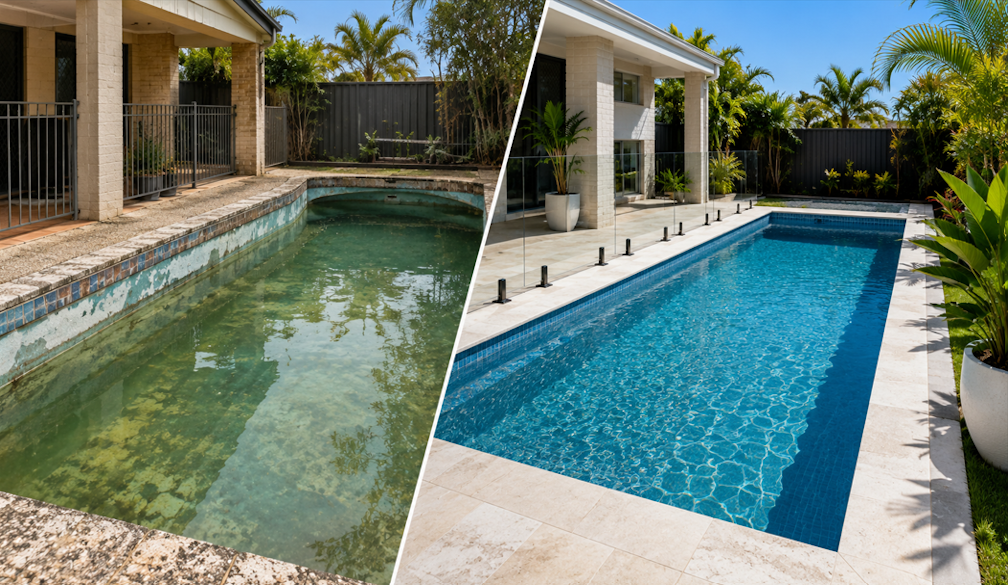
Every pool surface has a finite life. The fibreglass gel coat of a fibreglass pool, the pebblecrete or render of a concrete pool, the vinyl liner of a vinyl pool: each of these surfaces ages, discolours, degrades, and eventually reaches a point where maintenance cannot restore its appearance or its structural integrity. When that point arrives, the pool owner faces a decision that is different from any routine maintenance question: not whether to service the pool, but whether to renovate it.
Pool renovation is one of the more significant investments a Perth property owner can make in their outdoor amenity, and it is one where the decisions made before the renovation begins have a large effect on both the quality of the outcome and the total cost. Understanding what drives pool surface deterioration in Perth's specific climate and water conditions, what the renovation options are for different pool types, and how to approach the project, gives pool owners the informed position from which to make the renovation decision that serves their property best.
Why Perth Pool Surfaces Age the Way They Do
Perth's climate and water conditions create a specific combination of stresses on pool surfaces that accelerates deterioration compared to some other Australian locations.
High UV exposure. Fibreglass gel coats, vinyl liners, and the pigments in pebblecrete and render all degrade under sustained UV exposure. Perth's high solar radiation is one of the harshest conditions in Australia for UV-sensitive materials. A fibreglass pool that might retain its original colour for twelve to fifteen years in a lower-UV location may show significant bleaching and chalking within eight to ten years in Perth.
Perth's water chemistry challenges. Perth's water supply is characterised by high mineral content, particularly in areas supplied by groundwater sources. Hard water increases the rate of calcium scale formation on pool surfaces. Calcium scaling that accumulates on pebblecrete or fibreglass surfaces is not merely aesthetic: as scale builds up and is dissolved by acid treatments over years, the surface below is progressively etched and weakened.
Temperature cycling. Perth's large seasonal temperature variation, from water temperatures that can exceed 35 degrees in summer to below 15 degrees in winter, subjects pool surfaces and the structure beneath them to significant thermal expansion and contraction cycling. Cracking in concrete pool shells and blistering in fibreglass surfaces can be accelerated by this cycling over many years.
Chlorine and chemical exposure. The sustained chemical environment of a pool, including chlorine, pH adjusters, and other chemical additions, is aggressive toward surfaces over time. Surfaces that are poorly maintained, with chemistry running out of range for extended periods, accumulate chemical damage that accelerates deterioration.
Recognising When Renovation Is Needed Rather Than More Maintenance
The transition from a pool that needs more attentive maintenance to one that needs renovation is not always obvious. The signs that renovation is becoming the more appropriate response than continued maintenance:
Surface chalking or delamination in fibreglass pools. A fibreglass pool whose gel coat has oxidised to a chalky, rough texture is showing the visible consequence of UV degradation. Light chalking can sometimes be restored through polishing, but significant chalking or gel coat delamination typically indicates that the surface has reached its usable limit. A resurfaced or recoated fibreglass pool has a new gel coat that restores both the appearance and the protective function of the original surface.
Sustained algae that cannot be eradicated. Pool surfaces that have become microscopically porous through age, chemical damage, or physical abrasion provide a substrate for algae that routine chemical treatment cannot fully penetrate. If a pool requires increasingly aggressive treatment to maintain water quality that it previously maintained easily, a compromised surface may be contributing to the difficulty.
Structural cracking in concrete pools. Fine surface cracking in pebblecrete or render is typically cosmetic and addressable through surface repair. Structural cracking that moves or that has leaked, or cracking that has grown significantly over time, requires structural assessment before surface renovation is appropriate.
Discolouration that does not respond to treatment. Staining from metals (iron, copper, manganese) and from organic sources accumulates in pool surfaces over years. Some staining is reversible through specific chemical treatment. Staining that is too deep in the surface to respond to treatment, or that has permanently discoloured the surface material, is a renovation indicator.
Tile delamination and grout failure. Waterline tiles that are detaching from the pool shell, or grout that has failed and is allowing water behind the tile, require renovation rather than maintenance. Attempting to re-grout individual tiles without addressing the underlying cause of adhesion failure typically does not produce durable results.
Pool Renovation Options for Perth Homes
The range of renovation options available depends on the pool type and construction, the extent of the deterioration, and the budget and goals of the pool owner.
Fibreglass pool renovation options:
Fibreglass pools can be renovated through several approaches depending on the condition of the existing gel coat and shell structure.
A gel coat restoration through professional polishing and recoating can address early-stage chalking and minor surface oxidation, restoring the gloss and colour without a full resurface. This is the most economical intervention when the gel coat is not yet fully degraded.
A full gel coat resurface involves applying a new gel coat layer over the cleaned and prepared existing shell. This is the standard renovation for fibreglass pools where the original gel coat has reached the end of its useful life. The new gel coat restores the pool's appearance and its chemical resistance properties and typically extends the pool's surface life by ten to fifteen years.
A fibreglass pool that has developed structural issues requires a different approach, potentially including structural repair followed by a new gel coat, or in cases of significant structural compromise, assessment by a structural engineer before any surface renovation is appropriate.
Concrete pool renovation options:
Concrete pools offer more renovation options than fibreglass because the shell is more structurally robust and the surface materials can be changed entirely.
Resurfacing with a new pebblecrete or aggregate finish is the most common renovation for aged concrete pools in Perth. The old surface is removed by hydro-blasting or mechanical preparation, and a new aggregate finish is applied. This restores the pool's appearance completely and renews the surface life.
Conversion to a tiled finish involves applying a full tile finish over the concrete shell rather than an aggregate surface. Tiles are more durable than pebblecrete, easier to maintain, and provide a premium appearance. The conversion cost is higher than aggregate resurfacing, but the resulting surface has a longer service life and is arguably more appropriate for a contemporary Perth home.
Application of a paint or pool coating system is the most economical surface renovation option for concrete pools and is appropriate where the budget does not support full resurfacing. Pool paint systems have shorter service lives than aggregate or tile finishes and require reapplication every three to five years, but they restore the appearance and reduce the surface porosity that causes algae problems at a lower initial cost.
The Pool Equipment Audit That Should Accompany Every Renovation
A pool surface renovation is the best opportunity to address pool equipment that has been ageing alongside the deteriorating surface. Accessing pool plumbing, lighting, and fittings is easiest when the pool is already empty for the surface renovation. Addressing equipment issues during the renovation avoids the cost of draining the pool again for equipment work shortly after the renovation is complete.
The equipment audit that should accompany any pool renovation includes:
Return jets and fittings. The return jets and other fittings that penetrate the pool shell are sealed at their interface with the shell surface. A surface renovation is the ideal time to replace aged fittings and ensure fresh seals, because these cannot be properly re-sealed over an aged surface.
Pool lighting. Pool lights have finite service lives and are significantly easier to replace when the pool is empty. If existing lights are more than ten years old, replacing them with LED equivalents during the renovation avoids early post-renovation disruption.
Plumbing and skimmer boxes. Plumbing that has aged alongside the surface, and skimmer boxes whose bodies or weirs have deteriorated, are worth replacing during the renovation when access is straightforward.
Pump and filter assessment. While not requiring pool drainage for replacement, a pump and filter assessment timed with the renovation allows the equipment replacement to be planned and budgeted as part of the overall renovation scope. Pool pump and filtration equipment that is installed alongside a new pool surface gives the renovated pool the best possible start to its renewed service life.
Managing the Renovation Process
Pool renovation projects in Perth involve specific tradespeople, specific materials, and specific sequencing that differs from general building renovation work.
The renovation contractor should be experienced in the specific surface type being applied, because application technique and curing conditions are critical to the quality of the finished surface. Pebblecrete and aggregate finishes require specific application temperature and humidity conditions and appropriate curing time before the pool is filled. Gel coat recoating has specific preparation, application, and curing requirements that differ from aggregate work.
After any pool surface renovation, the water fill and chemistry startup process requires careful attention. New pebblecrete and aggregate surfaces leach cement compounds into the pool water during the initial filling and chemical startup period, requiring specific management to prevent calcium scaling on the new surface. This startup chemistry period is one of the most important and most commonly mismanaged aspects of a pool renovation, and getting it right protects the investment in the new surface from the first day.
For Perth pool owners planning a renovation, establishing the service relationship with an experienced pool service provider before the renovation is complete gives access to knowledgeable startup chemistry management from the day the pool is filled.
Conclusion
Pool renovation in Perth is a significant investment that, when timed correctly and executed well, restores a pool's appearance and function and extends its useful life by a decade or more. The decision to renovate rather than continue maintaining a deteriorating surface is straightforward when the surface condition is assessed honestly and the renovation options are understood.
Getting the renovation right, from surface preparation through to equipment updates and startup chemistry management, is the difference between a renovation that delivers excellent value across its extended service life and one that requires attention again within a few years.