Underlying inflation has slipped below 6%, but is the slide enough to stop the RBA pushing up rates further?
- Written by: John Hawkins, Senior Lecturer, Canberra School of Politics, Economics and Society, University of Canberra
Australia’s inflation rate has fallen for the second consecutive quarter.
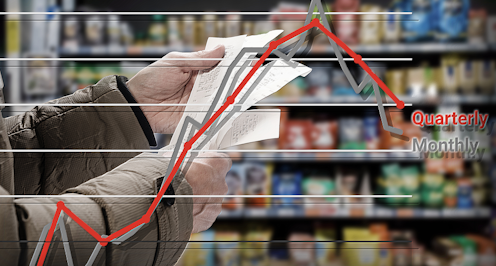
After reaching a 30-year high of 7.8% at the end of 2022, annual inflation as measured by the Bureau of Statistics’ quarterly Consumer Price Index[1] slid to 7% in the March quarter of 2023, and fell further to 6% in the June quarter.
The quarterly results are consistent with the newer monthly measure of annual inflation[2] which has also been falling since hitting a high of 8.4% in December.
The monthly measure slid to 5.4% in June.
Helping bring inflation down were state government electricity rebates and cuts in the prices some households paid for medicines.
The prices of new dwellings grew more slowly as demand eased and problems with the supply of materials improved.
Conversely, there were sharp increases in the prices of insurance and some other financial services.
The bureau’s measure of rents (which covers rents paid in distinction to more widely quoted measures of rents advertised) grew by 6.7% in the year to June, up from 4.9% in the year to March, and the most since 2009.
Underlying inflation down
To get a better idea of what would be happening were it not for some of these unusual and outsized moves, the bureau calculates what it calls a trimmed mean[3] measure of “underlying” inflation.
This excludes the 15% of prices that climbed the most in the quarter and the 15% of prices that climbed the least or fell.
This measure, closely watched by the Reserve Bank, is also falling and is now 5.9%.
The fall in Australia’s inflation is in line with falls in other Western nations including the United States, Canada and the United Kingdom. They have been brought about by an easing of supply bottlenecks and slowing economic activity in response to increases in interest rates.
An exception is China, which has almost no inflation.
Much of the slide in Australia’s inflation rate reflects weaker economic growth.
The economy grew only 0.2% in the March quarter. The Reserve Bank believes it grew by only that much again[4] in the June quarter.
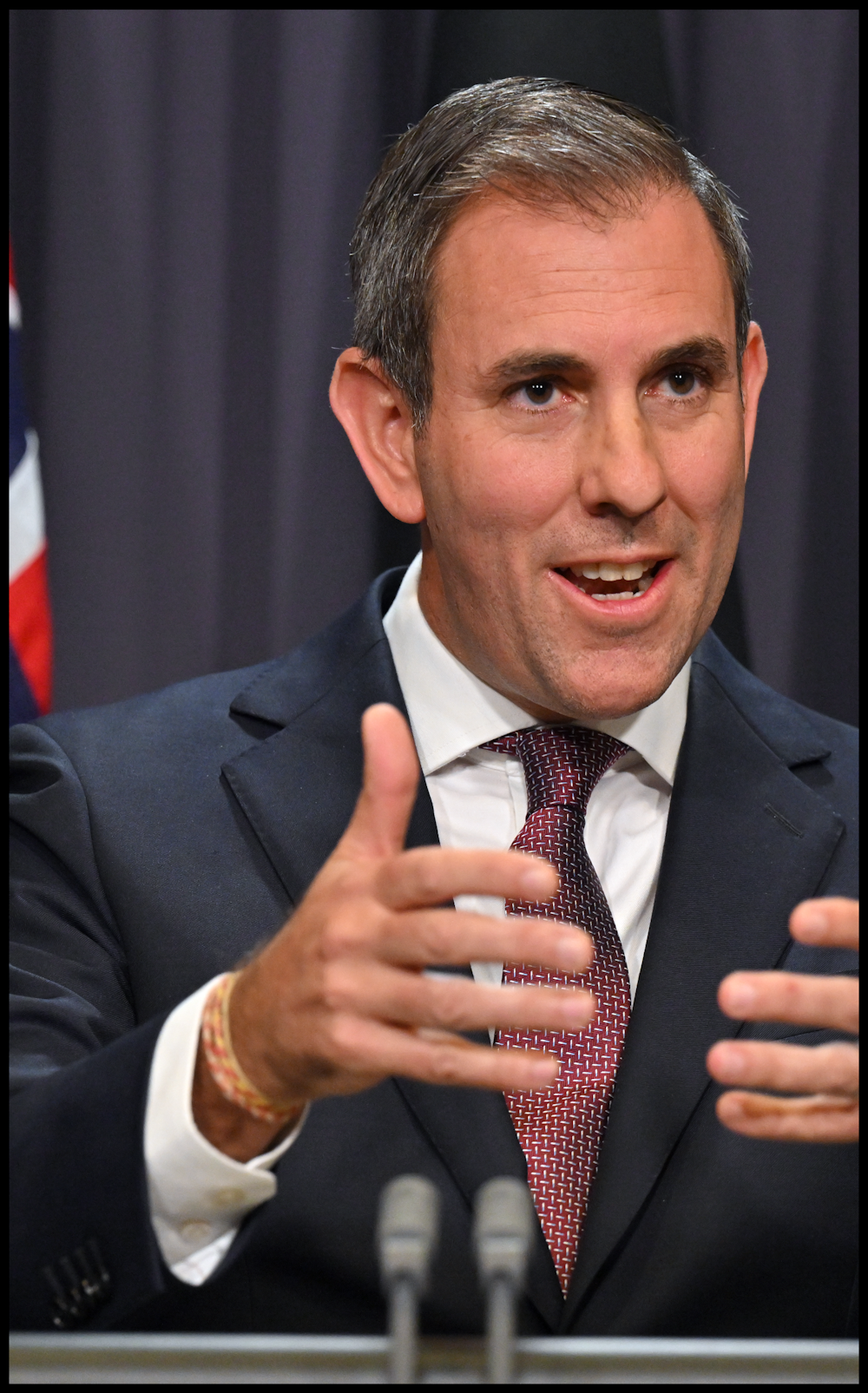
Treasurer Jim Chalmers was keen to highlight the role of his budget cost-of-living package which he said would help with rent, energy bills and childcare.
Many common medicines would become cheaper from September as a result of the government’s decision to allow some people to buy two months’ worth of supply for the price of a single prescription.
Chalmers said inflation was only 0.8% in the June quarter itself, less than half the rate of the quarterly peak in the March quarter of 2022, just before the 2022 election.
While he would prefer inflation to be falling more quickly, Australia was “making progress”.
What does it mean for my mortgage?
The 6% inflation rate is lower than the 6.3% forecast[5] for June in the Reserve Bank’s Statement of Monetary Policy[6] released in May, although that forecast assumed a lower cash rate than the 4.1% the bank lifted its cash rate to in June.
This makes it look as if inflation is falling fast enough to reach the bank’s 2-3% target band by mid-2025, which is a pace the bank had said was acceptable.
Outgoing governor Phil Lowe defended[7] that pace in April, saying
if we can get inflation back to 3% by mid-2025 and preserve many of those job gains that have been delivered in the last few years, that’s a better outcome than getting inflation back to 3% one year earlier and having more job losses.
Incoming governor Michele Bullock has also[8] argued a faster return to target would likely mean unnecessary job losses, saying:
our judgement is that if we can return inflation to target in a reasonable timeframe – while preserving as many of the employment gains as we can – that would be a better outcome.
Today’s news does not suggest the bank needs to lift rates further. It shows it is still on what Lowe calls the “narrow path[9]” to getting things right.
Read more: The Lowe road – the RBA treads a 'narrow path'[10]
It is possible that the broad-based increases in the inflation rate for services, driven in part by faster wage growth, might be a concern for the bank. And it is possible the present low unemployment rate could push up wages growth further.
The bank will be scanning reports from its business liaison program[11] for clues.
But it is likely to take comfort from the fact inflation is falling as it expected it to, and at about the expected pace. It will meet to discuss rates next Tuesday.
It certainly isn’t likely to cut rates for quite some time. At 6%, inflation remains well above its 2-3% target.
References
- ^ Consumer Price Index (www.abs.gov.au)
- ^ monthly measure of annual inflation (www.abs.gov.au)
- ^ trimmed mean (www.rba.gov.au)
- ^ only that much again (www.rba.gov.au)
- ^ forecast (www.rba.gov.au)
- ^ Statement of Monetary Policy (www.rba.gov.au)
- ^ defended (www.rba.gov.au)
- ^ also (www.rba.gov.au)
- ^ narrow path (www.rba.gov.au)
- ^ The Lowe road – the RBA treads a 'narrow path' (theconversation.com)
- ^ business liaison program (www.rba.gov.au)
Authors: John Hawkins, Senior Lecturer, Canberra School of Politics, Economics and Society, University of Canberra