SUV and ute sales slowed due to NZ's Clean Car Discount – expect that to reverse under a new government
- Written by: Timothy Welch, Senior Lecturer in Urban Planning, University of Auckland
With National, ACT and NZ First locked in coalition negotiations, various urgent and climate-related transport challenges hang in the balance.
Based on pre-election rhetoric, the Clean Car Discount (CCD) scheme may soon be gone. While popular with the public, National has criticised the electric vehicle rebate portion as a “Tesla subsidy”, and the fees charged for high-emissions vehicles as a “ute tax”.
Transport agency Waka Kotahi has already put funding for cycling, pedestrian and public transport initiatives on hold[1], pending a “clear direction from the incoming government on its transport investment priorities”.
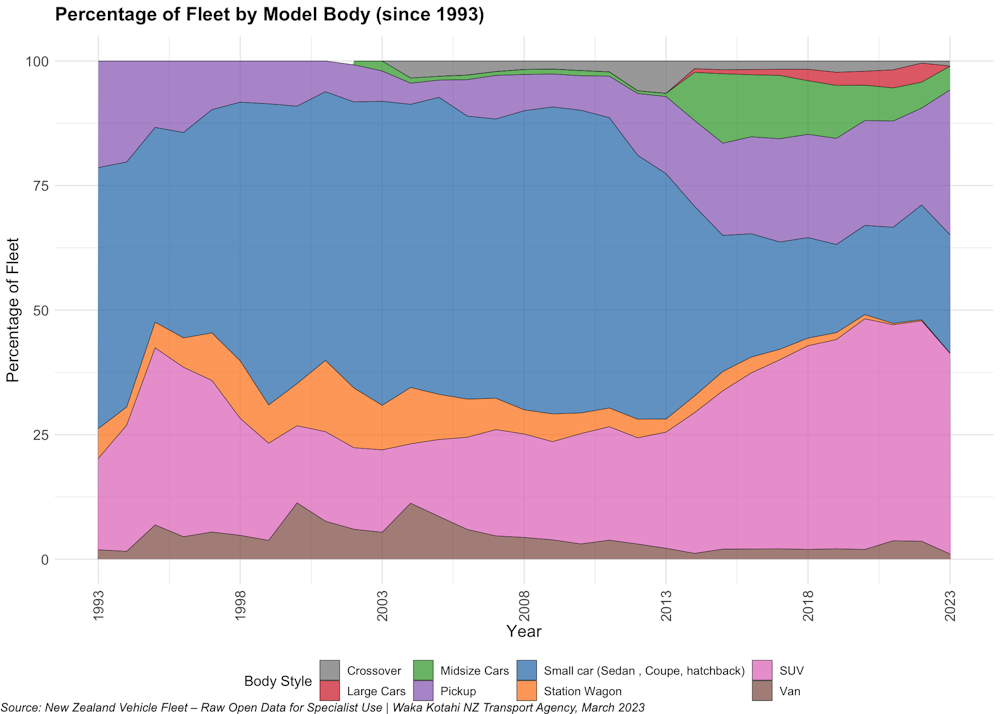
If the CCD does end, it’s likely the upward trend in SUV and ute purchases, which lost steam with the introduction of the programme, will once again pick up. Combined with any lost momentum on developing other transport modes, the impact on road safety and emissions reduction could be significant.
Utes and SUVs take over
Big vehicles already dominate New Zealand streets.
In 2009, over 75% of annual passenger vehicle registrations were for small cars, sedans and hatchbacks. SUVs and utes made up just 20% of imports.
By 2022, 87,669 (53%) of the 164,813 new vehicles sold[2] in New Zealand were SUVs of some variety, and 35,056 (21%) were utes. All other vehicles, including passenger cars, vans and buses, comprised about 25% of new registrations.
Read more: Where did the cars go? How heavier, costlier SUVs and utes took over Australia's roads[3]
Four of the five top-selling vehicles in the passenger segment in 2022 were utes and SUVs. They included (in order of sales volume) the Ford Ranger, Toyota Hilux, Mitsubishi Outlander and Mitsubishi Triton. Combined, these four big vehicles accounted for 40% of new registrations.
The low fuel economy of these vehicles directly translates to higher carbon emissions. Depending on the model, the Ford Ranger[4] has a fuel economy rating between 7.6 litres per 100 kilometres and 11.5 L/100km; the Toyota Hilux[5] has a range of 7.1 L/100km to 9.7 L/100km.
By comparison, the best-selling conventionally fuelled compact car, the Suzuki Swift[6], manages a significantly more efficient 4.6 to 6.1 L/100km.
Blind spots and safety
SUVs and utes are also much taller, weigh more, have higher grilles and bonnets, and have more blind spots than more compact vehicles. This makes them more dangerous in urban environments, for pedestrians and cyclists in particular.
In a crash, a vulnerable pedestrian is more likely to suffer a direct strike to the head from a ute or SUV than from a smaller car, where they are more likely to roll onto the bonnet and hit their head with less blunt force.
Read more: Four reasons SUVs are less safe and worse for the environment than a regular car[7]
A recent report from the Vias Institute[8] in Brussels found that if a ute hits a pedestrian or cyclist, “the risk of fatal injuries [increases] by nearly 200%”.
The same report showed ute occupants are 65% less likely than other vehicle type occupants to suffer a serious or fatal injury in a crash. Safety is one of the main reasons SUV and ute owners cite for buying a larger vehicle.
Conversely, the risk of serious or fatal injury for occupants of smaller cars that collide with utes increases by 50%.
Problems with a technological fix
SUV and ute manufacturers have recognised the increased danger blind spots pose to vulnerable road users. New technology has been added to the vehicles, including proximity sensors, 360-degree cameras and automatic emergency braking (AEB).
The technology is geared primarily to avoid collisions with other vehicles and improve safety for vehicle occupants. Studies have shown it can reduce vehicle-to-vehicle collisions by up to 25%.
The record with pedestrians and cyclists is less clear. But one obvious problem is the inability of the technology to function when the vehicle is turning, operating in adverse weather conditions, or at a very slow speed.
Read more: 70 years of road-based policies created today's problems – does National’s transport plan add up?[9]
A recent study[10] from the US Insurance Institute for Highway Safety showed fatal collisions with crossing pedestrians were more likely when a vehicle is turning than when it was not.
The rates were about twice as high for SUVs, nearly three times as high for vans and minivans, and nearly four times as high for pickups as they were for cars.
The Ford Ranger’s AEB system “does not react to pedestrians in turning scenarios[11]”, according a safety testing report from the Australasian New Car Assessment Program (ANCAP), the independent vehicle-testing organisation used by Australia and New Zealand. The Toyota Hilux and Mitsubishi Triton have no ANCAP data on turning.
Danger and discouragement
Utes and SUVs also tend to have more blind spots than smaller cars when reversing. In New Zealand, five children are killed every year in driveway “backover” incidents.
As far back as 2011, before the big shift to larger vehicles, a Safekids New Zealand report[12] on child driveway injuries found:
Cars run over more children than any other type of vehicle, but light trucks, commercial vans, four-wheeled drive and sport utility vehicles (SUVs) are consistently identified as being over-represented in the numbers of vehicles involved.
According to ANCAP safety tests, none of the four top-selling SUVs and utes in New Zealand have AEB systems tested or operated in backover scenarios.
Pedestrians and cyclists are over-represented in road deaths. Last year was particularly deadly for vulnerable road users, with cyclists making up 5% of all road deaths[13] despite accounting for only about 1% of all trips[14].
The sad irony is that the dominance of SUVs and utes reduces the ability[15] of communities to create safer streets that would encourage more walking and cycling. If the new government reverses transport policies aimed at encouraging walking and cycling and reducing the prevalence of large vehicles, those efforts will be set back even further.
References
- ^ on hold (www.rnz.co.nz)
- ^ new vehicles sold (www.mia.org.nz)
- ^ Where did the cars go? How heavier, costlier SUVs and utes took over Australia's roads (theconversation.com)
- ^ Ford Ranger (www.stuff.co.nz)
- ^ Toyota Hilux (www.stuff.co.nz)
- ^ Suzuki Swift (www.carsguide.com.au)
- ^ Four reasons SUVs are less safe and worse for the environment than a regular car (theconversation.com)
- ^ report from the Vias Institute (www.vias.be)
- ^ 70 years of road-based policies created today's problems – does National’s transport plan add up? (theconversation.com)
- ^ recent study (www.iihs.org)
- ^ does not react to pedestrians in turning scenarios (s3.amazonaws.com)
- ^ Safekids New Zealand report (media.starship.org.nz)
- ^ 5% of all road deaths (www.transport.govt.nz)
- ^ 1% of all trips (www.transport.govt.nz)
- ^ reduces the ability (theconversation.com)
Authors: Timothy Welch, Senior Lecturer in Urban Planning, University of Auckland