What if I discover mould after I move into a rental property? What are my rights?
- Written by: Rebecca Bentley, Professor of Social Epidemiology and Director of the Centre of Research Excellence in Healthy Housing at the Melbourne School of Population and Global Health, The University of Melbourne
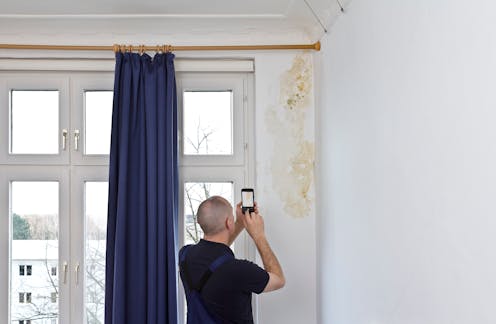
A startling number of Australian rental homes come with an unwanted housemate: mould.
If you discover mould in a rented home, who is responsible and what can you do if the landlord seems unwilling to fix it?
Read more: Climate-related disasters leave behind trauma and worse mental health. Housing uncertainty is a major reason why[1]
Find the cause
The landlord is responsible if the mould is caused by the structural condition of the property. This can include things like leaking pipes, gutters, roofs or windows.
Tenants are responsible for mould remediation if the way they occupy a home has promoted mould growth. For example, if they have not been using exhaust fans in bathrooms, have been failing to ventilate their home or have been storing wet clothes in a cupboard.
This means establishing the cause of the mould is crucial to working out who’s responsible for repairs.

Why are so many rentals mouldy?
Australia has a rental home mould problem chiefly because much of our housing hasn’t been built to suit our climate. Houses tend not to be built with sufficient consideration of:
It is estimated that nearly 17% of privately rented homes and 22% of social housing dwelling require major repairs[2]. This includes structural defects, such as large cracks in walls or leaking gutters, that can generate mould growth.
Tenant representatives have said in the past there is also a problem of weak enforcement of laws concerning the condition of rental homes[3].
4 ways to cut mould risk
To reduce your mould risk, you need to manage indoor moisture and temperature. Try to:
keep the home well ventilated
open windows and use exhaust fans in the bathroom and kitchen
in humid climates, use air conditioning or a dehumidifier
in cold climate, use a dehumidifier (desiccant dehumidifiers might more appropriate in very cold places)
reduce moisture in the home by wiping up spills and condensation on surfaces
dry washing outside
if buying a dryer, opt for a condensing dryer instead of a conventional dryer (condensing driers put out much less vapour)
report any structural issues (such as leaking pipes or windows that don’t close properly) to the agent or landlord as soon as you notice them.
 Don’t dry your washing inside.
Shutterstock
Don’t dry your washing inside.
Shutterstock
Rental minimum standards differ by state or territory
In New South Wales, adequate ventilation is one of the minimum standards[4] properties must meet to be considered fit to live in.
If the rental provider has been notified about mould problems in the house but has failed to act, you might consider getting advice from the Tenants’ Union of NSW[5].
Its fact sheet on mould[6] also explains what to do if you’d like to contact the NSW Civil and Administrative Tribunal[7] to apply for repairs, rent reduction or compensation.
In Victoria, rental minimum standards[8] say “all rooms must be free from mould and damp caused by or related to the building structure.”
The Tenants Victoria[9] website has information on how to ask a landlord to fix a mould problem or structural problems leading to mould and how to apply to the Victorian Civil and Administrative Tribunal[10] if the landlord fails to act.
In Queensland, it depends on when you signed the lease. If you signed after September 1 this year (after new standards[11] were introduced) tenants should notify the landlords of mould as soon as they discover it[12].
If mould is a result of problems with the property and the landlord doesn’t undertake repairs, tenants can contact the Queensland Civil and Administrative Tribunal[13].
The guidelines in Western Australia[14] say the landlord must ensure the premises is “in a reasonable state of cleanliness and a reasonable state of repair […] and must conduct any repairs within a reasonable period after the need for the repair arises.” And in Western Australia[15], mould caused by faults in gutters or other fixtures is the responsibility of the rental provider. Further information on what to do[16] if a dispute over the premises can’t be resolved amicably is available on the state government website.
In South Australia[17] rental properties must be “reasonably free from mould or other irritants [and] reasonably free from the adverse effects of moisture or damp.” If a landlord refuses to fix something after being asked, the tenant can apply to the South Australian Civil and Administrative Tribunal[18].
In Tasmania[19], rental properties must be clean and in good repair when leased out. According to[20] the Tasmanian government website on the issue,
‘Clean’ includes having no […] serious mould/rising damp issues.
If the tenant requests repairs and the landlord doesn’t act, the tenant can lodge a repair order with the Commisioner’s office[21].
In the Australian Capital Territory, the Tenants’ Union ACT has guidance on what to do if you discover mould[22] in a property you rent.
In the Northern Territory, tenants may wish to seek advice from the Tenants’ Advice Service[23] if there is a mould problem in a property they rent.
What policy change could help?
If the cause of indoor mould is related to the design and construction of the house, rental providers should act. But tenants may not have the information they need to determine and substantiate this claim and can’t do much to get rental providers to act on mould if it’s not clear what’s causing it. Also, renters often worry asking for repairs could lead to a rent increase or eviction.
Solutions include strengthening tenants rights to compel landlords to investigate the cause of mould in a house (given that knowing the cause is essential to assign responsibility for repairs). There should also be more stringent enforcement of current minimum standards relating to mould in rental properties.
Given the scale of problems like mould in Australian homes, policymakers may wish to consider whether a parliamentary inquiry on home environments and health is needed.
This would give Australians a chance to speak about their experiences – something that could help policy makers improve regulation in the rental sector.
Read more: Sudden mould outbreak after all this rain? You’re not alone – but you are at risk[24]
References
- ^ Climate-related disasters leave behind trauma and worse mental health. Housing uncertainty is a major reason why (theconversation.com)
- ^ major repairs (www.abs.gov.au)
- ^ condition of rental homes (www.ahuri.edu.au)
- ^ minimum standards (www.fairtrading.nsw.gov.au)
- ^ Tenants’ Union of NSW (www.tenants.org.au)
- ^ fact sheet on mould (www.tenants.org.au)
- ^ NSW Civil and Administrative Tribunal (www.ncat.nsw.gov.au)
- ^ rental minimum standards (www.consumer.vic.gov.au)
- ^ Tenants Victoria (tenantsvic.org.au)
- ^ Victorian Civil and Administrative Tribunal (www.vcat.vic.gov.au)
- ^ standards (www.housing.qld.gov.au)
- ^ mould as soon as they discover it (www.rta.qld.gov.au)
- ^ Queensland Civil and Administrative Tribunal (www.qcat.qld.gov.au)
- ^ Western Australia (www.legislation.wa.gov.au)
- ^ Western Australia (www.commerce.wa.gov.au)
- ^ what to do (www.commerce.wa.gov.au)
- ^ South Australia (www.housingsafetyauthority.sa.gov.au)
- ^ apply to the South Australian Civil and Administrative Tribunal (www.sa.gov.au)
- ^ Tasmania (www.cbos.tas.gov.au)
- ^ According to (www.cbos.tas.gov.au)
- ^ Commisioner’s office (www.cbos.tas.gov.au)
- ^ mould (www.tenantsact.org.au)
- ^ Tenants’ Advice Service (www.dcls.org.au)
- ^ Sudden mould outbreak after all this rain? You’re not alone – but you are at risk (theconversation.com)
Authors: Rebecca Bentley, Professor of Social Epidemiology and Director of the Centre of Research Excellence in Healthy Housing at the Melbourne School of Population and Global Health, The University of Melbourne