What is Iran’s ‘axis of resistance’ and why is it uniting in fury against the US and Israel?
- Written by: Mariam Farida, Lecturer in Terrorism and Counter-Terrorism Studies, Macquarie University
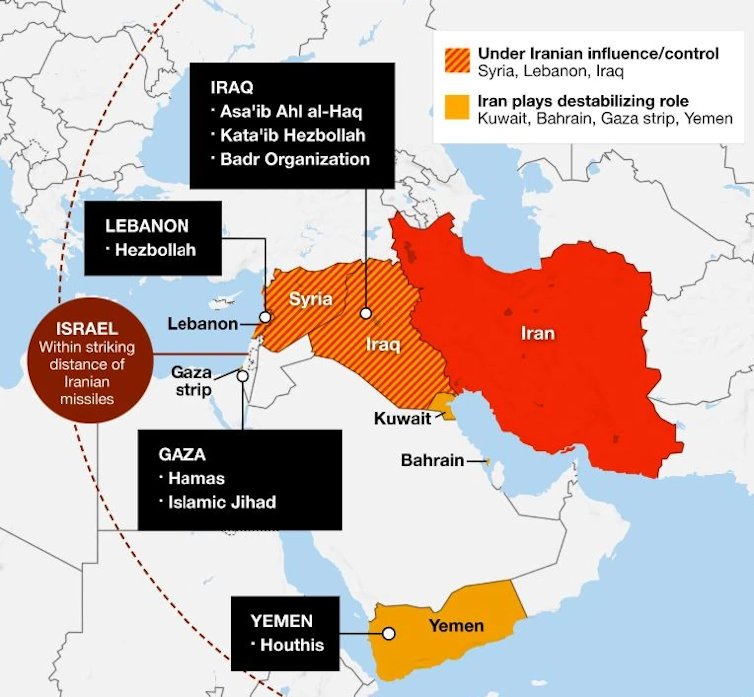
Days after a drone attack killed[1] three US soldiers at a military outpost in Jordan – an attack blamed on a shadowy Iranian-linked militia group – it appears a wider regional conflict may have been averted. At least for now.
The US has indicated it will take a tiered response[2] to the attack – though it hasn’t said how – and the head of Iran’s Revolutionary Guards has said[3] that Tehran is “not looking for war.”
But Iranian-backed militias in Iraq and Syria have now launched[4] more than 160 attacks against the US military since the October 7 Hamas attack on Israel and start of the war in Gaza. And Houthi militants in Yemen, also supported by Iran, have threatened to continue their attacks on ships in the Red Sea.
So, what is driving these groups in the so-called “axis of resistance” and how much control does Iran have over their actions?
Shia armed groups in Iraq
The militia blamed by the US for the drone attack in Jordan, Kata’ib Hezbollah, said earlier this week it was halting[7] its military operations in Iraq under pressure from both Iran and Iraq.
It is just one of many Iran-backed groups in the country that operates under the umbrella banner of Islamic Resistance in Iraq.
Armed militias began emerging in Iraq in the wake of the US invasion of the country in 2003. These groups grew exponentially stronger when they organised as a collective front to confront the ISIS terror group.
The Popular Mobilisation Forces[8], or Al Hashd Al Sha’bi, was established in 2014 and became the main Shia paramilitary organisation confronting ISIS, alongside other Iran-backed groups such as Hezbollah in Syria.
But with threat of ISIS decreasing after its military defeat in 2019, the Popular Mobilisation Forces shifted their attention back to US targets in Iraq.
In recent years, these groups have presented themselves as the muqawama[9], or “resistance”, against the US and its allies in Iraq. As such, they have launched hundreds of attacks against US and Turkish military bases and other targets in Iraq and Syria.
Hezbollah
Hezbollah, or the “Party of God”, emerged in the 1980s as an armed militia to free the southern parts of Lebanon from Israeli occupation and to improve conditions for the marginalised Shia minority in Lebanon.
The party has subsequently portrayed itself as a legitimate political party in Lebanon. As such, Hezbollah has been able to successfully operate across multiple domains[10]. It has a civilian (da’wa) role in social welfare and religious education in Lebanon, as well as a military-resistance role (jihad), carrying out attacks against US and Israeli targets in Lebanon and across the border with Israel.
Its relationship with Iran has deepened[11] over the years, with Hezbollah receiving[12] hundreds of millions of dollars a year from Iran for training and weapons.
Yet, Hezbollah has proved to be extremely competent in its ability to downplay its religious ideals and principles to operate with autonomy as a mainstream political organisation in Lebanon.
Houthis
Also known as Ansar Allah (“Supporters of God”), the Houthis[13] are a Shia armed group that emerged out of the Zaydi sect from Yemen’s northern highlands in the 1990s. The group rebelled against Yemen’s government in 2014 and eventually took control over most of the country. The group then spent years, with Iran’s backing, fighting a military coalition led by Saudi Arabia that was trying to oust them.
Interestingly, even though Houthis were never directly engaged in attacking US targets (or its allies) in the past, this changed with the Israeli war against Hamas in Gaza.
Read more: How much influence does Iran have over its proxy 'Axis of Resistance' − Hezbollah, Hamas and the Houthis?[14]
The Iran connection
From the outset, what these groups have in common is a shared sectarian and ideological connection – Shia Islam.
Shias have historically[15] been a minority in the Muslim world, suffering systematic persecution, political isolation and low socio-economic status in countries such as Iraq, Lebanon and the Gulf states.
But this began to change with the Iranian revolution in 1979 and the rise of Shia clergy in that country. The Iranian regime, mainly through its military apparatus, the Revolutionary Guards, sought to transfer the “Shia revolution” across borders to try to redress years of Shia political isolation and economic deprivation.
Hezbollah was considered the first and most successful of the Iran-backed organisations that arose from this movement. It was able to build and maintain a strong military arm and political presence in Lebanon that made it a key regional player – and still does.
With its weaponry and financial backing, Iran became the ideological guardian of this growing “axis” of groups across the Middle East. These proxy groups, in turn, have helped Iran maintain a great degree of strategic power in the region, which has become key to its foreign policy and its ability to wield influence.
Read more: Iran is not the regional puppetmaster many think and risks losing control if the current crisis escalates[16]
United by resistance
But even though these groups share deep political and ideological connections, they still operate as nationalist organisations in their respective countries. As such, each has its own domestic interests and ambitions. This has included improving the livelihoods of Shia communities and gaining political power.
This has been framed as a form of resistance or muqawama. This can be viewed in different ways: resistance against occupation, resistance against oppressive regimes and resistance against imperialist, hegemonic powers.
This is a cornerstone of Shia ideology – the idea of “oppressors vs. the oppressed” – which grew from the martyrdom of Hussein ibn Ali, grandson of the Prophet Muhammad, during the battle of Karbala[17] in the year 680. This narrative has become the symbol of Shia resistance in its various forms.
This is part of the reason why groups like Hezbollah, the Houthis and the Islamic Resistance in Iraq have united under the same banner – “Axis of Resistance”. This theme extends to Hezbollah’s resistance against the Israeli occupation of southern Lebanon, the Houthis resistance against the Saudi-coalition forces, and the armed Shi’ite groups in Iraq attacking ISIS and now US troops.
More recently, these groups have united as a form of resistance against Israel (and its main supporter, the US) over its war in Gaza.
The extent of Iran’s power over these proxies remains a big question. Iran has denied ordering the attacks on US forces in Iraq, Syria and now Jordan, saying each faction in the “axis of resistance” acts independently to oppose “aggression and occupation[18]”.
The fact we are seeing a rise in military operations by all of these groups, however, indicates they are becoming increasingly essential to Iran and its strategy of expanding its influence and countering the US in the Middle East.
References
- ^ killed (theconversation.com)
- ^ tiered response (www.youtube.com)
- ^ said (www.nytimes.com)
- ^ launched (www.washingtonpost.com)
- ^ Master Strategist/Axis of Resistance (historica.fandom.com)
- ^ CC BY-SA (creativecommons.org)
- ^ halting (www.nytimes.com)
- ^ Popular Mobilisation Forces (www.lse.ac.uk)
- ^ muqawama (acleddata.com)
- ^ multiple domains (www.routledge.com)
- ^ deepened (theconversation.com)
- ^ receiving (www.cfr.org)
- ^ Houthis (theconversation.com)
- ^ How much influence does Iran have over its proxy 'Axis of Resistance' − Hezbollah, Hamas and the Houthis? (theconversation.com)
- ^ historically (scholar.harvard.edu)
- ^ Iran is not the regional puppetmaster many think and risks losing control if the current crisis escalates (theconversation.com)
- ^ battle of Karbala (blog.oup.com)
- ^ aggression and occupation (www.nytimes.com)
Authors: Mariam Farida, Lecturer in Terrorism and Counter-Terrorism Studies, Macquarie University