Can more ethical histories be written about early colonial expeditions? A new project seeks to do just that
- Written by: Cameo Dalley, Senior Lecturer, The University of Melbourne
Aboriginal and Torres Strait Islander readers are advised this article contains names and images of deceased people. The name of the Aboriginal man in this article was how he was referred to, and his relative has requested we honour this name.
Truth-telling is at the heart of a new research project we are currently leading that re-examines the legacy of the Hann Expedition, which travelled Queensland’s Cape York Peninsula in 1872.
Our project seeks to rewrite this period of history – and others – to honour the voices and experiences of Aboriginal people whose contributions to colonial-era expeditions have long been overlooked.
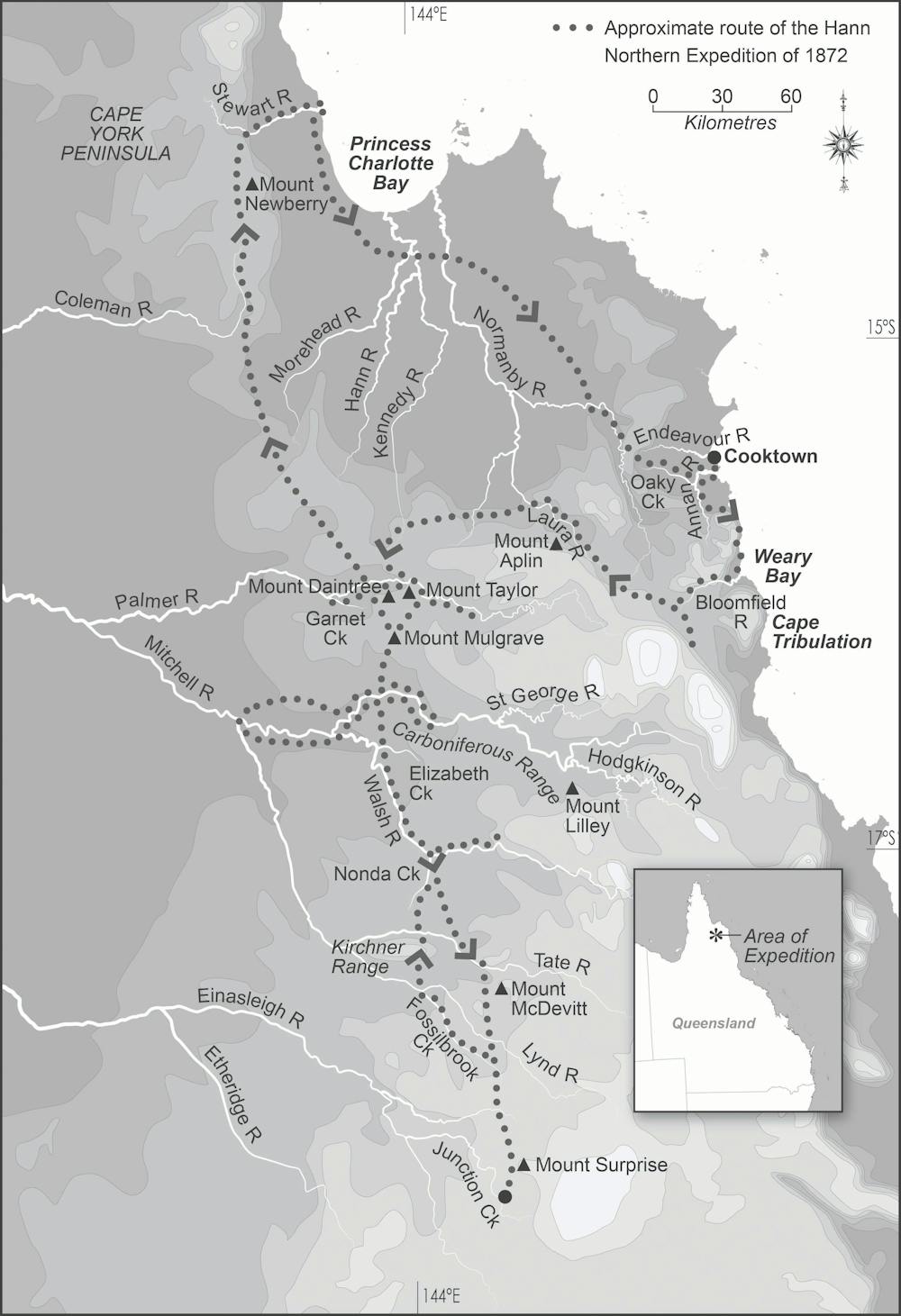
The Hann Expedition began in Mt Surprise, Queensland, in April 1872, and made a loop across the peninsula before finishing at the Junction Creek Telegraph Station seven months later. The team consisted of six white men and an Aboriginal guide. The purpose was to map and record “unknown” parts of Queensland and determine whether the lands would be feasible for mining and pastoral development.
Apart from geological descriptions and mapping, the expedition is credited with recording and collecting specimens of at least 149 plants previously unknown to Western science. However, using records from the expedition, we found[1] these species were likely only located with the help of the young Girramay man, Jerry, who was their guide.
Jerry was derogatorily referred to as “the blackboy”, and his important role in the expedition has never been fully acknowledged.
The importance of Aboriginal knowledge to the expedition compelled us to further examine the encounters the men had with other Aboriginal people along the route. This likely included Olkala, Kuku Yalanji, Lama Lama and Guugu Yimithirr people.
In one of these encounters, botanist Thomas Tate and Jerry found a young Aboriginal boy near a lagoon and took him back to their camp. The boy’s family immediately retrieved him and returned the next day, threatening the team with weapons.
In other encounters, the team unsuccessfully tried to communicate with Aboriginal people, seeking information that would be useful to their expedition.
Our research team also found a detailed map created by Norman Taylor, the expedition’s geologist, which includes observations about encounters with Aboriginal people, as well as environmental details not recorded elsewhere.
The original map had been held in the Queensland State Archives since at least the 1980s, but had not been connected to other materials from the expedition. Although a detailed analysis of the map has only just begun, it suggests local Aboriginal people helped the expedition navigate difficult terrain along their route, particularly along the coast.
Read more: Why First Nations 'ununiformed warriors' qualify for the Australian War Memorial[2]
Descendants leading research
Our work takes its lead from Indigenous scholars and practitioners, such as Rose Barrowcliffe, Fiona Foley, Julie Gough, Natalie Harkin, Shino Konishi, Jeanine Leane and Djon Mundine, and others[3]. Their work has been instrumental in critiquing the silencing of Aboriginal voices in colonial history. Wiradjuri scholar Jeanine Leane calls this[4] a form of “cardboard incarceration”.
Our research team includes descendants of the 1872 expedition, such as the project lead and co-author, Peter Taylor (a descendant of Norman Taylor’s), and co-researcher and co-author Cameo Dalley (a great-granddaughter of Tate’s).
In addition, Nicole Huxley, a Gudjala leader, is a descendant of Jerry. Ms Huxley and her family wanted Jerry’s story to be told, in particular his role in keeping the expedition team alive at dangerous points in their travels.
As descendants, each of us has inherited[5] different family narratives about what took place on the expedition, and whose contributions were central.
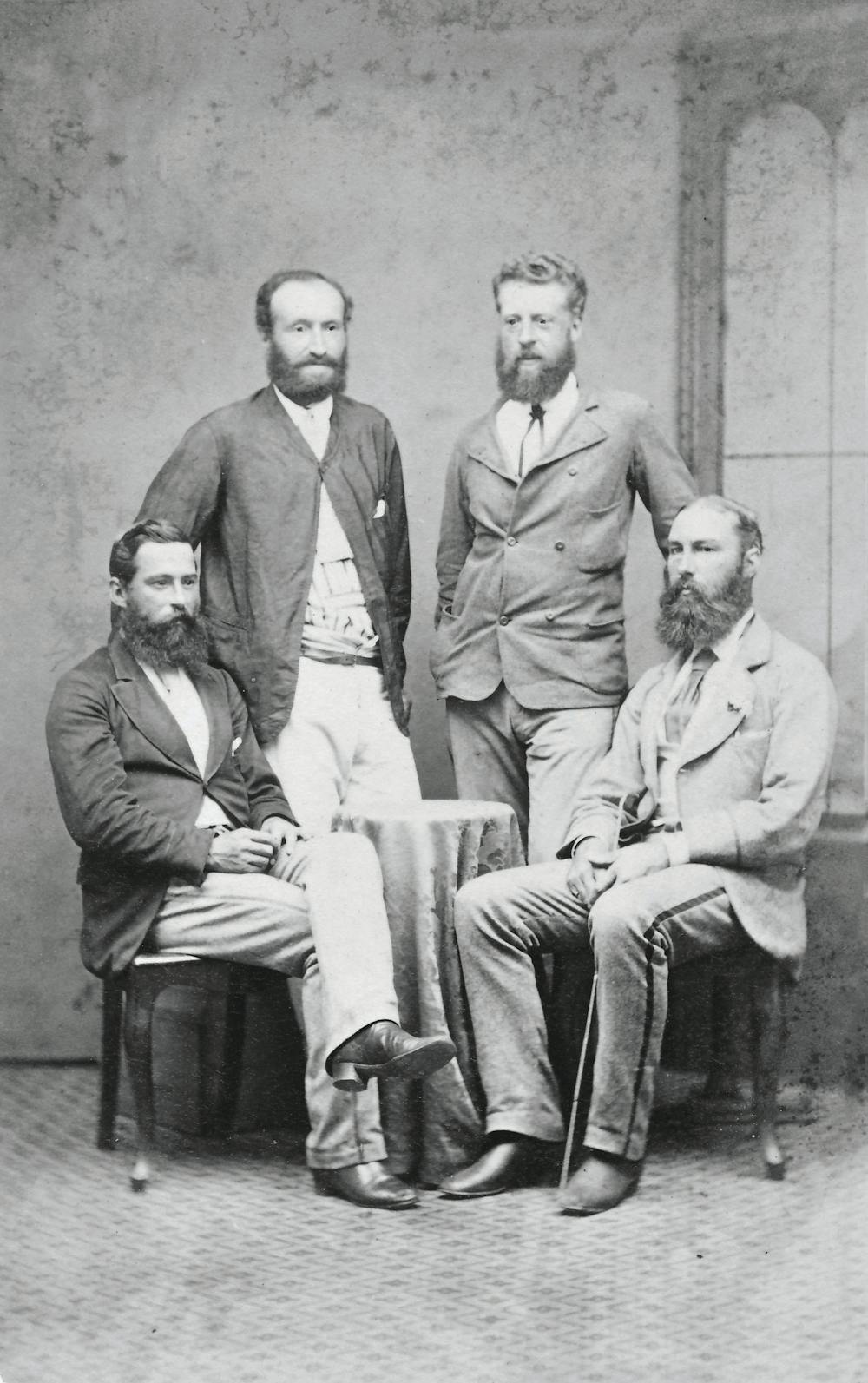 Expedition officers (from left): William Hann (leader), Frederick Warner (surveyor), Thomas Tate (naturalist) and Norman Taylor (geologist).
Norman Taylor Collection, MS 16289, Australian Manuscripts Collection, State Library of Victoria., Author provided (no reuse)
Expedition officers (from left): William Hann (leader), Frederick Warner (surveyor), Thomas Tate (naturalist) and Norman Taylor (geologist).
Norman Taylor Collection, MS 16289, Australian Manuscripts Collection, State Library of Victoria., Author provided (no reuse)
The Balkanu Cape York Development Corporation, which supports the land and development interests of Aboriginal people on Cape York, has also partnered with the project. Further funding will support our research and the involvement of Traditional Owners along the expedition route, including Olkala, Kuku Yalanji, Lama Lama and Guugu Yimithirr people.
As Gerhardt Pearson, the executive director of Balkanu, says:
…following the Hann Expedition, the violence and dispersal of Indigenous people was so devastating, the memories and stories of this period still haunt many people.
The united commitment of the descendants and their detailed knowledge of this expedition will be incredibly valuable in working with Elders across the cape who still grieve about their own history.
Part of this process involves what is referred to as “rematriation”, or the reunification of Indigenous people and their knowledges with Country. This can include Indigenous people taking over the management of collections of artefacts and other specimens from the colonial era.
In our project, this includes botanical collections now held in the Royal Botanic Gardens Kew (London), the National Herbarium of Victoria at the Royal Botanic Gardens (Melbourne), and the Queensland Herbarium. These institutions are keen to develop protocols for involving Indigenous communities in the interpretation and management of collections.
Read more: 50 years after Evonne Goolagong's Australian Open win, we should remember her achievements – and the racism she overcame[6]
Why truth-telling is needed in Australia
Truth-telling was a vital component of the Uluru Statement from the Heart[7] signed by over 200 Indigenous delegates from around Australia. However, the failed referendum[8] on a Voice to Parliament last year arguably demonstrated an apathy towards such processes at a national level.
This project shifts focus to local and regional approaches to truth-telling and the importance of individuals and families in taking responsibility for their role in shaping history. This is even more important for those of us with ancestors responsible for the intergenerational trauma experienced by Aboriginal people.
For the white descendants involved in our project, this will require us to sit uncomfortably in the privilege we have inherited because of this violence and think meaningfully about what can be done in the present.
Selective memory can be a tool of colonisation, and this project goes directly to the responsibilities of the descendants of colonisers to challenge this.
References
- ^ found (www.publish.csiro.au)
- ^ Why First Nations 'ununiformed warriors' qualify for the Australian War Memorial (theconversation.com)
- ^ and others (press.anu.edu.au)
- ^ calls this (corditebooks.org.au)
- ^ inherited (www.tandfonline.com)
- ^ 50 years after Evonne Goolagong's Australian Open win, we should remember her achievements – and the racism she overcame (theconversation.com)
- ^ Uluru Statement from the Heart (ulurustatement.org)
- ^ failed referendum (theconversation.com)
Authors: Cameo Dalley, Senior Lecturer, The University of Melbourne