Eight charts on how Australia’s population is growing – and changing
- Written by: Liz Allen, Demographer, POLIS Centre for Social Policy Research, Australian National University
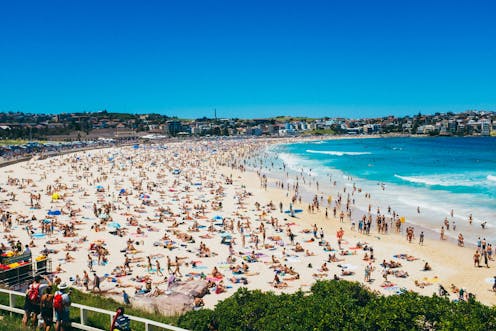
People form the foundation of society, determining all manner of things from housing needs to economic wellbeing. And population characteristics can tell us much about how the inhabitants of a place have changed over time and where the population might be headed in the future.
Australia’s population now numbers around 27 million[1]. On its own, however, this figure says little about our demography. Unpacking Australia’s population composition reveals the challenges and opportunities that lay ahead.
Living longer and with fewer children
Australians can expect to live into their eighties[2]. Our increased longevity, alongside below-replacement fertility[3], means Australia’s population is structurally ageing. The challenges of an ageing population include greater aged care needs, amid a relative shrinking workforce[4].
In other words, populations like Australia need to work out how to fund more with fewer financial resources or risk declining living standards[5].
The chart below is a unique way to visualise population projections. It shows the size of Australia’s population for males and females, broken down by age. Over time, some ages balloon out, like the 50–80 year olds. Some ages barely move, like the 0–10 year olds. Hover your mouse over each line to see the full population pyramid and additional information.
With Australia on track to become a nation of predominantly middle-aged people (and older) by 2065[6], a healthy and robust workforce is crucial to economic sustainability.
The shape of population age distribution matters more than ever, especially with evidence indicating children in Australia will be outnumbered by people aged 65 and over in the coming ten years[7].
Increasing women’s participation[8] in paid work has been one response[9] to Australia’s ageing workforce. But focusing on women’s economic participation fails to consider the gender bias in unpaid caring, placing enormous pressure on women to do it all[10].
And growing intergenerational inequality threatens the future prospects of young people[11]. Job insecurity, housing affordability, gender inequality and climate change are all placing enormous strain on younger people, contributing to their deep uncertainty about the future. Young people just aren’t getting a go.
High short-term growth, potential for population decline
Australia’s population has grown at a historically high rate[12] since the reopening of international borders during COVID-19. Most of Australia’s population growth is from overseas migration, as has been the case since 2005[13] (except during COVID border closures[14]).
While net overseas migration has increased in the short term, this is projected to decline[15] in the coming years. However, immigration will still contribute the most to population increase.
Natural population increase – the number of births versus deaths – also contributes to Australia’s rising population. However, this rate is also on the decline. By 2054, official projections[16] anticipate deaths will outnumber births, meaning in the absence of overseas immigration the nation’s population would start declining.
Migration helps offset the adverse consequences of an ageing population. Without immigration, Australia’s population would start shrinking decades earlier than expected. The national budget would be adversely impacted and the societal contributions that migrants make would be lost.
More diverse than ever
Half the world has below-replacement fertility, and the average number of births per woman is set to decline even further[17]. Australia is competing with the likes of Germany, Canada, the United States, New Zealand and the United Kingdom to attract suitable people to migrate.
Australia can no longer rely on migration from countries like the UK to sustain its workforce. From a Blak country[18] to a European colonial settlement, Australia now relies heavily on people migrating from India and China.
Not all populations in Australia have the same demography. First Nations people, for example[19], have a much younger age profile and higher growth rate than the non-Indigenous people. They also have a lower life expectancy and higher infant mortality, reflecting the enduring discrimination[20] First Nations people face in Australian society.
City living
Australia’s population is also highly urbanised[21], with a high concentration of people living along the southeastern coastline from southeast Queensland to Victoria.
Cities in Australia continue to reign supreme, growing faster than regional areas overall. Vital infrastructure – transportation, housing, education, health care and employment – are a major draw card. Despite numerous attempts throughout Australia’s history, population decentralisation is unlikely[22].
Cities offer the largest opportunities for education and employment, attracting the bulk of international movers. Sydney and Melbourne draw in more than half the nation’s overseas migration intake.
By 2036, Melbourne is projected to be Australia’s largest capital city[23], not surprising give Sydney has a considerable surplus of people moving[24] to live in other places in Australia. And, no, Melbourne hasn’t already overtaken Sydney[25] – this is just some fancy accounting using unconventional definitions[26].
Households are changing[27], too. More people are living alone, and the number of people in each household on average is declining. A close examination of Australia’s demography helps contextualise the country’s housing mismatch.
Australia’s demography shows a country with great opportunity, so long as the challenges are addressed. Population data enables policymakers to take an evidence-based approach to help shape our country’s future.
References
- ^ 27 million (www.abs.gov.au)
- ^ their eighties (www.abs.gov.au)
- ^ below-replacement fertility (population.gov.au)
- ^ shrinking workforce (theconversation.com)
- ^ declining living standards (www.ceda.com.au)
- ^ by 2065 (www.abs.gov.au)
- ^ in the coming ten years (www.abs.gov.au)
- ^ women’s participation (www.abs.gov.au)
- ^ one response (www.afr.com)
- ^ to do it all (www.theguardian.com)
- ^ young people (www.theguardian.com)
- ^ historically high rate (www.abs.gov.au)
- ^ 2005 (theconversation.com)
- ^ COVID border closures (www.abs.gov.au)
- ^ decline (www.abs.gov.au)
- ^ official projections (www.abs.gov.au)
- ^ decline even further (www.thelancet.com)
- ^ Blak country (theconversation.com)
- ^ for example (www.abs.gov.au)
- ^ enduring discrimination (www.indigenousmhspc.gov.au)
- ^ highly urbanised (www.abs.gov.au)
- ^ population decentralisation is unlikely (socialsciences.org.au)
- ^ largest capital city (www.abs.gov.au)
- ^ people moving (www.abs.gov.au)
- ^ overtaken Sydney (www.theguardian.com)
- ^ unconventional definitions (www.smh.com.au)
- ^ Households are changing (aifs.gov.au)
Authors: Liz Allen, Demographer, POLIS Centre for Social Policy Research, Australian National University
Read more https://theconversation.com/eight-charts-on-how-australias-population-is-growing-and-changing-227153