what makes the Olympic surf break at Teahupo'o unique – and so challenging
- Written by: Tom Shand, Honorary Senior Lecturer, Department of Civil and Environmental Engineering, University of Auckland, Waipapa Taumata Rau
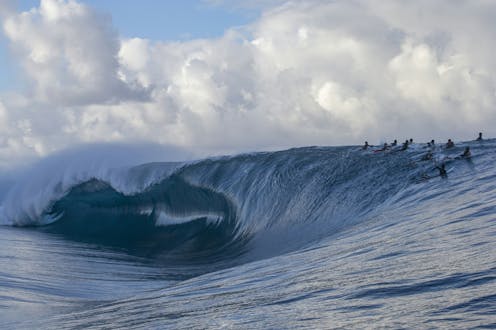
As the Olympics get going in earnest this week, not everyone’s attention is focused on host city Paris. Surf fans are heading to Tahiti, half a world away in French Polynesia.
Why? Well, apart from the French coast resembling a lake at this time of year, on the south-west coast of Tahiti Iti is a wave unlike any other on the planet: Teahupo'o, which translates somewhat ominously as “place of skulls”.
The wave is unique in the way it breaks. The lower part of the wave appears to drop away below sea level, with the top half folding over dramatically to create an almost cartoonishly perfect form.
It is both the weight of water in the plunging lip and the risk of injury or death for a surfer in the wrong position that make this one of the world’s heaviest waves (in both senses of the word).
To understand why the wave breaks like this, we need to start with bathymetry[1]: the shape of the seabed that influences waves as they approach the shore. At Teahupo'o, a combination of factors[2] comes into play.
A one-of-a-kind wave
Waves arriving at Teahupo’o generally originate from intense “roaring forties[3]” storm systems south of New Zealand. By the time the waves reach Tahiti they have become ordered swell, with wave heights of two to five metres and periods of 14 to 20 seconds between successive waves.
These types of long-period waves normally start interacting with the seabed at depths of around 200 metres. On most coasts, this depth would occur up to several kilometres offshore. But at Teahupo’o, it is much closer, just a couple of hundred metres.
This rapid change in depth forces the wave to “shoal” very quickly – the wave speed slows, the distance between waves compresses and the wave height increases.
The change is so abrupt that the wave is still very linear – it hasn’t had time to develop the peaked crest and flat trough (the lowest part of the wave) typical of waves in shallow water.

Waves breaking on this type of steep slope would typically collapse, breaking from the middle of the wave and creating an unsurfable mess. But this doesn’t happen.
At around ten metres’ depth, a flatter shelf in the reef allows the wave to stabilise and “stand up” with a steep front face, before finally breaking as the reef rises again.
And break it does. Owing to the linearity, there is far more water in the crest (the part above water) then most waves, and a deeper trough in front.
This makes for the characteristic below-sea-level break at Teahupo'o, with the overturning lip being half the wave height, and a jet of compressed air forced out of the wave’s barrel after breaking.
The larger the wave, the closer to the steep offshore ramp it breaks, and the more extreme the plunging.
A pro surfers’ paradise
A range of other unique features contribute to the way the wave breaks at Teahupo’o – and what makes it so challenging as a surfing wave.
A deep channel runs alongside the shallow reef shelf. The wave doesn’t break in this deeper area, allowing it to peel – to break in one direction (in this case towards the left looking towards the shore) – and enabling surfers to ride the wave before it finally closes out onto shallow reef.
A part of the shallow reef platform extends offshore, into the reef pass. This shallow area bends and focuses wave energy from the wider, deeper part of the wave back into the breaking wave. This happens particularly on more westerly orientated swells, increasing the intensity of breaking.
As well as this, the Teahupo'o wave breaks in a direction nearly opposite to the prevailing trade winds, keeping the wave face smooth.
A low tidal range also limits the times the reef is too deep or too shallow to surf. And the wave is near the Passa Hava'e reef pass, which helps the wave’s focusing and breaking. But because it isn’t right in the pass, the wave isn’t affected by high tidal or wave-induced currents.
New-generation wave models that simulate individual waves, rather than just average energy density, provide insight into what creates a surf break such as Teahupo'o (see figure below). These models provide insight into what happens as waves shoal and refract (bend and focus) over the seabed as they approach break point.
They also significantly improve our understanding of what makes a particular surf break unique. This can help in assessing the potential impact of human or natural modifications to the environment.
References
- ^ bathymetry (oceanservice.noaa.gov)
- ^ combination of factors (youtu.be)
- ^ roaring forties (oceanservice.noaa.gov)
- ^ CC BY-NC-SA (creativecommons.org)
- ^ CC BY-NC-SA (creativecommons.org)
Authors: Tom Shand, Honorary Senior Lecturer, Department of Civil and Environmental Engineering, University of Auckland, Waipapa Taumata Rau