Australia needs permanent supportive housing to end homelessness – and it will pay for itself
- Written by: Cameron Parsell, Professor, School of Social Science, The University of Queensland
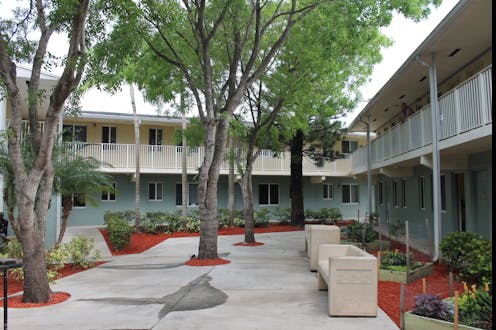
Australia needs to provide permanent supportive housing[1] for many reasons. The most compelling reason is simple: it permanently ends homelessness for our most marginalised citizens.
Permanent supportive housing combines affordable housing with health and social services for people for whom mainstream systems do not work. It’s an evidence-informed approach that ends homelessness for people who are so excluded from opportunities and mainstream institutions that basic principles of citizenship barely exist for them. They are people whose deprivation, especially through generations, not only makes them sick, but also results in premature deaths[2].
We saw short-lived COVID policy successes[3] in housing the homeless. But we are now seeing an increase[4] in homelessness. It’s a societal failure that causes great harm to people in our cities, suburbs and even towns.
The evidence[5] shows that permanent supportive housing, by ending chronic homelessness and rough sleeping, enables people to improve their health and wellbeing. They can be safe and regain control over their lives.
Supportive housing also produces cost offsets for the state. This is because it reduces costs for the criminal justice and crisis health systems. The security and affordability that permanent supportive housing provides mean people spend less time in ambulances, emergency departments, courts and prisons.
For instance, there was a study[6] of Brisbane Common Ground permanent supportive housing, using robust government-linked data. It showed an overall net saving of $13,100 per tenant in the first year of being housed compared to a year sleeping rough.
Why do people become homeless?
Another way to frame the argument for investing in permanent supportive housing is to be clear that homelessness is a mark of policy failure.
People are homeless not because the country lacks the wealth to do better, nor because we don’t know how to end it. We also need to move beyond the unfortunate and enduring myth that people choose to be homeless.
We now know homelessness is the result of how we choose to organise society[7]. This includes the choices we make about housing affordability, the extent, resourcing and accessibility of public health and human services, and the quality of connections between housing and the services and resources people need to live meaningful lives.
How can this model be delivered?
There are multiple approaches to permanent supportive housing. It can:
- be social housing or private housing with a subsidy
- be standalone housing or multiple apartments in one building
- provide support services onsite at the housing or through an outreach model
- target single people or families
- work for First Nations people, non-Indigenous people and culturally and linguistically diverse populations.
Despite these diverse approaches, permanent supportive housing has seven essential features[8]:
- housing is affordable, with rent capped at 30% of income
- housing is permanent, not crisis or transitional accommodation
- people are tenants with a lease, not program clients
- social and health services are integrated into the model
- tenants have the same rights and responsibilities as any citizen in terms of using, or refusing to use, social and health services
- using these services or doing anything other than complying with tenancy law is not a condition of being housed
- the housing providers and service providers are separate organisations to ensure the person collecting rent is not the person providing support.
New plan offers a chance to change
The Australian government is developing a National Housing and Homelessness Plan. It’s an ideal opportunity to commit to a permanent supportive housing system.
The evidence for the effectiveness of permanent supportive housing is as clear as the evidence that our current approaches do not work. We urgently need to do things differently. Permanent supportive housing is a significant part of what this difference could be.
For permanent supportive housing to greatly reduce homelessness, Australia needs to invest at scale. We need to move beyond one-off programs and successful pilot projects that have helped families[9] who are homeless and at risk of domestic violence and abuse.
We know what works. We are just not great at using this knowledge to change how we deliver housing and support.
Permanent supportive housing must be part of a broader strategy to increase the supply of social and affordable housing[10].
The United States offers some ideas to consider. The Corporation for Supportive Housing[11] has helped to develop more than 385,000 permanent supportive housing units. These have been delivered using tax credits, innovative finance models and government subsidies.
With the right mix of Commonwealth and state investment and policies, both Australian community housing providers and not-for-profit social services could help deliver permanent supportive housing on a large scale.
The key elements and benefits of supportive housing explained.It’s a matter of choice
Government intervention is critical. For a start, governments will own, fund or subsidise the housing. Governments will also have to fund the supporting social and health services.
Ultimately, Australia will only choose to end homelessness when there is the social and political will to do this. And that depends on making the case for how permanent supportive housing fundamentally enables people to live well and society to work well. This includes advocating for and supporting this approach in our neighbourhoods.
The stark inequities and human suffering created by homelessness are a threat to social cohesion and connection to the state as citizens. Permanent supportive housing will enable us to stop wasting taxpayer money on responding to the consequences of homelessness. It can help build a more unifying vision of society that actually delivers on the ethos of a fair go.
References
- ^ permanent supportive housing (www.mercyfoundation.com.au)
- ^ results in premature deaths (onlinelibrary.wiley.com)
- ^ COVID policy successes (povertyandinequality.acoss.org.au)
- ^ an increase (theconversation.com)
- ^ The evidence (www.thelancet.com)
- ^ study (issr.uq.edu.au)
- ^ how we choose to organise society (www.politybooks.com)
- ^ seven essential features (psychiatryonline.org)
- ^ helped families (www.micahprojects.org.au)
- ^ social and affordable housing (theconversation.com)
- ^ Corporation for Supportive Housing (www.csh.org)
Authors: Cameron Parsell, Professor, School of Social Science, The University of Queensland