What does family look like in Australia? It’s more diverse than you think
- Written by: Yuvisthi Naidoo, Senior Research Fellow, Social Policy Research Centre, UNSW Sydney
When we think of the concept of the family, a specific version often springs to mind: a mother, a father and children, usually two or three. It’s the version of society our policies and systems are built around.
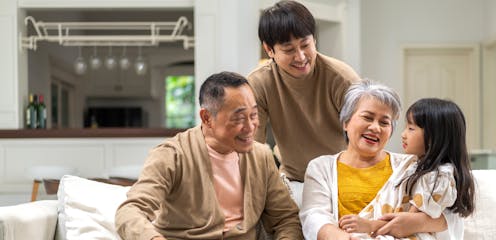
But Australia’s families are far more diverse. Some are multigenerational, some are sole-parent, some are blended. We need to understand how families have evolved over time and what that means for the social fabric of our country.
Our new research[1], released today, charts years of data to map out what families have looked like historically and what they look like now. We also looked at how these families function, including income, wealth, labour division and care responsibilities.
Charting change over time
Families are the primary social environment in which we are cared for. As such, they play a fundamental role in our development and in making a thriving society.
Of the six million[2] children and young people, aged 0–19 years, currently growing up in Australia, the majority learn and develop with the care and support of families. More than two and a half million families are raising children under the age of 15.
Our understanding of who counts as family has expanded enormously over the past 50 years. But too often, we assume families are nuclear. Research too is guilty of examining “families” without exploring variation. If any different forms of family are explored, they typically divide families into couple-parent and sole-parent families.
Shining a spotlight on family diversity is essential to ensuring that policies, systems and society are supportive and inclusive of the many ways children and young people grow up. We need to change the way[3] we think about family.
Our team, in partnership with Uniting NSW.ACT[4], will report annually over the next decade to chart the diversity of families, how this changes over time, and the implications for policy and practice. Our first report analyses the 2022 wave of Housing Income and Dynamics in Australia (HILDA) data and the 2021 Census to examine these issues.
We found[5] while the majority of children live in couple-parent (69%) and sole-parent (11%) families, 12% of children live in step/blended families, 6% live in multigenerational families, and around 1% live in foster families or families made up of other kin.
We also found First Nations families are more likely to live in multigenerational (9%), step and/or blended (27%), sole-parent (23%), or foster and other kin (6%) families.
Care, wealth and labour
Our analysis of ten years of the Census shows this diverse mix of families has been a consistent part of the Australian population over time.
As well as nurturing children and supporting young adults as they establish themselves in the world, we found families provide care during times of ill-health and disability. Unsurprisingly, multigenerational families are likely to provide this kind of care, because they are living with older adults with care needs.
But this was also the case for sole-parent families, step/blended families and foster and other kin families. All these family types are at least twice as likely to provide care than couple families.
We know the cost of living is affecting many families. However, our research suggests that couple families, on the whole, have higher incomes (around 1.5 times more) and higher levels of wealth, and are more likely to be able to cope with rising costs than other families.
Sole-parent families, step/blended families, multigenerational families and foster and other kin families have lower incomes and are more likely to experience financial hardship, with close to 20% reaching out to friends, family and community for financial help.
Across all family types, we found that old patterns around the gendered division of labour are still in force. Women continue to do more housework and more child-rearing than men. Women have this in common across all family types.

What’s more, the majority of women (more than two-thirds) report they believe they are doing more than their fair share. Most men, on the other hand, (again, around two-thirds) feel their contributions are about right. Men heading sole-parent families are the main exception to this pattern.
These findings challenge conventional notions of family structure and underscore the importance of inclusive support systems policies that recognise and address the multifaceted needs of families. For example, some family assistance programs[7] base access to supports on household incomes, assuming an increase in resources will benefit all families equally, without considering the number of people in the household or the complexity of caring roles they may hold.
Why does this matter?
Greater understanding of family diversity is important in public debate, policy development and service delivery.
By thinking about “children and young people and the people who are raising them”, we have developed a new typology of families, which includes: step/blended, multigenerational, and foster and other kin families – groups that are rarely included in quantitative research.
The higher care responsibilities of these family types, combined with access to fewer financial resources, shows the importance of ensuring our policies and programs understand more about the many kinds of families who live in Australia. The findings show there is work to do to ensure that conditions and opportunities are equal for all families.
At the same time, old challenges about women’s uneven greater share of work raising children, and caring for the homes in which we live, continue to need our focused attention to redress gender imbalances.
Importantly, the research also uncovers areas of hope. Despite the obvious challenges many families face, the resilience and care within families is clear. Satisfaction with relationships with children and between siblings is high across all family types.
In the next decade we hope to build a compelling narrative that provides a rich evidence base on how family practices, relationships, needs and circumstances change.
A better understanding of the rich of tapestry of families and family life in which children and young people are raised in Australia will compel us to look more closely in the design of our policies and systems to disrupt entrenched disadvantage and secure the futures of the next generation.
References
- ^ new research (www.uniting.org)
- ^ six million (www.abs.gov.au)
- ^ change the way (research-information.bris.ac.uk)
- ^ Uniting NSW.ACT (www.uniting.org)
- ^ We found (www.uniting.org)
- ^ Shutterstock (www.shutterstock.com)
- ^ some family assistance programs (www.servicesaustralia.gov.au)
Authors: Yuvisthi Naidoo, Senior Research Fellow, Social Policy Research Centre, UNSW Sydney