Stable public housing in the first year of life boosts children’s wellbeing years down the track – new research
- Written by: Jaimie Monk, Research Fellow, Motu Economic and Public Policy Research
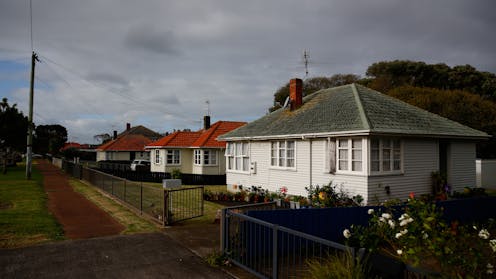
New Zealand’s unaffordable housing market means low-income families face big constraints on their accommodation options. This involves often accepting housing that is insecure, cold, damp or in unsuitable neighbourhoods.
But little is known about the impact of housing type early in life on children’s wellbeing over time.
Using data from nearly 6,000 children in the Growing Up in New Zealand[1] study, our new research[2] compared outcomes for children provided with public housing support during the crucial earliest years (pregnancy through to nine months) with those in other types of housing.
What we found supports ongoing investment in secure, quality housing as a way to reduce inequalities in New Zealand – particularly for those with very young children.
Importantly, by the age of 12, children who started life in public housing had higher levels of wellbeing than some of their peers.
Tracking wellbeing
For our project, we used data on the type of housing at nine months of age, as well as mothers’ assessments of children’s social and emotional development across the period when the children were two to nine years old.
The final data we used were the children’s own responses regarding their quality of life at 12 years old.
Housing was categorised into four types: private ownership (52.3% of children), public rental (9.1%), private rental (35.8%) or other (2.9%).
The New Zealand government provides housing subsidies to approximately 7% of the population. Public housing comprises around 4% of the country’s housing stock.
Demand for help has remained high, with 20,300 people on the waitlist for social housing[3] in December 2024. At the same time, Kāinga Ora has axed 212 housing projects[4] because they did not stack up financially, or were in the wrong locations.
Housing influences behaviour
Throughout our research, we found children who began life in public housing were the group facing the most disadvantage. They exhibited higher levels of behavioural difficulties in early childhood than those in other housing types.
These behavioural difficulties include conduct, hyperactivity and emotional or peer relationship problems. However, their difficulty scores declined more steeply over time, getting closer to their peers by age nine.
In contrast, children’s trajectories of prosocial behaviour, such as being kind and helpful, were the same for each group.
By 12, self-reported wellbeing for children who started life in public housing was at or above that of their peers in private rentals, despite being in the most disadvantaged group in their early years.
These results are different to the outcomes seen in similar research[5] from Australia which found children in public housing had widening gaps in wellbeing compared with their peers in privately owned houses.
In New Zealand, factors such as strong relationships with important adults such as parents and teachers, and reduced exposure to bullying, were found to be more strongly associated with quality of life at this age than housing type or frequency of moving house.
The importance of a stable home
Our work focuses on the early years of a child’s life where security, financial stability and a warm, dry home are important for children’s healthy development. Public housing filled this need for many low-income families.
Despite the positive results seen at 12, gaps in behavioural development between children from the public housing group and their peers were apparent when children started school.
These differences in school readiness mean these children are likely to need wider support to ensure they can make the most of long-term educational opportunities.
But overall, having access to public housing in infancy appears to have cumulative benefits for vulnerable children in New Zealand, providing a stable base for families as children start their lives.
References
- ^ Growing Up in New Zealand (www.growingup.co.nz)
- ^ new research (www.motu.nz)
- ^ 20,300 people on the waitlist for social housing (www.salvationarmy.org.nz)
- ^ Kāinga Ora has axed 212 housing projects (www.1news.co.nz)
- ^ research (doi.org)
Authors: Jaimie Monk, Research Fellow, Motu Economic and Public Policy Research