Who could be Iran’s next supreme leader? And how is he chosen?
- Written by Shahram Akbarzadeh, Director, Middle East Studies Forum (MESF), Deakin University
Since beginning their assault on Iran, that United States and Israel have been explicit that their ultimate goal is regime change.
The attacks are supposed to present a historic opportunity for Iranians to overthrow an authoritarian state and embrace democracy.
Yet, as the Iraq war in the early 2000s made clear, regime change does not necessarily bring[1] a liberal alternative. It first destroys the existing order and creates a political vacuum. This is fertile ground for rival factions to fight it out and settle scores.
How a new supreme leader will be chosen
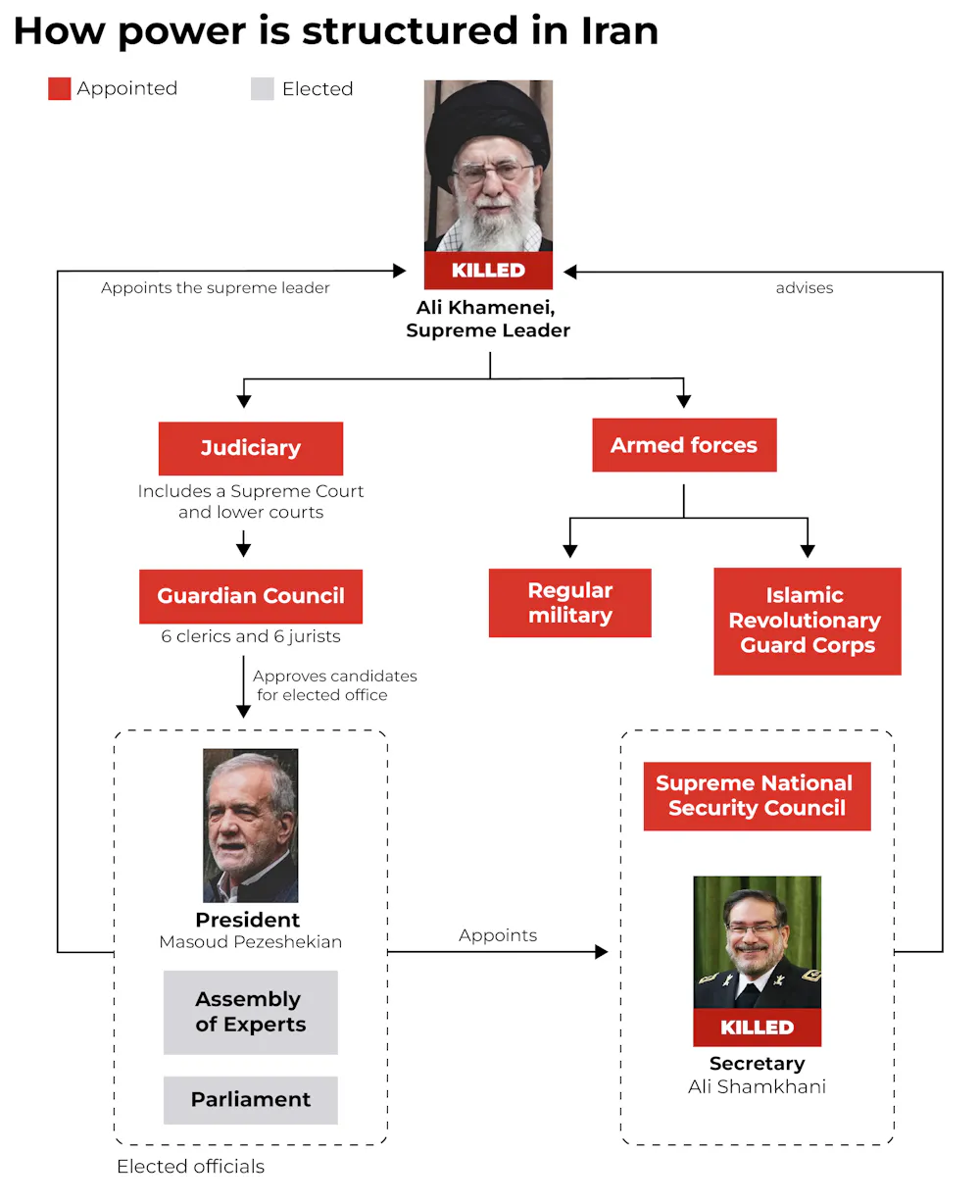
The US-Israel aerial campaign has targeted the regime’s leadership and its nerve system: Iran’s military bases, missile sites and strategic infrastructure. The supreme leader of Iran and its head of state, Ayatollah Ali Khamenei[2], is among the casualties.
While the authorities have moved fast to show they are still in charge, the death of the supreme leader is a shock.
The regime is now engaged in an existential battle for its survival. This makes the selection process for Khamenei’s successor all the more crucial.
The Iranian constitution sets out the mechanics of the succession process through a body called the Assembly of Experts[3]. This is a collective of 88 Islamic religious scholars who have gone through a strict vetting process by the Guardian Council to confirm their loyalty to the supreme leader.
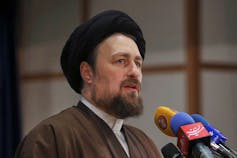
Those who could step into the role include Mojtaba Khamenei[6], the son of the deceased supreme leader, who has started appearing in more public events. Another possibility is Hassan Khomeini[7], the grandson of Ayatollah Ruhollah Khomeini, the founder of the Islamic Republic of Iran.
But the wild card could be Alireza Arafi[8], who is currently a member of the Guardian Council, deputy chairman of the Assembly of Experts and director of Iran’s Islamic seminaries. He is a seasoned politician and has significant religious standing.
There is no explicit timeframe for the appointment of the next supreme leader. Given the immediate focus on the war effort, it may take some time. It could also be postponed to avoid putting a target on the successor’s back.
In the meantime, under the constitution, a three-person interim council[9] was formed to make decisions. This council includes Arafi; the moderate president, Masoud Pezeshkian; and the hardline head of the judiciary, Gholam-Hossein Mohseni-Eje’i.
 The three-person council currently running Iran.
AAP, Wikimedia
The three-person council currently running Iran.
AAP, Wikimedia
Regional pressure building
Meanwhile, the IRGC has effective free rein to lead the fight against the US and Israel.
Pezeshkian, the president of Iran, is officially in charge of this effort as the head of the national Defence Council. But in practice, he is seen as a weak president with no real autonomy. He simply parroted Khamenei during the June 2025 war with Israel, and has given no indication he will try to chart a new course now. This may be expected, given Iran is under attack.
As a result, the combative IRGC is setting the agenda. We can see evidence of this in the closure of the Strait of Hormuz and Iran’s indiscriminate attacks on neighbouring states. For IRGC, this is not the time for a measured response, but for a show of military capabilities to punish the US-Israeli aggression. It appears to be acting according to a pre-prepared script.
Iran’s attacks on Persian Gulf countries hosting US military bases, such as the United Arab Emirates, Qatar, Bahrain and Kuwait, are burning bridges.
In recent years, Iran had worked hard to improve its relations with its Arab neighbours. It resumed diplomatic ties with Saudi Arabia in 2023 and was deepening its bilateral ties with the Saudis for the upcoming Hajj, the annual pilgrimage of Muslims to Mecca.
In return, members of six-country Gulf Cooperation Council called on US President Donald Trump to avoid a military confrontation with Iran in early January as his administration ratcheted up the rhetoric of regime change.
Now that these countries have been hit by Iranian missiles and drones, they will need to recalculate their options. They are reportedly considering ending their neutrality and striking back[10] at Iran.
Trump has suggested the war could take four weeks. For Iran, time is on its side. As long as it can withstand the aerial strikes and inflict damage on the United States directly and indirectly – inflicting damage on the global economy – the regime will likely hold on to power.
Tehran expects that if it can hold out long enough, Trump will lose patience with the war effort and realise regime change is much harder than he anticipated.
References
- ^ regime change does not necessarily bring (theconversation.com)
- ^ Ayatollah Ali Khamenei (theconversation.com)
- ^ Assembly of Experts (www.taylorfrancis.com)
- ^ Council on Foreign Relations, Reuters, AAP (www.cfr.org)
- ^ died in a helicopter accident (theconversation.com)
- ^ Mojtaba Khamenei (edition.cnn.com)
- ^ Hassan Khomeini (www.independent.co.uk)
- ^ Alireza Arafi (www.iranintl.com)
- ^ a three-person interim council (www.aljazeera.com)
- ^ ending their neutrality and striking back (www.theguardian.com)
Authors: Shahram Akbarzadeh, Director, Middle East Studies Forum (MESF), Deakin University
Read more https://theconversation.com/who-could-be-irans-next-supreme-leader-and-how-is-he-chosen-277360