


The rebuilding in Nepal needs to start now. This is what worked after an earthquake a decade ago – and what to avoid
- Written by: Weekend Times
In the aftermath of the devastating flash floods in Nepal on August 26, the immediate priority was to save lives and meet the urgent needs of victims. But the relief efforts must
also begin laying the foundations for the future.
This requires a delicate balancing act. The early days after a disaster are crucial for ensuring a long-term recovery sets off in the right direction.
This means addressing challenging questions about how and where to rebuild homes, even while rescue efforts are ongoing and debris is being cleared. It also means ensuring aid agencies and policymakers are investing humanitarian funding in the right way and listening to communities.
After a 7.8-magnitude earthquake struck Nepal in 2015, killing nearly 9,000 people, I led a review of the recovery efforts of 15 of the largest international NGOs and their partners, which had received around US$100 million of funding from the United Kingdom’s Disasters Emergency Committee (DEC) and the Canadian Humanitarian Coalition.
While that earthquake was very different to the recent flood catastrophe in terms of scale, spread and severity, there are still many lessons about what to do after a disaster – and what not to do.
Cash is important
Communities need cash after a disaster. Where markets are working, this money gives people greater control over what they need most. While this is derided by some as potentially wasteful (“What if they spend it on the wrong thing?”), the overwhelming evidence shows that it works.
In my review after the 2015 quake, I found the immediate transfers of cash to survivors by NGOs working with local banks was highly effective. These survivors were able to prioritise what to spend it on, such as medicine, food or rent.
Direct cash transfers was also at the top of the United Nations’ appeal to donors after the floods last month “to give families the dignity to buy essential goods while stimulating local economies”.
But one of the most important findings from our review is that all this money can’t just be allocated for short-term relief.
Several months after the 2015 earthquake, far too many NGO staff told me they were still operating in response mode, providing the basic necessities to victims. As one field worker said, “it is only about relief, there is nothing on development”, while a senior NGO manager said, “we’re still in delivery mode, the conversations [about the future] aren’t happening”.
Thinking about the future means supporting farmers to re-establish their livelihoods, for instance, or repairing water systems to ensure access to safe drinking water.
Big decisions on housing
Short-term temporary housing for victims can also be problematic, if not handled the right way. Shelter usually takes up much of the money spent in post-disaster recovery efforts. In 2015, this accounted for 55% of the funds provided by the DEC.
In my view, funds shouldn’t be spent on elaborate temporary shelters, which has unfortunately been a focus of too many misguided international design saviours following disasters. These types of projects should never be taken up by serious aid agencies or responsible governments.
If temporary shelters are needed, local materials and local skills work best. Permanent rebuilding as quickly as possible is the goal, especially for Nepalis now, given winter is arriving soon.
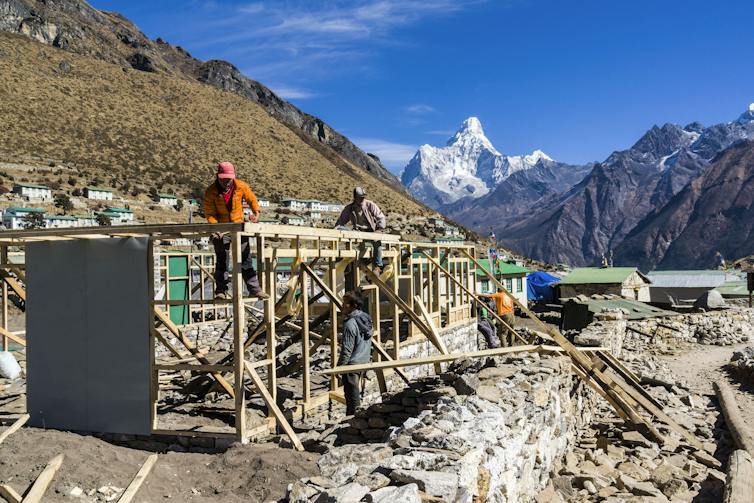
Our 2015 review found a mixed bag of housing responses. The best efforts involved training up local carpenters and masons to a proficient standard to build quality shelters quickly. In other cases, aid providers with little or no technical skills oversaw complex housing projects, with worse outcomes.
Where to rebuild is also important. Unlike the situation after the 2015 earthquake, where rebuilding tended to take place in the same location, riverside communities devastated by the floods in Nepal today may need to be rebuilt elsewhere, given further deluges from melting glaciers are a real possibility.
This will be a hard decision to make, given the strong connections many communities have to their villages and land. But these decisions need to be made very quickly, as temporary housing has a habit of becoming permanent.
Rebuilding also requires materials. After the 2015 earthquake, bureaucratic red tape and corruption hindered the recovery by delaying the arrival of much-needed supplies from overseas, such as corrugated iron sheets. Bribes were demanded at border crossings, for example, which slowed progress.
International NGOs and donors are well attuned to the risks of corruption following disasters and must resist the paying of bribes in Nepal today.
And when aid money is funnelled through government agencies, there is always misappropriation, even when auditing takes place.
This will undoubtedly be a concern during the flood recovery, given Nepal ranks 109 out of 181 countries in Transparency International’s annual perception of public sector corruption index.
Listening to communities
Finally, aid agencies need to listen to the people they seek to serve.
Affected communities need to be seen as agents of their own recovery – not the “helpless victims” that some newspaper headlines would have you believe.
In 2015, there were too many instances in which community engagement was limited due to speed or sacrificed because of needless donor contracting requirements.
One independent survey undertaken at the time asked residents if their particular problems were being addressed by aid agencies. A resounding three-quarters said “very little” or “not at all”.
Women, in particular, felt their specific needs weren’t being addressed – adequate shelter, financial support, health care, and clean water and sanitation.
The aid agencies on the ground in Nepal now will hopefully be undertaking needs assessments to tailor their support in the most effective manner. This must be a continuous process to make sure communities are heard.
David Sanderson does not work for, consult, own shares in or receive funding from any company or organisation that would benefit from this article, and has disclosed no relevant affiliations beyond their academic appointment.