If you're thinking of leaving a violent partner, you need a financial plan. This toolkit can help
- Written by: Glennda Scully, Professor, Curtin University
The COVID-19 pandemic has driven a surge of calls to domestic violence support services, as survivors of violence spend more time at home with their abusers due to lockdowns and other restrictions.
Many feel they can’t leave — or that they must return to abusers[1] — because they lack financial security or are unsure about where to turn for financial assistance.
Domestic violence may include physical violence, but it can also mean verbal, emotional or financial abuse — or a combination of these. Financial abuse can include a partner preventing or trying to prevent you from knowing about family finances, accessing money, making decisions about what to buy, controlling your income or using the phone, internet or car.
Our free online resource, titled Your Toolkit[2], outlines a “roadmap for recovery” to support women’s physical safety and long-term financial security. We have had a surge of traffic to the site since the pandemic began (and have updated it with COVID-19 specific advice).
Read more: What governments can do about the increase in family violence due to coronavirus[3]
The guide breaks the process into four steps to support women hoping to leave: the preparation phase, the launch phase, the “nourish” phase aimed at preserving safety, and the “flourish” stage aimed at supporting long-term financial stability.
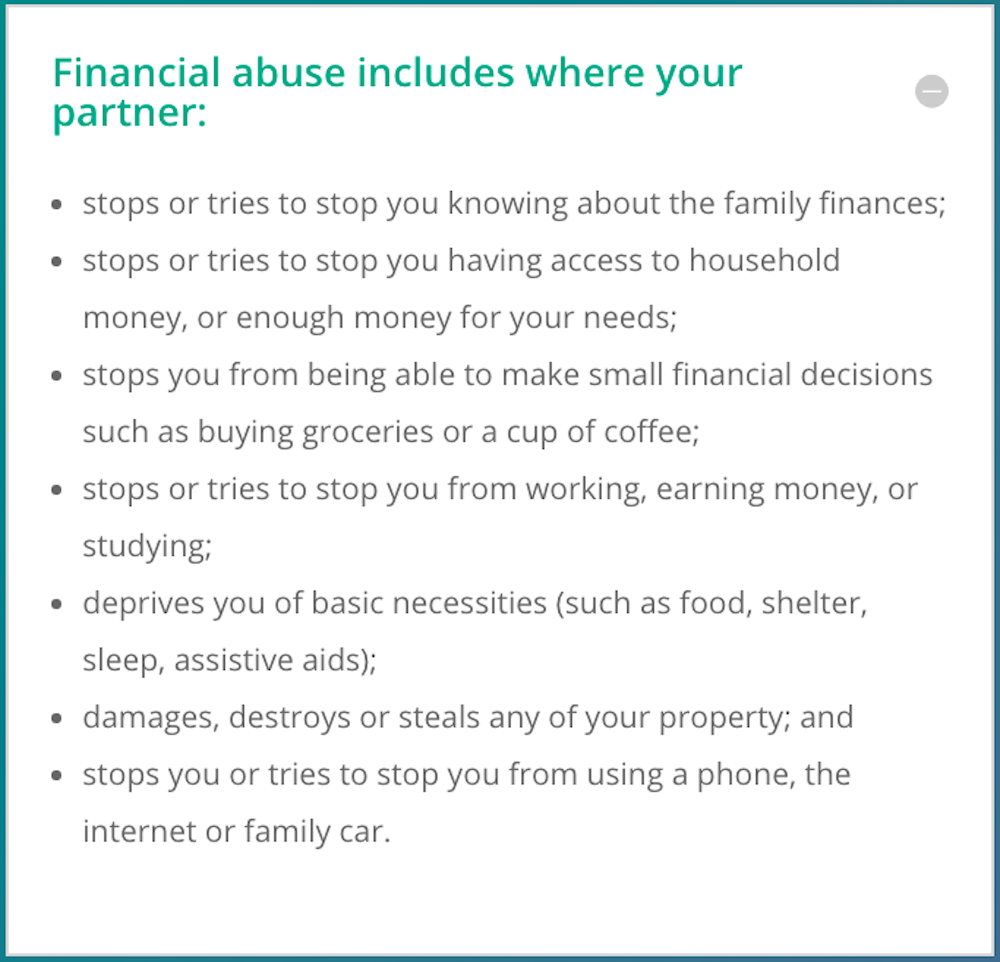 What is financial abuse?
Your Toolkit[4]
What is financial abuse?
Your Toolkit[4]
Preparing to leave
Planning[5] is the most important phase in preparing to leave.
When preparing to leave it is important to keep yourself safe when using technology. Be sure to manage the settings on all your devices. If, at any time, you think your partner is tracking your location through your device, our advice is to ditch it.
Collect and keep safe your important documents, including your passport and driver’s licence. If you can, collect evidence of your abuse (such as photos). If you can access cash and credit cards, they can also be really useful.
If you choose to leave, you’ll need to consider the safety of yourself, children and pets. Start thinking through legal advice, escape routes and emergency contacts, checklists and logistics.
We know this can be overwhelming, so we have included some links to resources in the toolkit[6] to help. Prepare when and where you can get support.
Launching your plan
When you launch[7] your plan, remember to call 000 if you are in crisis. You’ve made the decision to leave. We know you haven’t come easily to this place and you may be frightened. Make sure you are aware of short- and medium-term support available to help keep you and your children safe when you decide to leave.
The launch section of our guide outlines how to get help in an emergency, leave home safely, get a Violence Restraining Order and where to get food and a bed for the night in a crisis.
 Before you leave, think through legal advice, escape routes and emergency contacts, checklists and logistics.
Shutterstock
Before you leave, think through legal advice, escape routes and emergency contacts, checklists and logistics.
Shutterstock
Navigating paperwork as you work towards financial security
For the next[8] part of your journey, which we call the “nourish” phase, you’ll need to know where and how to access support payments and services, longer-term accommodation options, how to look after your ongoing personal safety, and where to get legal advice on your rights.
The site[9] provides information to help navigate the paperwork and sustain you on the journey to financial security and independence.
Flourishing with a longer-term financial plan
To thrive in the long run, you need financial stability. A crucial component is having a budget, and the “flourish” section of the guide[10] details how to build one.
A budget sets out your income and expenses and, importantly, allows you to plan for the future. It identifies ahead of time when you may have a shortfall in funds.
Use the MoneySmart budget planner[11] so you can create a budget, see where your money is going, and work out whether your income will cover your expenses. Once established, you can look at savings and borrowing plans and get advice about superannuation, tax and how the bank can help you.
Sometimes, women who have left a violent relationship face legal and tax problems. There are many free and expert advisors you can see for advice. For tax advice you can access free tax clinics in your state. For details, check out the Australian Taxation Office’s Tax Clinic Program[12].
Unless you’ve experienced it yourself, it’s hard to appreciate just how difficult it is to leave a violent relationship. Building a financial plan is a crucial part of making your exit successful in the long term.
Read more: 'We are in a bubble that is set to burst'. Why urgent support must be given to domestic violence workers[13]
If you need help, you can reach Australia’s national sexual assault, domestic and family violence counselling service on 1800 737 732 or via web chat, 24/7.
References
- ^ return to abusers (books.google.com.au)
- ^ Your Toolkit (www.yourtoolkit.com.au)
- ^ What governments can do about the increase in family violence due to coronavirus (theconversation.com)
- ^ Your Toolkit (www.yourtoolkit.com.au)
- ^ Planning (yourtoolkit.com.au)
- ^ toolkit (www.yourtoolkit.com.au)
- ^ launch (yourtoolkit.com.au)
- ^ next (yourtoolkit.com.au)
- ^ site (www.yourtoolkit.com.au)
- ^ guide (yourtoolkit.com.au)
- ^ MoneySmart budget planner (moneysmart.gov.au)
- ^ Tax Clinic Program (www.ato.gov.au)
- ^ 'We are in a bubble that is set to burst'. Why urgent support must be given to domestic violence workers (theconversation.com)
Authors: Glennda Scully, Professor, Curtin University