here are 3 priorities for future-proofing Australia
- Written by: Danielle Wood, Chief executive officer, Grattan Institute
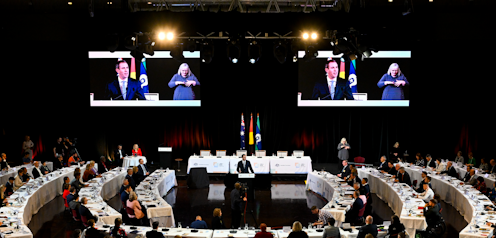
This is an edited extract from Danielle Wood’s keynote address[1] to the jobs summit. Read other articles in The Conversation’s series about the summit here[2].
In an economic landscape that is increasingly digital, increasingly focused on services sector work, and increasingly focused on a looming deadline for net zero emissions, I would like to put forward three priorities for future-proofing Australia.
Priority 1: investing in human capital
Microsoft founder and philanthropist Bill Gates has argued that the best leading indicator of a country’s outlook in 20 years’ time is the performance of its education system. Unfortunately, that indicator doesn’t look too crash hot for Australia.
OECD data shows the performance of Australian school students in reading and maths is going backwards, both over time and compared with other countries.
The average year 9 student is more than one year behind in maths compared to where the student of the same age was at the turn of this century. For reading it is around 9 months.
Read more: As the jobs summit talks skills – we predict which occupations will have shortages and surpluses in the next 2 years[3]
Just as worrying, the learning gap between students from advantaged and disadvantaged backgrounds more than doubles between year 3 and year 9.
If we are going to thrive as a nation, we simply have to turn this around.
There is a growing evidence base around what works in terms of teaching, but we struggle more with how to flow that through to practice on the ground. And we need to do much more to attract and retain high-performing teachers.
There are other aspects of education that will also need to evolve if we are going to remain a leading economy in coming decades:
boosting the vocational education and training system that has been left as the poor cousin to universities
improving links between industry and vocational and higher education institutions to build feedback loops on what’s needed as jobs evolve
acknowledging that education is a lifelong endeavour – for example, through recognition of micro-credentials and support for on-the-job training
attracting the best and brightest to Australia by improving the composition and functioning of our migration program.
Priority 2: making better use of our talent pool
Australian women are some of the world’s most highly educated, yet we rank 38th in the world when it comes to women’s economic opportunities.
Women are often excluded from full-time work, and from the most prestigious high-paid roles, because these so-called “greedy jobs” are incompatible with the load of unpaid care still disproportionately shouldered by women.
I can’t help but reflect that if untapped women’s workforce participation was a massive ore deposit, we would have governments lining up to give tax concessions to get it out of the ground.
High-quality, low-cost early education and care is necessary to unlock participation from women who would like to work more but who are sidelined by substantial cost hurdles.
But generational change will only come if men are also encouraged to participate more in unpaid care. Cultural shifts like this tend to play out over decades rather than years, but policy can shape culture.
Read more: Yes, we know there is a 'skills shortage'. Here are 3 jobs summit ideas to start fixing it right away[4]
It is equally important we tackle the economic and structural barriers to other groups participating to their fullest, including Australians with disabilities, our First Nations people, and older Australians.
Making sure care jobs are good jobs – properly remunerating care work is going to be critical to providing the quality and quantity of health, disability, and aged care services that our older population will need.
Fifty-eight per cent of early childhood workers are paid award wages, which can be as low as $22 an hour. You can certainly understand why an early childhood educator might decide to step away from their important but emotionally taxing role to take up a higher-paid position at Bunnings or McDonalds.
Priority 3: restoring economic dynamism
The Australian economy, like all of us, looks increasingly older, fatter, and slower.
Rates of company startups and exits declined in the years before COVID, impeding the normal flow of resources from lower-productivity to higher-productivity activities.
Not only is Australia not experiencing a “great resignation[5]”, we are experiencing something like the opposite – the proportion of workers switching jobs has been declining for decades.
Lower levels of dynamism and innovation have been linked to a lack of competitive pressure in the economy. In competitive markets, excess profits should be dissipated as new and innovative competitors enter. Increasingly, the most profitable firms are untroubled by new competitors.
Grattan Institute work shows that among the 20% of Australia’s most profitable firms in 2015, almost one-third were among the most profitable a decade previously. Recent research by Australia’s Competition Minister Andrew Leigh finds turnover among our market leaders has slowed.
Read more: The summit needs to get us switching jobs. It'd make most of us better off[6]
Being relaxed and comfortable may be profitable, but it is not good for Australia’s long-term economic prospects.
Making sure Australia’s competition laws are fit for purpose would help. The former head of the Australian Competition and Consumer Commission, Rod Sims, has argued the current mergers laws are failing to adequately protect competition. His warnings should prompt serious thought.
Economists have long warned of the productivity-sap from rent-seeking (seeking special favours). We should not be a country where firms see more upside in lobbying to get a better deal from governments than from investing in better products and services.
Grattan Institute’s 2018 report, Who’s in the Room?[7], suggests this concern is real for Australia. Heavily regulated sectors such as mining, property and construction, and gambling are characterised by remarkably high levels of political donations and lobbying compared to their relative economic contribution.
We need to be bolder
Finally – what of our people? How do we encourage workers to be bold and thrive in a more dynamic economy of the future?
The 2018 international OECD school education survey found 42% of Australian teenage boys and 52% of teenage girls expect to work in one of just ten common jobs by the age of 30, including lawyer, doctor or police officer. This set of aspirations has actually narrowed since the turn of the century.
This lack of awareness of the universe of possible jobs, particularly in fast-growing sectors, diverts young people from career paths that would generate the greatest benefits for them and the country.
High household indebtedness constrains the capacity of young people to change jobs later or take the risk of starting a business.
If we want to genuinely improve worker mobility, we have to also consider the role of the social safety net. Upgrading skills or even changing jobs can be costly and risky, particularly for more vulnerable workers.
Read more: First Nations workers are everywhere. The jobs summit must tackle Indigenous-led employment policy too[8]
The summit comes at an extraordinary time. Unemployment is lower than I’ve experienced in my lifetime, and we are in the early phase of significant structural shifts in jobs and activity as our economy decarbonises and digitises.
We need to lock in full employment as a policy objective, and capitalise on the extraordinary opportunity to give our long-term unemployed, older job-seekers, and people with a disability a chance to participate in paid work.
We need to invest in human capital big time, turning around the slide in our school results, rebuilding vocational education, and improving the quality of the signals we send to our young people about what will be needed in future.
We need to embrace the principle that no one who wants a job or more hours should be held back by structural barriers such as expensive or inaccessible care.
And we need to recognise the importance of boosting innovation, of strong market competition, of better policy design, and of government investment in enablers like cyber security, to become an economy on the technological frontier.
References
- ^ keynote address (grattan.edu.au)
- ^ here (theconversation.com)
- ^ As the jobs summit talks skills – we predict which occupations will have shortages and surpluses in the next 2 years (theconversation.com)
- ^ Yes, we know there is a 'skills shortage'. Here are 3 jobs summit ideas to start fixing it right away (theconversation.com)
- ^ great resignation (theconversation.com)
- ^ The summit needs to get us switching jobs. It'd make most of us better off (theconversation.com)
- ^ Who’s in the Room? (grattan.edu.au)
- ^ First Nations workers are everywhere. The jobs summit must tackle Indigenous-led employment policy too (theconversation.com)
Authors: Danielle Wood, Chief executive officer, Grattan Institute