Weekend Times


Google Workspace

Business News

How FTX Australia was able to get away with claiming it was 'ASIC-licenced'

  • Written by Pamela Hanrahan, Professor of Commercial Law and Regulation, UNSW Business School, UNSW Sydney
How FTX Australia was able to get away with claiming it was 'ASIC-licenced'

When cryptocurrency exchange FTX Group[1] collapsed in the Bahamas last month, its local subsidiaries FTX Australia[2] Pty Ltd and FTX Express[3] Pty Ltd fell over too.

The Australian companies were placed into administration on November 11 and within days the Australian Securities and Investments Commission (ASIC) had suspended[4] the Australian financial service licence FTX Australia had held since March 2022.

The fact that FTX Australia had an Australian financial service came as a surprise to some people, who had wrongly assumed everything crypto-related was beyond the reach of Australia’s regulators.

It also raised questions – including for Assistant Treasurer Stephen Jones[5] – about how FTX Australia managed to acquire its Australian financial services licence, and how ASIC seemed to have missed the chance to intervene sooner.

And it draws wider attention to the 20-year-old licensing system and what an Australian financial service actually means for the firms that have them.

Licensed to do what, precisely?
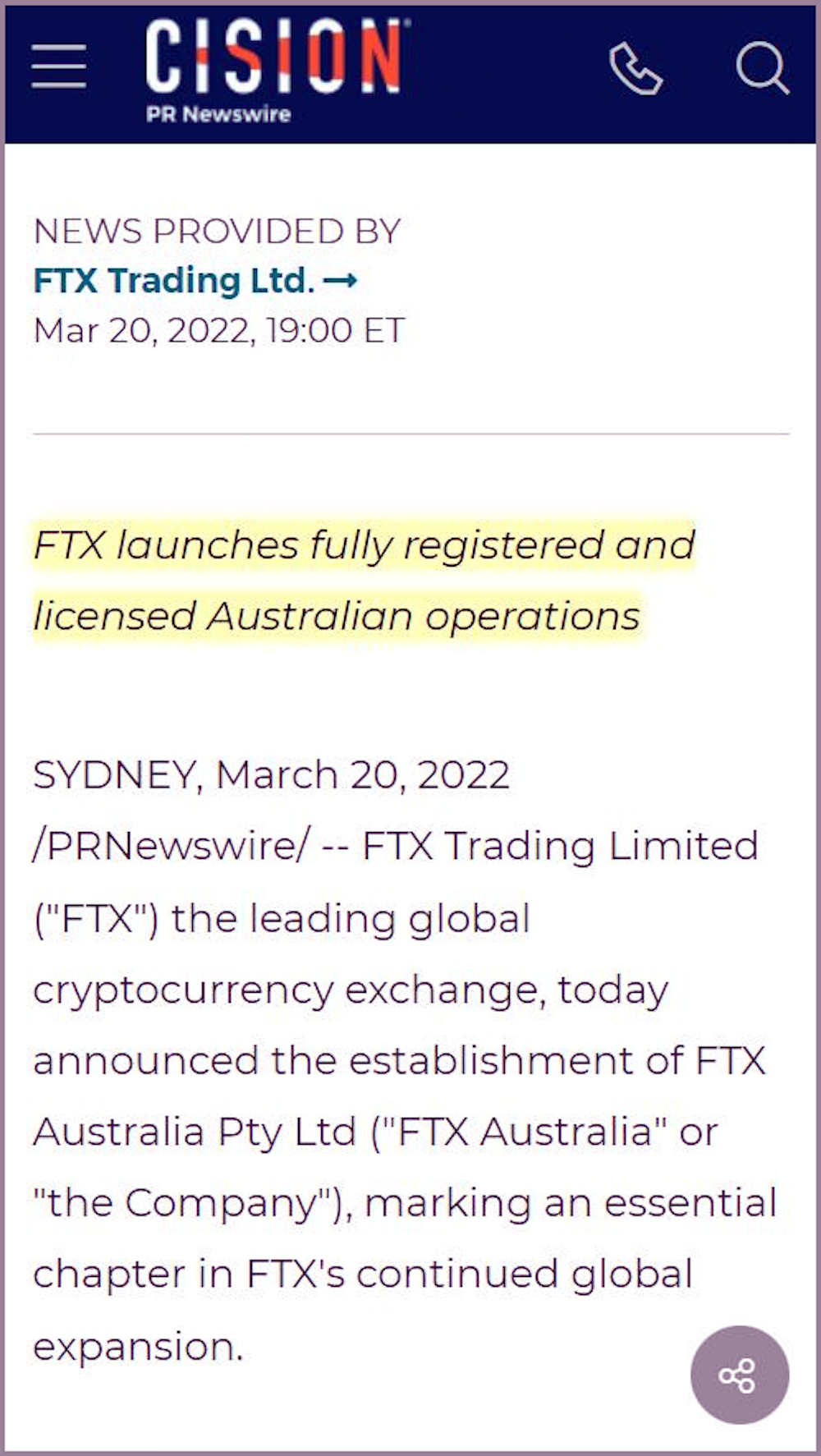
FTX Trading Limited[6] When FTX commenced operations in Australia this year, its media release was headed: “FTX launches fully registered and licensed Australian operations[7]”. But what exactly was it licensed to do? The Australian financial service (AFS) licensing regime in place since the late 1990s authorises each firm to do specified things, in relation to specified financial products, for specified clients. Each firm’s licence is different, and what is required by ASIC is different depending on what the firm is authorised to do. FTX Australia’s licence authorised it to deal in, make a market for, and provide general advice relating to derivatives and foreign exchange contracts to retail and wholesale clients. That’s it. Note that crypto-assets are not specified, nor is running a crypto-asset exchange. The jury is still out globally[8] on whether crypto-assets (as distinct from investments derived from crypto-assets) are financial products at all. It is possible to think of them as like gold bullion or fine art – or pet rocks[9] – where the asset itself is not a financial product, but a financial product might be constructed from it. If a cryptocurrency is not a financial product, then licensing laws can’t apply, which might explain why one of the two firms set up in Australia – FTX Express, which operated the crypto-exchange – was not AFS licensed. Read more: 'I thought crypto exchanges were safe': the lesson in FTX's collapse[10] The lesson is that knowing a firm has an AFS licence only takes you so far, and often not very far at all. Unless you check the specific authorisations[11], there’s no way of knowing how little the firm you are dealing with is licensed to do. And ASIC-regulation doesn’t involve prudential regulation[12], which is directed at the stability of the company itself, ensuring among other things that it should be able to meet its financial commitments under reasonable circumstances. Prudential regulation is the job of the Australian Prudential Regulation Authority, which regulated neither FTX Australia nor FTX Express. Licences for sale FTX Australia’s ASIC licence was originally granted to someone else entirely back in 2008. A series of takeovers meant it passed through a number of hands until it ended up with FTX in March this year. While an original applicant has to satisfy rigorous checks, this hasn’t always been the case for subsequent purchasers. ASIC has known for years that its ASF licences were ending up in new hands when companies were bought and sold. In 2017, it asked the government’s ASIC Enforcement Review Taskforce[13] to recommend changes to the law that would allow it to revisit an AFS licence when its owners changed. The change that was eventually legislated in 2020 only required licensees to notify[14] ASIC when a licence changed hands, within 30 days. It did not require ASIC to approve the change in control. Limited ASIC powers ASIC is able to inquire further to determine whether there is reason to believe a new licensee was likely to contravene its statutory obligations or is “fit and proper” – but it is not required to do so. If it finds either that the licensee is likely to contravene its obligations or that it is not fit and proper, it is able to suspend or cancel the licence after giving the new owners a fair hearing. Read more: How 'bad credit' lender Cigno has dodged ASIC's grasp[15] But such inquiries have not become routine. Most of the (hundreds of) licensee purchases notified each year seem to go through to the keeper, as did FTX’s. Even if ASIC had reviewed FTX’s purchase of the licence in March 2022, it might well have found no grounds to revoke it, given the very limited range of activities it authorised. The FTX collapse may result in ASIC changing its attitude to change-of-control transactions involving AFS licensees, for which it might need more resources. But even if that happens, clients would still be well advised to take care to understand exactly what “AFS licensed” really means. References^ FTX Group (www.abc.net.au)^ FTX Australia (kordamentha.com)^ FTX Express (kordamentha.com)^ suspended (asic.gov.au)^ Assistant Treasurer Stephen Jones (www.afr.com)^ FTX Trading Limited (www.prnewswire.com)^ FTX launches fully registered and licensed Australian operations (www.prnewswire.com)^ jury is still out globally (www.ft.com)^ pet rocks (www.afr.com)^ 'I thought crypto exchanges were safe': the lesson in FTX's collapse (theconversation.com)^ specific authorisations (asic.gov.au)^ prudential regulation (www.apra.gov.au)^ Enforcement Review Taskforce (treasury.gov.au)^ notify (asic.gov.au)^ How 'bad credit' lender Cigno has dodged ASIC's grasp (theconversation.com)Authors: Pamela Hanrahan, Professor of Commercial Law and Regulation, UNSW Business School, UNSW Sydney

Read more https://theconversation.com/how-ftx-australia-was-able-to-get-away-with-claiming-it-was-asic-licenced-196361

The Weekend Times Magazine

Smart Lock: The Future of Home Security and Convenience

A smart lock has revolutionized the way people think about home security. Moving beyond traditional keys and mechanical locks, smart locks bring technology and convenience together, offering homeowners and businesses a new...

A Fantastic Trip To Melbourne, Australia With Minimal Spending? Here’s How?

Famed for the iconic Melbourne cup horse race, Melbourne, Australia ranks as one of the best travel destinations worldwide. It offers tourists an escape from the hustle and bustle of...

What To Look For In a Robot Pool Cleaner

Robotic pool cleaners are a stunning feat of modern technology, allowing you to keep your pools clean with minimal effort on your part. Pool cleaning and maintenance has always remained...

How To Gain Financial Freedom In Retirement

Planning for retirement? Retired already? Discover how you can gain financial independence during your golden years. Hitting retirement is a joyous milestone - a just reward for a lifetime of hard...

Turning fashion into power - Beauty with Brains

During this unfortunate time of our lives there’s a hidden gem business which keeps the hopes up for many lives of women of all walks of life. Fashion...

The Psychology of Your Floor Plan: How Layout Shapes the Way You Live

When most people think about designing a new home, they focus on finishes, colours, or even the kitchen benchtop. But the quiet hero of liveability is the floor plan. A...

Prime Minister Press Conference Australian Parliament House

PRIME MINISTER: Good afternoon everyone. Today's meeting of the National Cabinet came during a week of what I'd describe of increased hope. This was a week of hope. We were...

Top Applications of Sandstone Crazy Pavers

Crazy paving may not seem like an expensive flooring option, but it is well worth your attention and thought. It refers to the ‘crazed’ appearance of a completed area and...

Niacinamide: Skincare’s Ultimate Multitasker

One ingredient, multiple uses: why niacinamide is this year’s most relevant skincare ingredient Niacinamide—also known as vitamin B3—is celebrated as skincare’s brilliant all-rounder. A relative newcomer in commercial cosmetic formulations, this...

hacklink hack forum hacklink film izle hacklink testsahabettipobetrocket play casino australiapadişahbetgalabetNon GAMSTOP Casinosbeste online casinonon GamStop casinos UKNon GamStop Sitesjojobetholiganbetbetcio