A new bill is proposing a human right to housing. How would this work?
- Written by: Chris Martin, Senior Research Fellow, City Futures Research Centre, UNSW Sydney
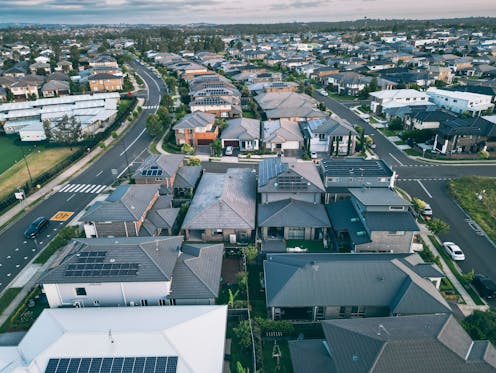
There’s a new bill[1] before federal parliament calling for housing to be considered a fundamental human right.
The bill, introduced last week by independent federal parliamentarians Kylea Tink and David Pocock, would require the government to create a ten year National Housing and Homelessness Plan.
One part of the bill states housing should be considered a fundamental human right for all Australians. Here’s how this would work.
Read more: To deliver enough affordable housing and end homelessness, what must a national strategy do?[2]
Housing under Albanese
Since its election in 2022, the Albanese government has had to fight political battles to pass its housing policies.
This includes the Housing Australia Future Fund[3]: a $10 billion fund to provide an annual $500 million for social and affordable rental housing. It passed the parliament last year.
There’s also the “Help to Buy” shared equity scheme[4]. Under this scheme, 10,000 households a year would be eligible for a government equity contribution of up to 40% of the purchase price of a new home. It’s yet to pass[5] the parliament.
But many in the community continue to struggle with unaffordable rents[6], barriers to home ownership and rising rates[7] of homelessness.
Housing and homelessness problems are complex because they crossover different areas of policy and different levels of government. There are many agencies that do housing policy.
But so far, the government has not had a clear plan. Its election promise[8] to develop a National Housing and Homelessness Plan is still under development. And at the moment, it does not appear[9] to be addressing important policy areas like tax and finance.
We need a plan that coordinates all government activities, to really address housing as a system.
Our research
Last year, colleagues and I published research[10] for the Australian Housing and Urban Research Institute on how to make an effective national housing plan.
We recommended the plan should include a law that requires the government of the day to have a plan, and report on progress, according to some overarching objectives.
Since then, more than 100 other housing researchers, industry experts, civil society leaders and politicians of different political persuasions have supported our idea[11] for a legal basis for a housing plan.
Tink and Pocock have also taken up our research and turned it into the National Housing and Homelessness Plan Bill[12].
What’s in the bill?
The bill would require the housing minister of the day to develop and implement a ten year National Housing and Homelessness Plan. This would mean taking a view of housing policy beyond three-year election cycles.
The legislation would also set some basic directions for the government’s plan, including “ensuring that everyone in Australia has adequate housing”, and “preventing and ending homelessness”. This reflects the legislation’s human rights-based approach.
The legislation would also require the housing minister to be collaborative and establish some new sources of information and advice for government. This includes a “consumer council”, including people with experience of homelessness. This would operate alongside the existing National Housing Supply and Affordability Council[13]: an independent group providing the government with expert advice. The consumer council would be able to escalate matters directly to the minister to ensure it’s heard.
The existing government agency Housing Australia would be nominated as the lead agency assisting the minister with the plan. A new government officer, the National Housing and Homelessness Advocate, would independently investigate housing policy issues and monitor the progress against the plan. The housing minister would also be required to periodically report to parliament on progress.
At the end of the ten years, the minister would be required to review and develop a new plan.

Importantly, it would still be for the government of the day to decide what’s in the plan. The legislation sets objectives and directions, but not policy details. The legislation does not say, for example, “thou shalt repeal negative gearing”! One government might devise a more market-orientated plan, while another might plan for greater non-market housing provision.
A government could still come up with a bad plan. But it will more likely make a good plan when it is required to take a human rights-based approach, adopt a long view, receive independent information and feedback and report on progress.
Why should housing be a human right?
The bill formally recognises housing as a human right for two reasons.
First, it serves as the constitutional basis for the legislation. The right to adequate housing is a human right under the International Covenant on Economic, Social and Cultural Rights[15], which Australia ratified almost 50 years ago.
This brings it within the parliament’s “external affairs[16]” power. The parliament relied on this power and the human right to housing when it passed the original legislation[17] establishing the National Housing Finance and Investment Corporation (now Housing Australia). Basically, it gives the government the legal authority to make a such a plan.
Secondly, an effective plan that’s going to work across different policy areas and bring in the range of institutions needs a place to start. Human rights provides a way to organise the policy across all the different branches of government that need to be involved.
The bill wouldn’t create the right for individual people to sue the government for inadequate housing. Instead, it would enshrine the right to housing as an objective that guides housing policy-making for Australians generally.
As it’s a private members bill, it would require substantial support in both houses to pass, which may not be forthcoming. Nonetheless, it’s important to consider what can be done to better address the country’s housing woes.
References
- ^ new bill (www.aph.gov.au)
- ^ To deliver enough affordable housing and end homelessness, what must a national strategy do? (theconversation.com)
- ^ Housing Australia Future Fund (www.abc.net.au)
- ^ shared equity scheme (theconversation.com)
- ^ yet to pass (www.theguardian.com)
- ^ unaffordable rents (www.abc.net.au)
- ^ rising rates (www.abc.net.au)
- ^ promise (alp.org.au)
- ^ does not appear (engage.dss.gov.au)
- ^ research (www.ahuri.edu.au)
- ^ have supported our idea (cityfutures.ada.unsw.edu.au)
- ^ National Housing and Homelessness Plan Bill (parlinfo.aph.gov.au)
- ^ National Housing Supply and Affordability Council (nhsac.gov.au)
- ^ Mick Tsikas/AAP (www.photos.aap.com.au)
- ^ International Covenant on Economic, Social and Cultural Rights (humanrights.gov.au)
- ^ external affairs (classic.austlii.edu.au)
- ^ original legislation (parlinfo.aph.gov.au)
Authors: Chris Martin, Senior Research Fellow, City Futures Research Centre, UNSW Sydney